

Search.pitchofcase.com is a browser hijacker that targets Mac computers
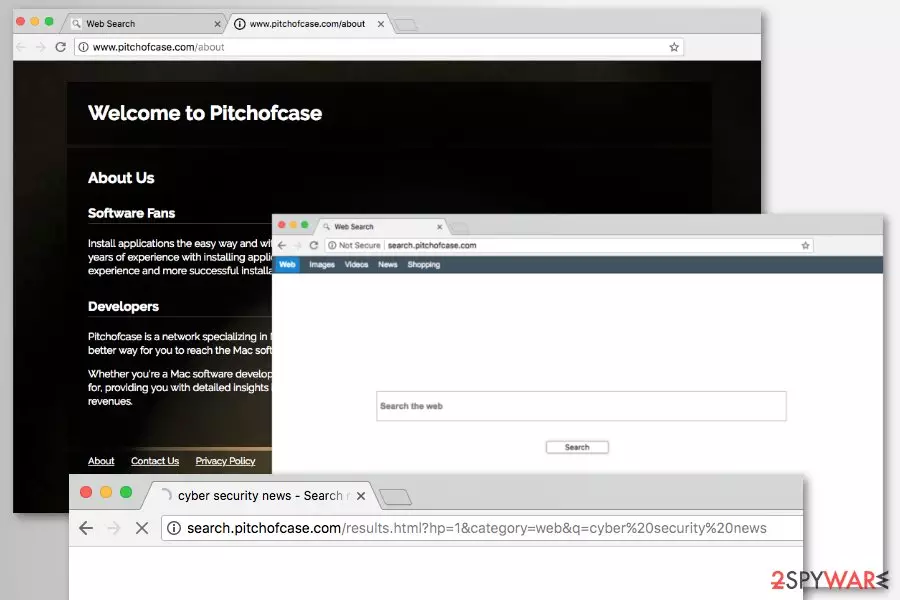
Search.pitchofcase.com is a bogus search tool that has features of the browser hijacker. This potentially unwanted program (PUP) spreads bundled with various free software that users can download from the Internet. Soon after infiltration, it hijacks affected browser’s startup page and built-in search box.
| Summary | |
| Name | Search.pitchofcase.com |
| Type | Browser hijacker |
| Danger level | Medium. Cannot cause direct damage, but increases chances to catch malware |
| Symptoms | Replaced homepage and default search engine; redirects to unknown websites, delivery of ads. |
| Targeted OS | Mac OS X |
| Distribution methods | Third-party download websites, software bundling |
| To remove Search.pitchofcase.com, install FortectIntego and run a full system scan | |
Search.pitchofcase.com virus does not seem to affect Windows machine. This unwanted application is designed to hack only Mac OS X.[1] Hence, it might hijack Safari, Mozilla Firefox, Google Chrome or any other browser with his compatible with macOS.
Once inside, Pitchofcase might make some changes to the system and install additional components to follow some of the following tasks:
- Set hxxp://search.pitchofcase.com/ as default search engine, homepage, and new tab URL address;
- Trigger search redirects to Yahoo;
- Prevent users from Search.pitchofcase.com removal;
- Initiate redirects to third-party websites;
- Display ads which promote suspicious software or services;
- Track information about users.
The real purpose of Pitchofcase is to promote various programs or increase traffic to commercial websites in order to generate advertising-based revenue. Therefore, it does not enhance browsing experience and gives no benefit to users.
Nevertheless, it redirects search queries to Yahoo; trusting them is not recommended. The PUP might trigger redirects to third-party sites as soon as you click on a result link. The problem with such search.pitchofcase.com redirect tendencies is not an inability to find needed information easily, but a promotion of the affiliate sites.
However, these redirects hide the biggest dangers of Pitchofcase virus. Some of these sites might be used for spreading malware or phishing attempts. Therefore, it’s not recommended to use this tool and get rid of as soon as it shows on the browser.
As we have mentioned, Search.pitchofcase.com removal is not that simple. The hijacker prevents from setting your preferred search tool as default one. In order to do so, you have to uninstall questionable browser extensions[2] and applications and reset the browser.
You can follow manual Pitchofcase removal guide at the end of the article, or you can speed up the process by scanning the system with FortectIntego or another reputable anti-malware.

A bogus search tool is promoted in software bundles
Search.pitchofcase.com hijack is most likely to occur when you download apps from third-party sources. These programs are usually bundles that might be spreading unwanted applications. For this reason, you have to always “unpack” freeware before clicking “Install” button.
To do so, opt for “Advanced” instead of “Recommended” installation settings. The latter settings do not let to see what optional apps are attached to the primary program. However, they are designed to install the whole bundle and surprising you with unwanted apps.
Meanwhile, when using “Advanced” installer, you have to unmark pre-selected third-party apps or agreements to change your default search engine.
Get rid of Search.pitchofcase.com
Search.pitchofcase.com removal can be performed either manually or automatically. The latter method is simpler and recommended for less skilled computer users. However, it’s perfect for those who want to get rid of hijacker within a few clicks.
However, if you prefer to remove Search.pitchofcase.com manually, you can find the detailed explanation below. Keep in mind that you need not only uninstall suspicious applications but delete associated files and reset web browser too.
Security experts from bedynet.ru[3] tell that users often miss some of the related components because they might be hidden in the system. As a result, Mac browsers get hijacked again. For this reason, automatic elimination is recommended.
Uninstall from Windows
Uninstall from Windows 10/8:
- Type Control Panel into the Windows search box and open the result.
- Under Programs, select Uninstall a program.


Uninstall from Windows 7/XP:
- Click on Windows Start > Control Panel (Windows XP users should click on Add/Remove Programs).
- In Control Panel, select Programs > Uninstall a program.


Remove the unwanted program:
- In the Programs and Features window, look for any recently installed suspicious entries, select them, and click Uninstall.
- If User Account Control appears, click Yes to confirm, then complete the removal.


Delete from macOS
Remove the unwanted application:
- From the menu bar, select Go > Applications.
- In the Applications folder, look for any suspicious entries, then drag them to Trash (or right-click and pick Move to Trash).


Delete leftover files and folders:
- Select Go > Go to Folder.
- Enter /Library/Application Support and remove any suspicious folders related to the unwanted program.
- Repeat the same check in the /Library/LaunchAgents and /Library/LaunchDaemons folders, deleting any suspicious entries.

- Finally, empty the Trash to permanently remove the leftovers.

Reset Internet Explorer
Remove dangerous add-ons:
- Open Internet Explorer, click on the Gear icon (IE menu) on the top-right corner of the browser
- Pick Manage Add-ons.
- You will see a Manage Add-ons window. Here, look for suspicious plugins. Click on these entries and select Disable.


Change your homepage if it was altered:
- Open IE and click on the Gear icon.
- Select Internet Options.
- In the General tab, delete the Home page address and replace it by your preferred one (for example, Google.com).
- Click Apply and then select OK.


Delete temporary files:
- Press on the Gear icon and select Internet Options.
- Under Browsing history, click Delete...
- Select relevant fields and press Delete.


Reset Internet Explorer:
- Click on Gear icon > Internet options and select Advanced tab.
- Select Reset.
- In the new window, check Delete personal settings and select Reset.


Remove from Microsoft Edge
Delete unwanted extensions from MS Edge:
- Select Menu (three horizontal dots at the top-right of the browser window) and pick Extensions.
- From the list, pick the extension and click on the Gear icon.
- Click Remove.


Clear cookies and other browser data:
- Click on the Menu (three horizontal dots at the top-right of the browser window) and select Settings > Privacy, search, and services..
- Under Clear browsing data, pick Choose what to clear.
- Select Cookies and other site data and Cached images and files. (apart from passwords, although you might want to include Media licenses as well, if applicable) and click on Clear.


Restore new tab and homepage settings:
- Click the menu icon and choose Settings.
- Then find On startup section.
- Click Remove next to any suspicious startup page.
Reset MS Edge if the above steps did not work:
- Press on Ctrl + Shift + Esc to open Task Manager.
- Click on More details arrow at the bottom of the window.
- Select Details tab.
- Now scroll down and locate every entry with Microsoft Edge name in it. Right-click on each of them and select End Task to stop MS Edge from running.


Instructions for Chromium-based Edge
Delete extensions from MS Edge (Chromium):
- Open Edge and click select Settings > Extensions.
- Delete unwanted extensions by clicking Remove.


Clear cache and site data:
- Click on Menu and go to Settings.
- Select Privacy, search and services.
- Under Clear browsing data, pick Choose what to clear.
- Under Time range, pick All time.
- Select Clear now.


Reset Chromium-based MS Edge:
- Click on Menu and select Settings.
- On the left side, pick Reset settings.
- Select Restore settings to their default values.
- Confirm with Reset.
- This will disable extensions and reset startup pages but will not delete bookmarks, saved passwords, or browsing history.


Remove from Mozilla Firefox (FF)
Remove dangerous extensions:
- Open Mozilla Firefox browser and click on the Menu (three horizontal lines at the top-right of the window).
- Select Add-ons.
- In here, select the unwanted extension and click Remove.


Reset the homepage:
- Click three horizontal lines at the top right corner to open the menu.
- Choose Settings.
- Under Home, set your preferred homepage and new tab settings.
Clear cookies and site data:
- Click Menu and pick Settings.
- Go to Privacy & Security section.
- Scroll down to locate Cookies and Site Data.
- Click on Clear Data...
- Select Cookies and Site Data and Temporary cached files and pages, then click Clear.


Reset Mozilla Firefox
If clearing the browser as explained above did not help, reset Mozilla Firefox:
- Open Mozilla Firefox browser and click the Menu.
- Go to Help and then choose Troubleshooting Information.

- Under Give Firefox a tune up section, click on Refresh Firefox...
- Once the pop-up shows up, confirm the action by pressing on Refresh Firefox.



Remove from Google Chrome
Delete malicious extensions from Google Chrome:
- Open Google Chrome, click on the Menu (three vertical dots at the top-right corner) and select More tools > Extensions.
- In the newly opened window, you will see all the installed extensions. Uninstall all suspicious extensions related to the unwanted program by clicking Remove.


Clear cache and web data from Chrome:
- Click on Menu and pick Settings.
- Under Privacy and security, select Clear browsing data.
- Select Browsing history, Cookies and other site data, as well as Cached images and files.
- Click Clear data.


Change your homepage:
- Click menu and choose Settings.
- Look for a suspicious site in the On startup section.
- Click on Open a specific or set of pages and click on three dots to find the Remove option.
Reset Google Chrome:
If the previous methods did not help you, reset Google Chrome to eliminate all the unwanted components:
- Click on Menu and select Settings.
- In the Settings, scroll down and click Advanced.
- Scroll down and locate Reset and clean up section.
- Now click Restore settings to their original defaults.
- Confirm with Reset settings.


Delete from Safari
Remove dangerous extensions:
- Open Safari, click Safari in the menu at the top-left of the screen, and select Preferences.
- Go to the Extensions tab, look for any suspicious entries, and click Uninstall to remove them.


Clear history and website data:
- Click Safari in the menu and pick Clear History.
- Set Clear to all history and confirm with Clear History.


Reset Safari:
- Click Safari in the menu and select Preferences > Advanced.
- Enable Show Develop menu in menu bar.
- From the menu bar, click Develop and select Empty Caches.


Did this guide help?
Be the first to comment