

Linkonclick.com is a browser hijacker that can expose a potentially dangerous content to its user
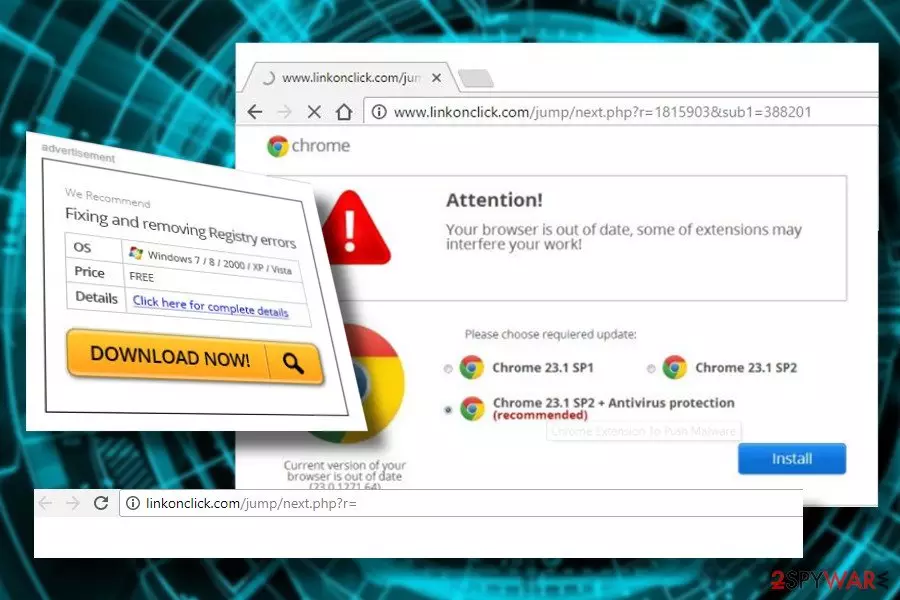
Linkonclick.com is a deceptive search site that keeps spreading on the Internet since 2015. Since the detection, it is referred to as a browser hijacker and a potentially unwanted program (PUP) due to the ability to infiltrate PCs without permission[1] and appear as a default start page, search provider, and a new tab URL on Chrome and other web browsers. Such web browsers modifications are followed by misleading redirects and a significant increment of intrusive online ads.
| Name | Linkonclick.com |
| Type | Browser hijacker |
| Active since | 2015 |
| Distribution | Bundling (spreads as an extension of free applications) |
| Web browsers compatible | Google Chrome, Mozilla Firefox, Internet Explorer, Microsoft Edge, Safari |
| Symptoms | Linkonclick.com set as a default start page, search provider, new tab URL. Common redirects to related domains. Many online ads |
| Elimination | Users of the Linkonclick.com hijacked web browsers can download FortectIntego and run a scan with it or follow manual removal instructions at the end of this post. |
According to the stats, Linkonclick.com virus attacks prevails in US, Indonesia, India, Venezuela, and Brazil. However, people across the whole world can easily download this misleading search site accidentally. That's because it is distributed as a freeware attachment.
Although you can find an appealing Linkonclick.com description of the freeware's setup, do not fall for accepting the offer. Instead of promised shopping assistance or similar services, the extension might initiate activities that are necessary for generating income for its developers and partners.
Despite the fact that it's not malicious, experts from Lesvirus.fr[2] warn about the risk that it poses and induce people to initiate a full Linkonclick.com removal. These are the facts about the search that the experts stress:
- It infiltrates PCs without asking permission directly. Right after that, web browser's settings (extensions, search engine, start page, new tab URL, etc.) are modified without authorization;
- The extension uses helper objects to evade Linkonclick.com removal;
- Kept on the system for a long time can multiply the number of malware installed;
- Linkonclick.com virus collaborates with third parties. It is highly involve in affiliate marketing and might seek to promote doubtful websites;
- Some of the sites might be filled with adult content or misleading offers to download software updates or scan the system for the virus;
- Linkonclick.com installer carries tracking cookies that are later injected into the web browser. Consequently, Search
- Data and some pieces of sensitive data (IP address, email address, approximate geographical location, name or sometimes even telephone number) start leaking to third-party servers.
It's a must to remove Linkonclick.com to keep the system malware free. The smallest piece of malware on the system gradually diminishes its performance and decrease its vulnerability,[3] so it's important to keep anti-virus program updated and activated.

We recommend to scan the system with FortectIntego, SpyHunterCombo Cleaner or MalwarebytesMalwarebytes to get rid of the hijacker from the system. A full system scan with a reputable anti-malware will make the process easier and ensure its successfulness.
Nevertheless, those who prefer deletion of unwanted programs in a regular way can find a guide on how to get rid of Linkonclick.com virus manually at the end of this article.
Install freeware carefully not to get infected with the browser hijacker
If you are familiar with the terms , such as “By clicking Next I agree to install XXX” or “I agree to use XXX as my start page” during the installation of free apps, then you must have heard about bundling. The term refers to a misleading distribution strategy of legitimate apps and potentially unwanted programs (PUPs).
The scheme of bundling is simple: freeware is filled with PUPs, which are represented as “recommended” free downloads that could improve web browser's experience. Of course, freeware developers receive a fee for distributing PUPs that's why they keep doing that despite various accusation from cybersecurity experts.
However, bundling remains legitimate since it discloses all the extras and allows rejecting their installation, but there's a catch. If people opt for Quick or Recommended setup, all the extras are installed by default. The only way to opt out of them is to pick Advanced or Custom installation option and remove check marks next to statements regarding your agreement to install add-ons, toolbars or plug-ins.
Eliminate Linkonclick.com virus in a quick way
Manual and automatic removal methods are both applicable in case if Linkonclick.com hijack. However, the usage of a reputable anti-malware would save your time and ensure the removal of all PUPs.
Manual Linkonclick.com removal might be a difficult task because it might be difficult to identify a related application. Besides, it might have been installed along with a bunch of other PUPs that need to be removed either. Otherwise, Linkonclick.com URL and reappear on your web browser after each system's reboot.
Uninstall from Windows
Uninstall from Windows 10/8:
- Type Control Panel into the Windows search box and open the result.
- Under Programs, select Uninstall a program.


Uninstall from Windows 7/XP:
- Click on Windows Start > Control Panel (Windows XP users should click on Add/Remove Programs).
- In Control Panel, select Programs > Uninstall a program.


Remove the unwanted program:
- In the Programs and Features window, look for any recently installed suspicious entries, select them, and click Uninstall.
- If User Account Control appears, click Yes to confirm, then complete the removal.


Delete from macOS
Remove the unwanted application:
- From the menu bar, select Go > Applications.
- In the Applications folder, look for any suspicious entries, then drag them to Trash (or right-click and pick Move to Trash).


Delete leftover files and folders:
- Select Go > Go to Folder.
- Enter /Library/Application Support and remove any suspicious folders related to the unwanted program.
- Repeat the same check in the /Library/LaunchAgents and /Library/LaunchDaemons folders, deleting any suspicious entries.

- Finally, empty the Trash to permanently remove the leftovers.

Reset Internet Explorer
Remove dangerous add-ons:
- Open Internet Explorer, click on the Gear icon (IE menu) on the top-right corner of the browser
- Pick Manage Add-ons.
- You will see a Manage Add-ons window. Here, look for suspicious plugins. Click on these entries and select Disable.


Change your homepage if it was altered:
- Open IE and click on the Gear icon.
- Select Internet Options.
- In the General tab, delete the Home page address and replace it by your preferred one (for example, Google.com).
- Click Apply and then select OK.


Delete temporary files:
- Press on the Gear icon and select Internet Options.
- Under Browsing history, click Delete...
- Select relevant fields and press Delete.


Reset Internet Explorer:
- Click on Gear icon > Internet options and select Advanced tab.
- Select Reset.
- In the new window, check Delete personal settings and select Reset.


Remove from Microsoft Edge
Delete unwanted extensions from MS Edge:
- Select Menu (three horizontal dots at the top-right of the browser window) and pick Extensions.
- From the list, pick the extension and click on the Gear icon.
- Click Remove.


Clear cookies and other browser data:
- Click on the Menu (three horizontal dots at the top-right of the browser window) and select Settings > Privacy, search, and services..
- Under Clear browsing data, pick Choose what to clear.
- Select Cookies and other site data and Cached images and files. (apart from passwords, although you might want to include Media licenses as well, if applicable) and click on Clear.


Restore new tab and homepage settings:
- Click the menu icon and choose Settings.
- Then find On startup section.
- Click Remove next to any suspicious startup page.
Reset MS Edge if the above steps did not work:
- Press on Ctrl + Shift + Esc to open Task Manager.
- Click on More details arrow at the bottom of the window.
- Select Details tab.
- Now scroll down and locate every entry with Microsoft Edge name in it. Right-click on each of them and select End Task to stop MS Edge from running.


Instructions for Chromium-based Edge
Delete extensions from MS Edge (Chromium):
- Open Edge and click select Settings > Extensions.
- Delete unwanted extensions by clicking Remove.


Clear cache and site data:
- Click on Menu and go to Settings.
- Select Privacy, search and services.
- Under Clear browsing data, pick Choose what to clear.
- Under Time range, pick All time.
- Select Clear now.


Reset Chromium-based MS Edge:
- Click on Menu and select Settings.
- On the left side, pick Reset settings.
- Select Restore settings to their default values.
- Confirm with Reset.
- This will disable extensions and reset startup pages but will not delete bookmarks, saved passwords, or browsing history.


Remove from Mozilla Firefox (FF)
Remove dangerous extensions:
- Open Mozilla Firefox browser and click on the Menu (three horizontal lines at the top-right of the window).
- Select Add-ons.
- In here, select the unwanted extension and click Remove.


Reset the homepage:
- Click three horizontal lines at the top right corner to open the menu.
- Choose Settings.
- Under Home, set your preferred homepage and new tab settings.
Clear cookies and site data:
- Click Menu and pick Settings.
- Go to Privacy & Security section.
- Scroll down to locate Cookies and Site Data.
- Click on Clear Data...
- Select Cookies and Site Data and Temporary cached files and pages, then click Clear.


Reset Mozilla Firefox
If clearing the browser as explained above did not help, reset Mozilla Firefox:
- Open Mozilla Firefox browser and click the Menu.
- Go to Help and then choose Troubleshooting Information.

- Under Give Firefox a tune up section, click on Refresh Firefox...
- Once the pop-up shows up, confirm the action by pressing on Refresh Firefox.



Remove from Google Chrome
Delete malicious extensions from Google Chrome:
- Open Google Chrome, click on the Menu (three vertical dots at the top-right corner) and select More tools > Extensions.
- In the newly opened window, you will see all the installed extensions. Uninstall all suspicious extensions related to the unwanted program by clicking Remove.


Clear cache and web data from Chrome:
- Click on Menu and pick Settings.
- Under Privacy and security, select Clear browsing data.
- Select Browsing history, Cookies and other site data, as well as Cached images and files.
- Click Clear data.


Change your homepage:
- Click menu and choose Settings.
- Look for a suspicious site in the On startup section.
- Click on Open a specific or set of pages and click on three dots to find the Remove option.
Reset Google Chrome:
If the previous methods did not help you, reset Google Chrome to eliminate all the unwanted components:
- Click on Menu and select Settings.
- In the Settings, scroll down and click Advanced.
- Scroll down and locate Reset and clean up section.
- Now click Restore settings to their original defaults.
- Confirm with Reset settings.


Delete from Safari
Remove dangerous extensions:
- Open Safari, click Safari in the menu at the top-left of the screen, and select Preferences.
- Go to the Extensions tab, look for any suspicious entries, and click Uninstall to remove them.


Clear history and website data:
- Click Safari in the menu and pick Clear History.
- Set Clear to all history and confirm with Clear History.


Reset Safari:
- Click Safari in the menu and select Preferences > Advanced.
- Enable Show Develop menu in menu bar.
- From the menu bar, click Develop and select Empty Caches.


Did this guide help?
Be the first to comment