A step-by-step removal guide for affected devices. Follow the verified procedure below — most readers complete it in under 10 minutes.
Alice Woods· Likes to teach users about virus prevention
TaxInfoHelp – a PUP which provides fast access to tax-related websites to collect revenue
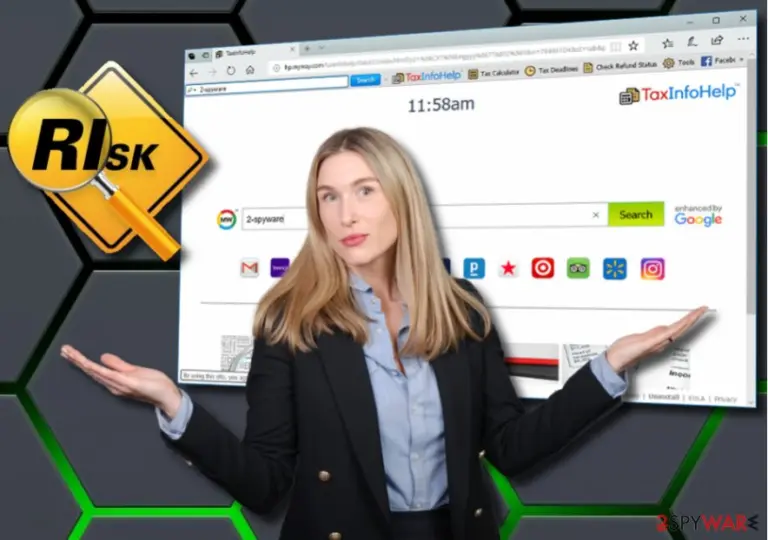
TaxInfoHelp is a browser hijacker developed by Mindspark Interactive Network[1] which has been actively promoting hp.myway.com website by setting this site instead of the start page or a default search engine right after infiltrating the system. Typically, it affects these browsers:
Google Chrome;
Mozilla Firefox;
Internet Explorer;
Other commonly used ones.
From the first view, this PUP[2]may seem very useful and legitimate as it provides fast access to links which contain various tax-related details. Despite the fact that it might look very comfortable to use, TaxInfoHelp Toolbar invades the system without any user's permission and starts causing activities which have nothing in common with the promised ones.
Name
TaxInfoHelp
Type
Browser hijacker/PUP
Danger level
Medium. Harms only browsers by modifying their settings. Does not touch any other computer files, and does not infect other systems
Affected browsers
All commonly known ones: Google Chrome, Mozilla Firefox, IE, Safari, etc
Similarities
It is familiar with other browser hijackers such as BitcoinPriceSearch, GamesZoneSearch, BabyNameReady, and many others
According to experts[3], the main thing this browser hijacker does is modifying browsers' settings. It sets the homepage, new tab URL and search provider to its promoted site which has already been mentioned in the first paragraph. Once you click on the browser icon, hp.myway.com pops-out and you are forced to enter this search provider each time you try getting online. These kinds of changes are irreversible unless you eliminate the PUP from the system.
Many questionable extensions are known to rely on the same operating principle similar to TaxInfoHelp:
BitcointPriceSearch;
GamesZone Search;
BabyNameReady;
etc.
All of these browser hijackers appear to have “useful features” and use them to trick their victims into letting them in. What hides behind them is the one same aim – trying to generate the profit from naive victims.
Furthermore, surfing the Internet can become harder as numerous pop-ups may show up while browsing. These kinds of intrusive advertisements come together with the browser hijacker as a way to gain revenue. To stop such annoying activity, you need to remove TaxInfoHelp toolbar and hp.myway.com fake search engine from your browser. Additionally, delete all related cookies and similar components of hijacker to make sure that you are prepared to search the web again.
We should add the last fact explaining our position regarding this toolbar. We recommend TaxInfoHelp removal to stop this program from tracking you. Typically, it collects personally non-identifiable data, but some types of data can also be considered as personal. For example, the toolbar is capable of collecting your email address, and similar data entered when visiting sites online. Additionally, your PC's IP address, its location, and similar details can also be recorded. The elimination of this extension is the only way to prevent the loss of such data, so make sure you take care of it without wasting too much time.
All browser hijackers get into system stealthily
To start with, such PUPs as browser hijackers and adware are not considered extremely dangerous, so you can be tricked into downloading them from their official download sites. Once visited, these sites come up to tricking many people into downloading the program while advertising “useful functions.”
Furthermore, a lot of infections come from regular software as optional components. Harmful programs can be situated inside them and downloaded/installed together.
Visiting various unknown sites and pressing on dubious hyperlinks (especially indirect ones) can also cause a browser hijacker infection. Inaccuracy usually is the main reason for these kinds of consequences.
We believe that you are concerned about how to avoid such harmful actions. Well, here are some guiding steps, which should help you, if you follow them correctly:
If you have entered a dubious looking site, do not press any links. Eliminate it immediately and never type in its URL again;
If you want to download a certain program from less known sites, look through all incoming downloads which are displayed in the Custom or Advanced section;
Install an antivirus. It will inform you if some kind of cyber threat is trying to break in your computer system, and will let you take actions against it.
Trustworthy help is here to guide you through the TaxInfoHelp elimination
To remove TaxInfoHelp virus, get rid of all dubious components which might contain various browser extensions, applications, and other browser plug-ins. You can eliminate the cyber threat from web browsers such as Chrome, Firefox, and others by using the guidance shown below this article.
If you are looking for a faster way to remove the virus, install programs that we recommend down below. These anti-malware tools will help you succeed in the TaxInfoHelp removal. Refresh your browsers after the procedure is done – this should be due to ensure that no harmful components are left.
Uninstall from Windows
Uninstall from Windows 10/8:
Type Control Panel into the Windows search box and open the result.
Under Programs, select Uninstall a program.
Uninstall from Windows 7/XP:
Click on Windows Start > Control Panel (Windows XP users should click on Add/Remove Programs).
In Control Panel, select Programs > Uninstall a program.
Remove the unwanted program:
In the Programs and Features window, look for any recently installed suspicious entries, select them, and click Uninstall.
If User Account Control appears, click Yes to confirm, then complete the removal.
Delete from macOS
Remove the unwanted application:
From the menu bar, select Go > Applications.
In the Applications folder, look for any suspicious entries, then drag them to Trash (or right-click and pick Move to Trash).
Delete leftover files and folders:
Select Go > Go to Folder.
Enter /Library/Application Support and remove any suspicious folders related to the unwanted program.
Repeat the same check in the /Library/LaunchAgents and /Library/LaunchDaemons folders, deleting any suspicious entries.
Finally, empty the Trash to permanently remove the leftovers.
Reset Internet Explorer
Remove dangerous add-ons:
Open Internet Explorer, click on the Gear icon (IE menu) on the top-right corner of the browser
Pick Manage Add-ons.
You will see a Manage Add-ons window. Here, look for suspicious plugins. Click on these entries and select Disable.
Change your homepage if it was altered:
Open IE and click on the Gear icon.
Select Internet Options.
In the General tab, delete the Home page address and replace it by your preferred one (for example, Google.com).
Click Apply and then select OK.
Delete temporary files:
Press on the Gear icon and select Internet Options.
Under Browsing history, click Delete...
Select relevant fields and press Delete.
Reset Internet Explorer:
Click on Gear icon > Internet options and select Advanced tab.
Select Reset.
In the new window, check Delete personal settings and select Reset.
Remove from Microsoft Edge
Delete unwanted extensions from MS Edge:
Select Menu (three horizontal dots at the top-right of the browser window) and pick Extensions.
From the list, pick the extension and click on the Gear icon.
Click Remove.
Clear cookies and other browser data:
Click on the Menu (three horizontal dots at the top-right of the browser window) and select Settings > Privacy, search, and services..
Under Clear browsing data, pick Choose what to clear.
Select Cookies and other site data and Cached images and files. (apart from passwords, although you might want to include Media licenses as well, if applicable) and click on Clear.
Restore new tab and homepage settings:
Click the menu icon and choose Settings.
Then find On startup section.
Click Remove next to any suspicious startup page.
Reset MS Edge if the above steps did not work:
Press on Ctrl + Shift + Esc to open Task Manager.
Click on More details arrow at the bottom of the window.
Select Details tab.
Now scroll down and locate every entry with Microsoft Edge name in it. Right-click on each of them and select End Task to stop MS Edge from running.
Instructions for Chromium-based Edge
Delete extensions from MS Edge (Chromium):
Open Edge and click select Settings > Extensions.
Delete unwanted extensions by clicking Remove.
Clear cache and site data:
Click on Menu and go to Settings.
Select Privacy, search and services.
Under Clear browsing data, pick Choose what to clear.
Under Time range, pick All time.
Select Clear now.
Reset Chromium-based MS Edge:
Click on Menu and select Settings.
On the left side, pick Reset settings.
Select Restore settings to their default values.
Confirm with Reset.
This will disable extensions and reset startup pages but will not delete bookmarks, saved passwords, or browsing history.
Remove from Mozilla Firefox (FF)
Remove dangerous extensions:
Open Mozilla Firefox browser and click on the Menu (three horizontal lines at the top-right of the window).
Select Add-ons.
In here, select the unwanted extension and click Remove.
Reset the homepage:
Click three horizontal lines at the top right corner to open the menu.
Choose Settings.
Under Home, set your preferred homepage and new tab settings.
Clear cookies and site data:
Click Menu and pick Settings.
Go to Privacy & Security section.
Scroll down to locate Cookies and Site Data.
Click on Clear Data...
Select Cookies and Site Data and Temporary cached files and pages, then click Clear.
Reset Mozilla Firefox
If clearing the browser as explained above did not help, reset Mozilla Firefox:
Open Mozilla Firefox browser and click the Menu.
Go to Help and then choose Troubleshooting Information.
Under Give Firefox a tune up section, click on Refresh Firefox...
Once the pop-up shows up, confirm the action by pressing on Refresh Firefox.
Remove from Google Chrome
Delete malicious extensions from Google Chrome:
Open Google Chrome, click on the Menu (three vertical dots at the top-right corner) and select More tools > Extensions.
In the newly opened window, you will see all the installed extensions. Uninstall all suspicious extensions related to the unwanted program by clicking Remove.
Clear cache and web data from Chrome:
Click on Menu and pick Settings.
Under Privacy and security, select Clear browsing data.
Select Browsing history, Cookies and other site data, as well as Cached images and files.
Click Clear data.
Change your homepage:
Click menu and choose Settings.
Look for a suspicious site in the On startup section.
Click on Open a specific or set of pages and click on three dots to find the Remove option.
Reset Google Chrome:
If the previous methods did not help you, reset Google Chrome to eliminate all the unwanted components:
Click on Menu and select Settings.
In the Settings, scroll down and click Advanced.
Scroll down and locate Reset and clean up section.
Now click Restore settings to their original defaults.
Confirm with Reset settings.
Delete from Safari
Remove dangerous extensions:
Open Safari, click Safari in the menu at the top-left of the screen, and select Preferences.
Go to the Extensions tab, look for any suspicious entries, and click Uninstall to remove them.
Clear history and website data:
Click Safari in the menu and pick Clear History.
Set Clear to all history and confirm with Clear History.
Reset Safari:
Click Safari in the menu and select Preferences > Advanced.
Enable Show Develop menu in menu bar.
From the menu bar, click Develop and select Empty Caches.






















































Be the first to comment