

Tyd1.xyz is a potentially unwanted program that modifies settings of web browsers without users' consent
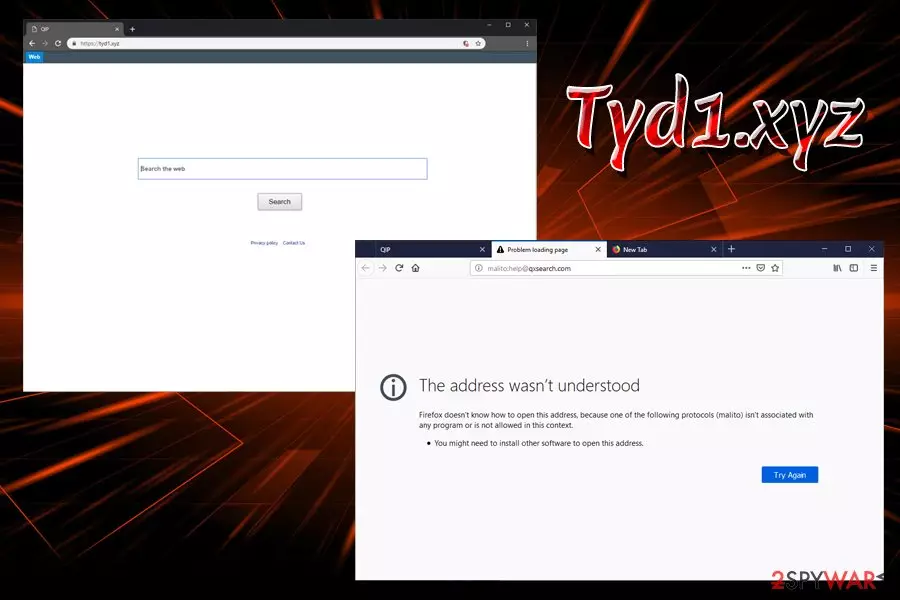
Tyd1.xyz is a browser hijacker created by QxSearch Inc. – a developer from the US. Potentially unwanted programs[1] are designed to infiltrate computers unnoticed and configure browser or system settings in order to expose users to commercial content. This is usually achieved with the help of pop-up ads, redirects, and other unwanted activities. Once installed Tyd1.xyz virus modifies settings of Google Chrome, Internet Explorer, Mozilla Firefox, Safari or other browser and sets https://tyd1.xyz as a homepage and a new tab address. Additionally, this PUP is known to track and collect personal and anonymous information, and may also share it with affiliates. Therefore, personal details that are being shared among many partners are at risk of being leaked.
| Name | Tyd1.xyz |
| Type | Browser hijacker/PUP |
| Symptoms | Altered browser settings, intrusive ads and redirects, etc. |
| Main dangers | Malware infection, data leak |
| Distribution | Software bundling, insecure websites |
| Elimination | Follow our instructions below or use professional software |
| Optimization | To ensure complete removal, use FortectIntego |
Altered settings or other installed components might sometimes create difficulties when trying to remove Tyd1.xyz from the system. In such a case, experts[2] advise users to make use of anti-virus software that would be able to get rid of the hijacker automatically. Otherwise, manual elimination of Tyd1.xyz can be performed by following our guide below.
Tyd1.xyz hijack can result in the following changes:
- Altered homepage, new tab address and a search engine;
- Sponsored links presented at the top of search results;
- Redirects lead to dubious websites;
- Suspicious bookmarks added without permission;
- Additional add-ons installed;
- Slow operation of the browser, etc.
As evident, these traits of Tyd1.xyz do not bring anything useful to the end user and disturb the normal operation of the web browser. Additionally, due to these activities, users might end up on malicious websites and install malware without knowing. Therefore, it is vital not to click on anything after a redirect or a pop-up, as it might result in system compromise.
Another dangerous behavior of Tyd1.xyz virus is the information gathering. Here's what the official Privacy Policy states:[3]
QxSearch may collect two types of information: 1) Personal Information, and 2(Anonymous Information. <…>
Through you use of the Site we may collect the following Personal Information: you name; email address; information you provided in public forums and/or social networks; information you provided us including your device identifier or IP address when you use the Site.
Therefore, if you decide to postpone Tyd1.xyz removal, your personal information might end up in unsafe hands. Instead, choose a reputable search engine like Google.com, Bing.com or Yahoo.com and browse without risk. Once you complete the elimination of the unwanted program, scan your device with FortectIntego – it will restore the normal operation within just a few minutes.

Bundled software hides unwanted applications inside
It does not matter how many warnings security experts give users, they will still rush through the installation of the new programs. Unfortunately, that is the first step how unwanted applications enter computers.
Software bundling is an old marketing trick that is extremely efficient because there will always be users who will click Next, Next, Agree – to be finished with the installation process as soon as possible. However, that is a reckless behavior when it comes to cybersecurity.
When installing freeware or shareware, be attentive. Read through the installation instructions carefully, and also check ToS and Privacy Policy. If the installation wizard does not provide such documents, abort the installation immediately. Finally, always opt for Advanced or Custom installation settings to get rid of potentially unwanted programs such as media players, uninstallers, driver updaters, and similar useless software.
Get rid of Tyd1.xyz and use legitimate web search providers
If you are somewhat computer savvy, you can try to remove Tyd1.xyz manually. You can find all the detailed instructions below. After you are done, it is as equally important to reset each of the installed browsers to make sure no settings of the hijacker are retained.
However, if you want to perform Tyd1.xyz removal as soon as possible or you are not that familiar with computers, we suggest you pick anti-malware software that specializes in potentially unwanted programs instead. All you have to do is perform a full system scan, and the security application will take care of everything automatically.
Uninstall from Windows
Uninstall from Windows 10/8:
- Type Control Panel into the Windows search box and open the result.
- Under Programs, select Uninstall a program.


Uninstall from Windows 7/XP:
- Click on Windows Start > Control Panel (Windows XP users should click on Add/Remove Programs).
- In Control Panel, select Programs > Uninstall a program.


Remove the unwanted program:
- In the Programs and Features window, look for any recently installed suspicious entries, select them, and click Uninstall.
- If User Account Control appears, click Yes to confirm, then complete the removal.


Delete from macOS
Remove the unwanted application:
- From the menu bar, select Go > Applications.
- In the Applications folder, look for any suspicious entries, then drag them to Trash (or right-click and pick Move to Trash).


Delete leftover files and folders:
- Select Go > Go to Folder.
- Enter /Library/Application Support and remove any suspicious folders related to the unwanted program.
- Repeat the same check in the /Library/LaunchAgents and /Library/LaunchDaemons folders, deleting any suspicious entries.

- Finally, empty the Trash to permanently remove the leftovers.

Reset Internet Explorer
Remove dangerous add-ons:
- Open Internet Explorer, click on the Gear icon (IE menu) on the top-right corner of the browser
- Pick Manage Add-ons.
- You will see a Manage Add-ons window. Here, look for suspicious plugins. Click on these entries and select Disable.


Change your homepage if it was altered:
- Open IE and click on the Gear icon.
- Select Internet Options.
- In the General tab, delete the Home page address and replace it by your preferred one (for example, Google.com).
- Click Apply and then select OK.


Delete temporary files:
- Press on the Gear icon and select Internet Options.
- Under Browsing history, click Delete...
- Select relevant fields and press Delete.


Reset Internet Explorer:
- Click on Gear icon > Internet options and select Advanced tab.
- Select Reset.
- In the new window, check Delete personal settings and select Reset.


Remove from Microsoft Edge
Delete unwanted extensions from MS Edge:
- Select Menu (three horizontal dots at the top-right of the browser window) and pick Extensions.
- From the list, pick the extension and click on the Gear icon.
- Click Remove.


Clear cookies and other browser data:
- Click on the Menu (three horizontal dots at the top-right of the browser window) and select Settings > Privacy, search, and services..
- Under Clear browsing data, pick Choose what to clear.
- Select Cookies and other site data and Cached images and files. (apart from passwords, although you might want to include Media licenses as well, if applicable) and click on Clear.


Restore new tab and homepage settings:
- Click the menu icon and choose Settings.
- Then find On startup section.
- Click Remove next to any suspicious startup page.
Reset MS Edge if the above steps did not work:
- Press on Ctrl + Shift + Esc to open Task Manager.
- Click on More details arrow at the bottom of the window.
- Select Details tab.
- Now scroll down and locate every entry with Microsoft Edge name in it. Right-click on each of them and select End Task to stop MS Edge from running.


Instructions for Chromium-based Edge
Delete extensions from MS Edge (Chromium):
- Open Edge and click select Settings > Extensions.
- Delete unwanted extensions by clicking Remove.


Clear cache and site data:
- Click on Menu and go to Settings.
- Select Privacy, search and services.
- Under Clear browsing data, pick Choose what to clear.
- Under Time range, pick All time.
- Select Clear now.


Reset Chromium-based MS Edge:
- Click on Menu and select Settings.
- On the left side, pick Reset settings.
- Select Restore settings to their default values.
- Confirm with Reset.
- This will disable extensions and reset startup pages but will not delete bookmarks, saved passwords, or browsing history.


Remove from Mozilla Firefox (FF)
Remove dangerous extensions:
- Open Mozilla Firefox browser and click on the Menu (three horizontal lines at the top-right of the window).
- Select Add-ons.
- In here, select the unwanted extension and click Remove.


Reset the homepage:
- Click three horizontal lines at the top right corner to open the menu.
- Choose Settings.
- Under Home, set your preferred homepage and new tab settings.
Clear cookies and site data:
- Click Menu and pick Settings.
- Go to Privacy & Security section.
- Scroll down to locate Cookies and Site Data.
- Click on Clear Data...
- Select Cookies and Site Data and Temporary cached files and pages, then click Clear.


Reset Mozilla Firefox
If clearing the browser as explained above did not help, reset Mozilla Firefox:
- Open Mozilla Firefox browser and click the Menu.
- Go to Help and then choose Troubleshooting Information.

- Under Give Firefox a tune up section, click on Refresh Firefox...
- Once the pop-up shows up, confirm the action by pressing on Refresh Firefox.



Remove from Google Chrome
Delete malicious extensions from Google Chrome:
- Open Google Chrome, click on the Menu (three vertical dots at the top-right corner) and select More tools > Extensions.
- In the newly opened window, you will see all the installed extensions. Uninstall all suspicious extensions related to the unwanted program by clicking Remove.


Clear cache and web data from Chrome:
- Click on Menu and pick Settings.
- Under Privacy and security, select Clear browsing data.
- Select Browsing history, Cookies and other site data, as well as Cached images and files.
- Click Clear data.


Change your homepage:
- Click menu and choose Settings.
- Look for a suspicious site in the On startup section.
- Click on Open a specific or set of pages and click on three dots to find the Remove option.
Reset Google Chrome:
If the previous methods did not help you, reset Google Chrome to eliminate all the unwanted components:
- Click on Menu and select Settings.
- In the Settings, scroll down and click Advanced.
- Scroll down and locate Reset and clean up section.
- Now click Restore settings to their original defaults.
- Confirm with Reset settings.


Delete from Safari
Remove dangerous extensions:
- Open Safari, click Safari in the menu at the top-left of the screen, and select Preferences.
- Go to the Extensions tab, look for any suspicious entries, and click Uninstall to remove them.


Clear history and website data:
- Click Safari in the menu and pick Clear History.
- Set Clear to all history and confirm with Clear History.


Reset Safari:
- Click Safari in the menu and select Preferences > Advanced.
- Enable Show Develop menu in menu bar.
- From the menu bar, click Develop and select Empty Caches.


Did this guide help?
Be the first to comment