

Regevpop is an annoying browser hijacker that attaches itself to Safari or another browser and displays intrusive ads
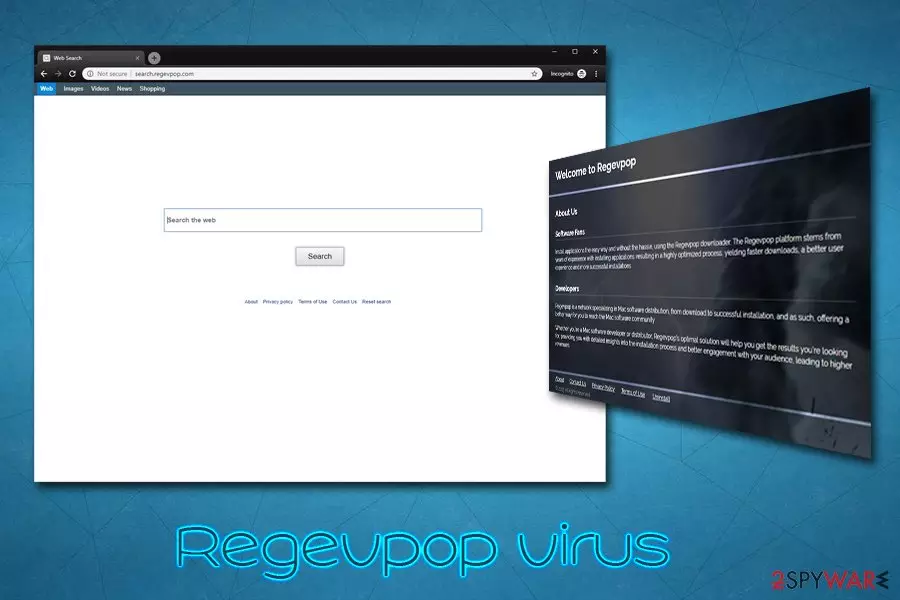
Regevpop is a browser extension designed for Google Chrome, Mozilla Firefox, and Safari browsers for Macs. It is advertised as a download manager that allegedly can make downloads faster and guarantees a “better user experience and more successful installations.”
However, Regevpop is also a potentially unwanted program, also known as OSX.Genieo – a browser hijacker which travels within software bundles, meaning that it gets installed without users' permission. Once inside the system, it changes web browser settings and assigns search.regevpop.com as a homepage and the new tab address, as well as introduces a custom search engine that redirects all results to Yahoo.
The intrusive activity does not stop there, however, as the infected users will quickly notice a bunch of sponsored links when searching up something online. Additionally, users will also see an increased amount of ads on most sites that they visit. Unfortunately, Regevpop removal might be slightly complicated unless a reputable security application is used.
| Name | Regevpop |
| Also known as | OSX.Genieo |
| Type | Browser hijacker |
| Category | Potentially unwanted program |
| Developer | Genieo Innovation |
| Advertised as | Download manager |
| Homepage set to | search.regevpop.com |
| Symptoms | Changed web browser settings, slow operation of the computer, sponsored search results, intrusive ads on all sites, etc. |
| Distribution | Software bundles, third-party sites, fake Adobe Flash updates |
| Termination | To remove Regevpop virus automatically, use FortectIntego |
Despite the fact that Regevpop virus uses the legitimate party to display the search results (Yahoo), they are not genuine, as the sponsored links at the top are presented in order for users to visit predetermined websites. In such a way, developers inflate the rank of promoted sites and generate revenue for each click made by users. Therefore, it is in their best interest to have as many users infected with Regevpop browser hijacker.
The developer of the Regevpop is Genieo Innovation – an Israeli company that was established back in 2008 and later acquired by Somoto – another suspicious PUP developer. Over the years, it engaged in a variety of dodgy practices, including using the infamous “Your Flash Player is out of date” technique,[1] which prompts users to update Flash but instead installs a potentially unwanted app. By far the worst case was noted by security researches in 2015 when a malicious installer would access sensitive information inside the keychain.[2]
While most of Regevpop hijack symptoms are quite apparent (changed homepage and new tab URL), other modifications to the system might be hidden from the users' eyes and can have much more serious ramifications. One of such hidden traits is data tracking, and the developers collect and share the following information:
- Search data
- Search queries
- Technical details
- Cookies[3]
- Installation information, etc.
Thus, users should be concerned if they see their web browser showing search.regevpop.com as the homepage.

To remove Regevpop virus safely, we suggest downloading and installing FortectIntego security software, although other reputable applications can be used. Simply download, install, and a run a full system scan – it should terminate all the potentially unwanted programs along with the found malware.
After that, we suggest you reset all the installed browsers, as Regevpop's changed settings might not go away even after its terminations. For full instructions, please check the bottom section of the article.
Do not get deceived by rogue installers and install free applications with care
Third-party installers often include bundled software. Unfortunately, users are not that well aware of the distribution technique and often end up installing software that they normally would not. While software bundling seems to be like a great option to try programs for free, it is often abused, and users end up with applications that change their browser settings without permission or even expose them to online risks.
Therefore, when downloading new applications, make sure the source is legitimate in the first place. Once the process starts, never skip through steps, decline all offers or deals, and always opt for the Advanced/Custom installation method rather than Recommended/Quick one. Unmark all the pre-ticked boxes that emerge and you will end up with the app that you intended to install instead of a bunch of PUPs.

Regevpop removal instructions
You can try to remove Regevpop virus manually by following our guide below. However, please do not forget to check for the traces of the potentially unwanted application in the following folders:
- /Library/LaunchAgents
- /Library/Application Support
- /Library/LaunchDaemons
If you are too confused about this, you should instead use anti-virus software for full Regevpop removal. Security software can find all the entries that are left after the PUP infection and restore your Mac to normal automatically.
Regardless of which option you choose to get rid of Regevpop, you should still make sure you reset all the installed browsers, as tracking technologies like cookies might still be present.
Delete from macOS
Remove the unwanted application:
- From the menu bar, select Go > Applications.
- In the Applications folder, look for any suspicious entries, then drag them to Trash (or right-click and pick Move to Trash).


Delete leftover files and folders:
- Select Go > Go to Folder.
- Enter /Library/Application Support and remove any suspicious folders related to the unwanted program.
- Repeat the same check in the /Library/LaunchAgents and /Library/LaunchDaemons folders, deleting any suspicious entries.

- Finally, empty the Trash to permanently remove the leftovers.

Reset Internet Explorer
Remove dangerous add-ons:
- Open Internet Explorer, click on the Gear icon (IE menu) on the top-right corner of the browser
- Pick Manage Add-ons.
- You will see a Manage Add-ons window. Here, look for suspicious plugins. Click on these entries and select Disable.


Change your homepage if it was altered:
- Open IE and click on the Gear icon.
- Select Internet Options.
- In the General tab, delete the Home page address and replace it by your preferred one (for example, Google.com).
- Click Apply and then select OK.


Delete temporary files:
- Press on the Gear icon and select Internet Options.
- Under Browsing history, click Delete...
- Select relevant fields and press Delete.


Reset Internet Explorer:
- Click on Gear icon > Internet options and select Advanced tab.
- Select Reset.
- In the new window, check Delete personal settings and select Reset.


Remove from Microsoft Edge
Delete unwanted extensions from MS Edge:
- Select Menu (three horizontal dots at the top-right of the browser window) and pick Extensions.
- From the list, pick the extension and click on the Gear icon.
- Click Remove.


Clear cookies and other browser data:
- Click on the Menu (three horizontal dots at the top-right of the browser window) and select Settings > Privacy, search, and services..
- Under Clear browsing data, pick Choose what to clear.
- Select Cookies and other site data and Cached images and files. (apart from passwords, although you might want to include Media licenses as well, if applicable) and click on Clear.


Restore new tab and homepage settings:
- Click the menu icon and choose Settings.
- Then find On startup section.
- Click Remove next to any suspicious startup page.
Reset MS Edge if the above steps did not work:
- Press on Ctrl + Shift + Esc to open Task Manager.
- Click on More details arrow at the bottom of the window.
- Select Details tab.
- Now scroll down and locate every entry with Microsoft Edge name in it. Right-click on each of them and select End Task to stop MS Edge from running.


Instructions for Chromium-based Edge
Delete extensions from MS Edge (Chromium):
- Open Edge and click select Settings > Extensions.
- Delete unwanted extensions by clicking Remove.


Clear cache and site data:
- Click on Menu and go to Settings.
- Select Privacy, search and services.
- Under Clear browsing data, pick Choose what to clear.
- Under Time range, pick All time.
- Select Clear now.


Reset Chromium-based MS Edge:
- Click on Menu and select Settings.
- On the left side, pick Reset settings.
- Select Restore settings to their default values.
- Confirm with Reset.
- This will disable extensions and reset startup pages but will not delete bookmarks, saved passwords, or browsing history.


Remove from Mozilla Firefox (FF)
Remove dangerous extensions:
- Open Mozilla Firefox browser and click on the Menu (three horizontal lines at the top-right of the window).
- Select Add-ons.
- In here, select the unwanted extension and click Remove.


Reset the homepage:
- Click three horizontal lines at the top right corner to open the menu.
- Choose Settings.
- Under Home, set your preferred homepage and new tab settings.
Clear cookies and site data:
- Click Menu and pick Settings.
- Go to Privacy & Security section.
- Scroll down to locate Cookies and Site Data.
- Click on Clear Data...
- Select Cookies and Site Data and Temporary cached files and pages, then click Clear.


Reset Mozilla Firefox
If clearing the browser as explained above did not help, reset Mozilla Firefox:
- Open Mozilla Firefox browser and click the Menu.
- Go to Help and then choose Troubleshooting Information.

- Under Give Firefox a tune up section, click on Refresh Firefox...
- Once the pop-up shows up, confirm the action by pressing on Refresh Firefox.



Remove from Google Chrome
Delete malicious extensions from Google Chrome:
- Open Google Chrome, click on the Menu (three vertical dots at the top-right corner) and select More tools > Extensions.
- In the newly opened window, you will see all the installed extensions. Uninstall all suspicious extensions related to the unwanted program by clicking Remove.


Clear cache and web data from Chrome:
- Click on Menu and pick Settings.
- Under Privacy and security, select Clear browsing data.
- Select Browsing history, Cookies and other site data, as well as Cached images and files.
- Click Clear data.


Change your homepage:
- Click menu and choose Settings.
- Look for a suspicious site in the On startup section.
- Click on Open a specific or set of pages and click on three dots to find the Remove option.
Reset Google Chrome:
If the previous methods did not help you, reset Google Chrome to eliminate all the unwanted components:
- Click on Menu and select Settings.
- In the Settings, scroll down and click Advanced.
- Scroll down and locate Reset and clean up section.
- Now click Restore settings to their original defaults.
- Confirm with Reset settings.


Delete from Safari
Remove dangerous extensions:
- Open Safari, click Safari in the menu at the top-left of the screen, and select Preferences.
- Go to the Extensions tab, look for any suspicious entries, and click Uninstall to remove them.


Clear history and website data:
- Click Safari in the menu and pick Clear History.
- Set Clear to all history and confirm with Clear History.


Reset Safari:
- Click Safari in the menu and select Preferences > Advanced.
- Enable Show Develop menu in menu bar.
- From the menu bar, click Develop and select Empty Caches.


Did this guide help?
Be the first to comment