

Etnessbr.pro is a deceptive website that tries to trick you into subscribing to desktop notifications
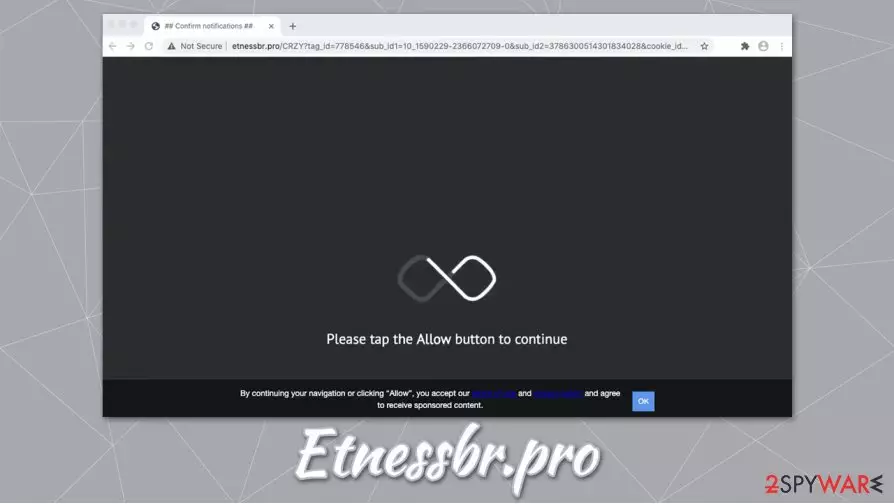
Etnessbr.pro is a website that you have come across at any time while browsing the web on your Google Chrome, Mozilla Firefox, Safari, or another web browser. Regardless of what content you might be presented with, the site will try to make you allow notifications to be shown. If you agree, you will be regularly sent ads directly to your desktop, regardless of the web browser is operational or not. In other words, Etnessbr.pro popups might start showing up while you are watching videos, playing video games, or working on a spreadsheet.
Besides, if you noticed that your web browser is redirecting you to Etnessbr.pro and similar sites, you should also make sure that there is no adware installed on your system. Experts[1] recommend scanning the machine with powerful anti-malware software, although manual checks can also be performed.
| Name | Etnessbr.pro |
| Type | Push notification virus, scam |
| Infiltration | The notifications are enabled after clicking “Allow” button on the website |
| Symptoms | Etnessbr.pro notifications are shown directly on the desktop at particular time intervals |
| Risks | The delivered popups are often of dubious and scam content – these links can result in monetary losses, installation of malware, or personal data disclosure to malicious actors. Additionally, continuous redirects and ads might indicate adware infection |
| Elimination | To get rid of site notifications, you will have to access the side permissions section of your web browser – we provide more details below |
| Further steps | If you notice suspicious behavior on your browser at any time (ads, redirects, automatic downloads, etc.), you should check your machine with anti-malware software, reset all the web browsers, and then fix virus damage with tools such as FortectIntego |
Etnessbr.pro is just one of many dubious websites that abuses a legitimate push notification feature and employs social engineering[2] in order to make users subscribe to intrusive ads. This activity guarantees that the site authors will profit from clicks that users make, whether intentional or accidental.
However, the provided links can often bring to malware-laden, phishing, scam, and other potentially dangerous websites. In other words, you should remove Etnessbr.pro notifications not only to stop the annoying site behavior but also to protect your online safety.
Upon site entry, Etnessbr.pro will display a seemingly innocent content, which can vary from visitor to visitor. However, in every case, the main goal of the site owners is to make users click on the “Allow” button. There are many tricks that can be used for that purpose, and the most commonly seen themes are as follows:
- A video is about to be played – press “Allow”
- If you are 18+, press “Allow”
- Click “Allow” if you are not a robot.
All these tricks are based on the implication that some underlying content will be disclosed as soon as the notifications are permitted. However, those who follow the instructions will soon be disappointed, as they will be redirected to the same page – there will be no video, no +18 content, or similar (note that the same thing happens if “Block” is pressed). In the meantime, Etnessbr.pro push notifications get enabled, and the ads show up soon after.
Therefore, you should not interact with the site in any way, as it does not bring anything. Etnessbr.pro is just a scam to make you subscribe to ads that could be malicious if clicked. Therefore, if you encounter the site while browsing the web, do not interact with it and simply close down the tab.

On the contrary, if you pressed “Allow,” you should never click on the shown ads and perform Etnessbr.pro removal from your desktop and the web browser immediately. Since many users are not familiar with how push notifications work, they do not know that it is the site settings of their browsers that need to access to stop the unwanted activities.
We explain how to get rid of intrusive notifications in the bottom section of this article. However, you should also make sure that your machine is not infected with adware or other threats – perform a full system scan with anti-malware software such as SpyHunterCombo Cleaner or MalwarebytesMalwarebytes. If something was lagged but the security program, you should also reset all the installed web browsers and attempt to fix virus damage with FortectIntego or similar repair tool.
Push notifications – a feature that might sometimes be used for spam
The push notification feature was first implemented almost a decade ago by Google in the Chrome browser, soon followed by Mozilla Firefox, MS Edge, and others. Initially, it was created having good intentions in mind – legitimate websites could allow users to receive relevant information directly to their desktop if they desire to do so. However, it did not take long for cybercriminals to figure out that push notifications are also a great way to push ads to users. In return, these ads can provide a substantial profit for the makers.
Soon after that, push notification scam sites were produced on a large scale, and inexperienced users kept allowing the content into their computers, infecting them with malware, and making them disclose their sensitive information directly to cybercriminals. To battle such malicious activity, Google and other companies began banning such sites, although they can not achieve it at the rate fast enough to stop all the scams. Thus, users can still fall for the push notification trick.
To prevent malicious push notifications, simply leave the dubious site, which promises underlying content after you click “Allow,” as no legitimate websites use such tactics.

Etnessbr.pro elimination process
As mentioned above, cybercriminals abuse the fact that some users are not familiar with how push notifications work or how to get rid of them. For this reason, there may be many people looking for Etnessbr.pro removal instructions. Note that if you enabled the ads after accessing the site, it does not necessarily mean that you are infected with a virus or something similar – you just have to access site settings. Here's how to do it:
Google Chrome
- Go to Menu > Settings > Advanced
- Pick Site Settings > Notifications
- In the Allow section, find the site URL
- Select More Actions and pick Block
Mozilla Firefox:
- Go to Menu > Options
- Pick Privacy & Security > Notifications > Settings
- Find the website address
- Click on the the drop-down menu and choose Block
- Save Changes
MS Edge (Chromium)
- Go to Menu > Settings
- Pick Site permissions
- Select Notifications on the right
- Find the suspicious website, and choose More actions
- Select Block.
Nonetheless, as a precautionary measure, you should either check for potentially unwanted programs[3] manually, as we explained below, or perform a full system scan with powerful anti-malware software. Additionally, if you choose to reset all the installed browsers, you can remove Etnessbr.pro ads and notifications in such a way as well.
Uninstall from Windows
Uninstall from Windows 10/8:
- Type Control Panel into the Windows search box and open the result.
- Under Programs, select Uninstall a program.


Uninstall from Windows 7/XP:
- Click on Windows Start > Control Panel (Windows XP users should click on Add/Remove Programs).
- In Control Panel, select Programs > Uninstall a program.


Remove the unwanted program:
- In the Programs and Features window, look for any recently installed suspicious entries, select them, and click Uninstall.
- If User Account Control appears, click Yes to confirm, then complete the removal.


Delete from macOS
Remove the unwanted application:
- From the menu bar, select Go > Applications.
- In the Applications folder, look for any suspicious entries, then drag them to Trash (or right-click and pick Move to Trash).


Delete leftover files and folders:
- Select Go > Go to Folder.
- Enter /Library/Application Support and remove any suspicious folders related to the unwanted program.
- Repeat the same check in the /Library/LaunchAgents and /Library/LaunchDaemons folders, deleting any suspicious entries.

- Finally, empty the Trash to permanently remove the leftovers.

Reset Internet Explorer
Remove dangerous add-ons:
- Open Internet Explorer, click on the Gear icon (IE menu) on the top-right corner of the browser
- Pick Manage Add-ons.
- You will see a Manage Add-ons window. Here, look for suspicious plugins. Click on these entries and select Disable.


Change your homepage if it was altered:
- Open IE and click on the Gear icon.
- Select Internet Options.
- In the General tab, delete the Home page address and replace it by your preferred one (for example, Google.com).
- Click Apply and then select OK.


Delete temporary files:
- Press on the Gear icon and select Internet Options.
- Under Browsing history, click Delete...
- Select relevant fields and press Delete.


Reset Internet Explorer:
- Click on Gear icon > Internet options and select Advanced tab.
- Select Reset.
- In the new window, check Delete personal settings and select Reset.


Remove from Microsoft Edge
Delete unwanted extensions from MS Edge:
- Select Menu (three horizontal dots at the top-right of the browser window) and pick Extensions.
- From the list, pick the extension and click on the Gear icon.
- Click Remove.


Clear cookies and other browser data:
- Click on the Menu (three horizontal dots at the top-right of the browser window) and select Settings > Privacy, search, and services..
- Under Clear browsing data, pick Choose what to clear.
- Select Cookies and other site data and Cached images and files. (apart from passwords, although you might want to include Media licenses as well, if applicable) and click on Clear.


Restore new tab and homepage settings:
- Click the menu icon and choose Settings.
- Then find On startup section.
- Click Remove next to any suspicious startup page.
Reset MS Edge if the above steps did not work:
- Press on Ctrl + Shift + Esc to open Task Manager.
- Click on More details arrow at the bottom of the window.
- Select Details tab.
- Now scroll down and locate every entry with Microsoft Edge name in it. Right-click on each of them and select End Task to stop MS Edge from running.


Instructions for Chromium-based Edge
Delete extensions from MS Edge (Chromium):
- Open Edge and click select Settings > Extensions.
- Delete unwanted extensions by clicking Remove.


Clear cache and site data:
- Click on Menu and go to Settings.
- Select Privacy, search and services.
- Under Clear browsing data, pick Choose what to clear.
- Under Time range, pick All time.
- Select Clear now.


Reset Chromium-based MS Edge:
- Click on Menu and select Settings.
- On the left side, pick Reset settings.
- Select Restore settings to their default values.
- Confirm with Reset.
- This will disable extensions and reset startup pages but will not delete bookmarks, saved passwords, or browsing history.


Remove from Mozilla Firefox (FF)
Remove dangerous extensions:
- Open Mozilla Firefox browser and click on the Menu (three horizontal lines at the top-right of the window).
- Select Add-ons.
- In here, select the unwanted extension and click Remove.


Reset the homepage:
- Click three horizontal lines at the top right corner to open the menu.
- Choose Settings.
- Under Home, set your preferred homepage and new tab settings.
Clear cookies and site data:
- Click Menu and pick Settings.
- Go to Privacy & Security section.
- Scroll down to locate Cookies and Site Data.
- Click on Clear Data...
- Select Cookies and Site Data and Temporary cached files and pages, then click Clear.


Reset Mozilla Firefox
If clearing the browser as explained above did not help, reset Mozilla Firefox:
- Open Mozilla Firefox browser and click the Menu.
- Go to Help and then choose Troubleshooting Information.

- Under Give Firefox a tune up section, click on Refresh Firefox...
- Once the pop-up shows up, confirm the action by pressing on Refresh Firefox.



Remove from Google Chrome
Delete malicious extensions from Google Chrome:
- Open Google Chrome, click on the Menu (three vertical dots at the top-right corner) and select More tools > Extensions.
- In the newly opened window, you will see all the installed extensions. Uninstall all suspicious extensions related to the unwanted program by clicking Remove.


Clear cache and web data from Chrome:
- Click on Menu and pick Settings.
- Under Privacy and security, select Clear browsing data.
- Select Browsing history, Cookies and other site data, as well as Cached images and files.
- Click Clear data.


Change your homepage:
- Click menu and choose Settings.
- Look for a suspicious site in the On startup section.
- Click on Open a specific or set of pages and click on three dots to find the Remove option.
Reset Google Chrome:
If the previous methods did not help you, reset Google Chrome to eliminate all the unwanted components:
- Click on Menu and select Settings.
- In the Settings, scroll down and click Advanced.
- Scroll down and locate Reset and clean up section.
- Now click Restore settings to their original defaults.
- Confirm with Reset settings.


Delete from Safari
Remove dangerous extensions:
- Open Safari, click Safari in the menu at the top-left of the screen, and select Preferences.
- Go to the Extensions tab, look for any suspicious entries, and click Uninstall to remove them.


Clear history and website data:
- Click Safari in the menu and pick Clear History.
- Set Clear to all history and confirm with Clear History.


Reset Safari:
- Click Safari in the menu and select Preferences > Advanced.
- Enable Show Develop menu in menu bar.
- From the menu bar, click Develop and select Empty Caches.


Did this guide help?
Be the first to comment