

Clay ransomware – computer infection that holds files hostage until $300 ransom is paid in bitcoin
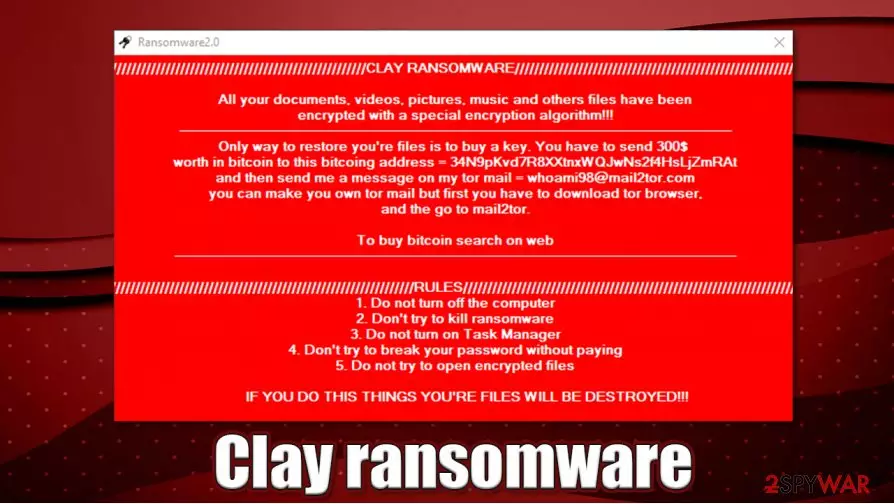
Clay ransomware is a cryptovirus that was first discovered by a security researcher xiaopao.[1] This malware attacks Windows operating systems via various methods, including spam emails, malicious links, software cracks, etc. Once installed, it operates just like any other virus of such type – it locks all videos, music, documents, and other files on the system with strong encryption. Suchlike data can no longer be accessed by victims. Unlike other ransomware, the Clay virus does not append an extension to the encrypted files.
After the encryption process, the malware drops a ransom note, which comes in the form of a pop-up window titled “Ransomware2.0.” It explains to users what happened to their files and asks them to transfer $300 worth of bitcoin to 34N9pKvd7R8XXtnxWQJwNs2f4HsLjZmRAt digital wallet in order to return encrypted data. Crooks behind Clay ransomware virus also leave an email behind for communication – whoami98@mail2tor.com.
| Name | Clay ransomware |
|---|---|
| Type | Ransomware, data locking malware, cryptovirus |
| Malware family | No connections to known malware families have been found |
| File extension | No file extension is appended to the affected files, although they can not be opened regardless |
| Ransom note | “Ransomware2.0” pop-up window |
| Contact | whoami98@mail2tor.com |
| Ransom size | $300 |
| Bitcoin wallet | 34N9pKvd7R8XXtnxWQJwNs2f4HsLjZmRAt |
| File Recovery | If no backups are available, recovering data is almost impossible. Nonetheless, we suggest you try the alternative methods that could help you in some cases – we list them below |
| Malware removal | Perform a full system scan with powerful security software, such as SpyHunterCombo Cleaner |
| System fix | Malware can seriously tamper with Windows systems, causing errors, crashes, lag, and other stability issues after it is terminated. To remediate the OS and avoid its reinstallation, we recommend scanning it with the FortectIntego repair tool |
Clay ransomware is one of many new computer infections that are designed for money extortion. Cybercriminals are very interested in creating this type of malware, as it can be very profitable if successful. Therefore, they could use several different methods to deliver the infection to as many computers as possible. Speaking of which, several anti-malware solutions recognize the sample, which is detected under the following names:[2]
- Win32:TrojanX-gen [Trj]
- Trojan.Encoder.32644
- Trojan:Win32/Wacatac.C!ml
- Gen:Variant.Razy.760416
- HEUR:Trojan-Ransom.MSIL.Encoder.gen, etc.
Once the virus is installed, it would perform Windows system changes for the encryption to be successful. For example, it would delete Shadow Copies to prevent the usage of automatic system backups for easy recovery after Clay ransomware removal.
Besides regular system changes, the malware also disables certain system functions – Task Manager in particular. Therefore, users can not launch it to stop the malicious process from running. As a result, all the incoming files are encrypted, so the computer becomes almost unusable.

Clay ransomware encrypts files with a strong encryption algorithm,[3] although it does not append any file extension. Suchlike modified files lose regular icons, however. After that, a ransom note is delivered, which reads:
////////////////////////////////CLAY RANSOMWARE////////////////////////////////
All your documents. videos. pictures. music and other files have been
encrypted with a special encryption algorithm!!!___________________________________
Only way to restore you're files is to buy a key. You have to send $300
worth in bitcoin to this bitcoing address = 34N9pKvd7R8XXtnxWQJwNs2f4HsLjZmRAt
and then send me a message on my tor mail = whoami98@mail2tor.com
you can make your own tor mail but first you have to download tor browser.
and the go to mail2tor.to buy bitcoin search on web
___________________________________
///////////////////////////////////////RULES//////////////////////////////////////
1. Do not turn off the computer
2. Don't try to kill ransomware
3. Do not turn on Task Manager
4. Don't try to break your password without paying
5. Do no try to open encrypted filesIF YOU DO THIS THINGS YOU'RE FILES WILL BE DESTROYED!!!
//////////////////////////////////////////////////////////////////////////////////////////
DECRYPT FILES
REAMING TIME: 00:59:39
Since the virus modifies Windows system heavily, you should access Safe Mode with Networking before you attempt to remove Clay ransomware virus from your system – we explain how below. Once in Safe Mode, initiate a full system scan with SpyHunterCombo Cleaner, MalwarebytesMalwarebytes, or another reputable security software. FortectIntego can also serve as an excellent tool to recover normal Windows functions and remediate system files. After that, refer to alternative methods for data recovery.
Paying cybercriminals is risky. How to recover encrypted files?
In the ransom note, cybercriminals behind the Clay file virus say that there is no other method to recover data besides paying them. They also include a timer that only gives victims an hour, although it is not specified what it does. Presumably, it indicates the time when recovering the decryptor is possible, however, there is no evidence for that.
The harsh truth is that only cybercriminals have the required key that would unlock files encrypted by the Clay virus. However, security experts[4] do not recommend paying or contacting the attackers for that matter, as they might never deliver their promises, even after bitcoin payment is sent. As a result, you might not only lose access to your files but also the money that you paid to crooks. This is especially true for new malware strains, where not many successful decryption tool retrievals were observed.

Instead, you can rely on alternative methods to recover Clay virus files, although keep in mind that for them to work, malware should fail to delete Shadow Copies. Nonetheless, third-party recovery applications might sometimes be able to recover at least some files. For detailed instructions, check the bottom section of this post.
Clay ransomware removal and file recovery
Before we begin this Clay ransomware removal guide, we would like to say that data recovery without obtaining the key from the attackers is unlikely. However, there is always a chance of retrieving at least some of your lost files, so you should not give up before you try. Alternatively, you can pay the $300 to threat actors, although it might end in a disaster to you – do it at your own risk.
As crooks mention in their ransom note “Ransomware2.0,” even shutting down the computer might damage files permanently. They might be bluffing – or not. Thus, just to be safe, you should make a copy of all the encrypted data before you remove Clay ransomware virus. Encrypted data does not hold any malicious code inside, so it is safe to use.
Finally, use the instructions below to access Safe Mode with Networking and scan your computer fully with SpyHunterCombo Cleaner, MalwarebytesMalwarebytes, or another security tool. Afterward, you can perform further checks for Windows system damage and remediation with FortectIntego. Once you are sure that the machine is clear from the virus, check the data recovery guide below; maybe you will get lucky.
Did this guide help?
Be the first to comment