

Hades ransomware – a cryptovirus that asks to contact attackers via TOX instant messaging service
Hades ransomware is a file-locking cyber threat that is made to extort money by encrypting data on victims' computers and forcing them into buying a necessary decryption tool. During encryption, all files are appended with five alphanumeric characters that represent the victims' ID.
Afterward, a ransom note text file, titled HOW-TO-DECRYPT-xxxxx.txt (x represents a unique user ID), is created, explaining to the victims what happened and what do they have to do to regain access to their files. Users who want to contact their assailants will have to use TOX instant messaging service.
Before Hades file virus starts data encryption, it archives and uploads it to remote servers controlled by cybercriminals to hold hostage. Victims can find about that by visiting the assailants' website using ixltdyumdlthrtgx.onion website on TOR or by using an alternative communication method – TOX service, which is known for its anonymity.
| name | Hades ransomware |
|---|---|
| Type | Cryptovirus |
| Ransom note | HOW-TO-DECRYPT-xxxxx.txt |
| appended file extension | All non-system files are appended with an appointed user ID consisting of 5 random characters |
| Additional info | The cybercriminals might have stolen victim files to blackmail them into paying the ransom |
| Criminal contact details | Users willing to contact the assailants must first use Tor browser to reach ixltdyumdlthrtgx.onion website. Then input this user ID in TOX messaging app – 2F5338DABD40348C71D858459FE7B8ED60DDD9CE4D260C656E4E236A91167C31165081A85F79 |
| Virus removal | All cryptoviruses and malware alike should be eliminated from infected devices by using reliable anti-malware software |
| System health | Ransomware causes damage and modifications to system settings and files. To undo these changes, use a powerful system tune-up tool like the FortectIntego app |
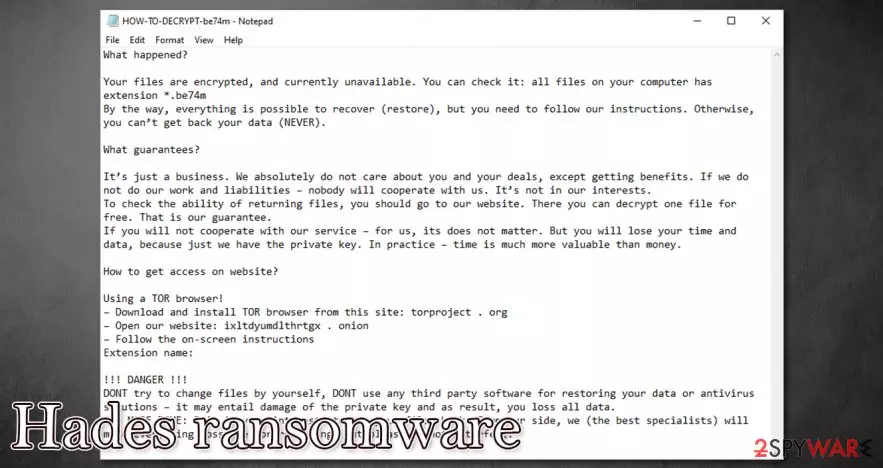
In the ransom note message of Hades ransomware, cybercriminals clarify to their victims what happened – that all files are encrypted and that the only way to get them back is by purchasing their decryption tool. To prove that they possess the required tool, they offer to upload one file to a previously mentioned TOR website. The whole message reads:
What happened?
Your files are encrypted, and currently unavailable. You can check it: all files on your computer has extension *.xxxxx
By the way, everything is possible to recover (restore), but you need to follow our instructions. Otherwise, you can’t get back your data (NEVER).
What guarantees?
It’s just a business. We absolutely do not care about you and your deals, except getting benefits. If we do not do our work and liabilities – nobody will cooperate with us. It’s not in our interests.
To check the ability of returning files, you should go to our website. There you can decrypt one file for free. That is our guarantee.
If you will not cooperate with our service – for us, its does not matter. But you will lose your time and data, because just we have the private key. In practice – time is much more valuable than money.
How to get access on website?
Using a TOR browser!
– Download and install TOR browser from this site: torproject . org
– Open our website: ixltdyumdlthrtgx . onion
– Follow the on-screen instructions
Extension name:
!!! DANGER !!!
DONT try to change files by yourself, DONT use any third party software for restoring your data or antivirus solutions – it may entail damage of the private key and as result, you loss all data.
ONE MORE TIME: It’s in your interests to get your files back. From our side, we (the best specialists) will make everything possible for restoring, but please do not interfere.
Ransomware could be aimed at specific targets (people, companies, institutions) or at random unlucky people. Our research shows that the most common method of getting your devices infected with this type of malware are:
- phishing emails
- file-sharing platforms
- RDP attacks
- drive-by downloads[1]
- exploiting software vulnerabilities
In order to stay safe on the internet, the first thing any computer user should do is to purchase a trustworthy anti-malware application like SpyHunterCombo Cleaner or MalwarebytesMalwarebytes. If kept up-to-date, this software could prevent ransomware payload files from gaining access to your device.

The worse thing any cyberattack victim could do is to contact the assailants and meet their demands. Ransom money could be used to spread their created ransomware further and to research new, more efficient ways to distribute it. That's why you should remove Hades ransomware ASAP. To do that automatically – use anti-malware software.
Once a file-locking virus enters a computer system, it edits the device's registry to help it accomplish its purpose. Having that in mind, following Hades ransomware removal, experts[2] recommend using the FortectIntego tool to fix any system irregularities.
Malware infections are mostly avoidable
As we've mentioned before, there are a lot of ways malware could get into your computer. But one of the most common methods used by cybercriminals is uploading their creations to file-sharing platforms, such as torrent sites. These websites are perfect for the job because no one scans the uploaded content.
Hackers can upload whatever they like to these types of sites and just sit and wait for unaware users to download whatever they might be offering. Cybercriminals trick their soon to be victims by naming their uploads as the latest game cracks, unlocked licensed software, or anything else that would lure everyday computer users.
In addition to that, ransomware could be camouflaged as practically any file type when built with obfuscation.[3] That way, although users think that they are downloading a video file or some .pdf documents, they could be downloading executable virus payload instead. Never using such sites or downloading from them would greatly decrease the chances of infecting your devices.
Instructions for Hades ransomware removal from affected Windows computers
Every day, cybercriminals introduce new ransomware that's aimed at everyday people. Until people (and companies) will pay the ransoms – the attacks won't stop. If you have your device infected, the only right thing to do is to remove Hades ransomware. By doing that, you might save someone else from becoming a victim.

We recommend entrusting Hades ransomware removal to professional anti-malware tools like SpyHunterCombo Cleaner or MalwarebytesMalwarebytes. Either of these apps should locate and eliminate the infection automatically. Furthermore, keep virus databases updated to prevent such perils in the future.
As we've mentioned in the first chapter, ransomware makes alterations to the system registry and other core settings. The changes might cause performance loss, crashes, or even ransomware renewal. So it's essential to restore these settings. We advise using powerful system tune-up tools like the FortectIntego or similar.
Did this guide help?
Be the first to comment