

Allowsuccess – is an untrustworthy site that seeks to trick you into accepting its push notifications
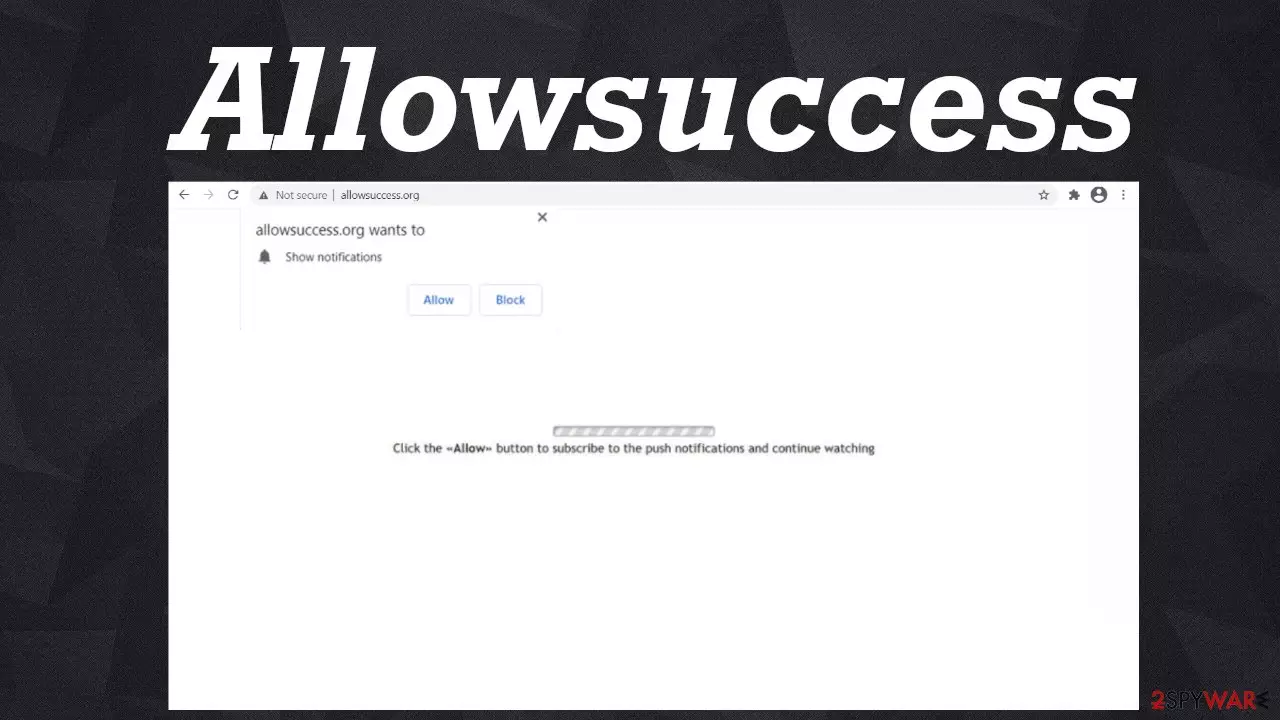
Allowsuccess is a push notification virus that will bombard you with deceptive ads if you press the Allow button. Thus please don't visit this treacherous website and don't accept its notifications. Different prompts are displayed to visitors, depending on their geolocation.
You might be asked to enable notifications to prove that you're not a robot, confirm that you're over 18 years old, enter the site, close the window, continue watching a video, etc. When a site uses such tricks to push its visitors into pressing the Allow button, it should never be visited.
In most cases, Allowsuccess virus is an outcome of an adware[1] infection. It is categorized as a potentially unwanted program (PUP) and is not as hazardous as malware, but you still should remove it immediately. This article will explain how to do that, how to avoid such perils in the future, and how to eliminate the annoying ads appearing directly on your PC desktop or phone screen.
| name | Allowsuccess |
|---|---|
| Type | Push notification virus, PUP, adware |
| URL address | Allowsuccess.org |
| IP address | 54.225.218.189 |
| Purpose | Generate revenue by redirecting internet traffic to affiliated portals |
| Symptoms | Ads appear as notification directly on your screen or desktop, new tabs with untrustworthy sites open out of the blue, device is running visibly slower |
| Risks | Installation of PUPs, malware infections, privacy issues |
| Distribution | Fake Flash Player updates, software bundles, deceptive ads, file-sharing platforms |
| Elimination | Remove potentially unwanted programs by scanning your device with a trustworthy anti-malware tool. Make sure that its virus signatures are up to date |
| System repair | Use the time-proven FortectIntego system tune-up software to fix any system irregularities and avoid abnormal system behavior, such as severe lag, BSoDs, freezing, etc. |
There are tons of sites that try to trick their visitors into pressing the Allow button, including Poloni-news5.online, Mycoolnewz.com, Ngtoinfor.online. Their motives are simple – get paid by generating traffic to affiliated sites to increase their sales and popularity.
That's why both adware and push notification viruses might advertise dangerous websites that pay the most. According to our research and numerous user reports, redirects open pages with porn, various scams, other PUPs, malware, gambling, gaming, etc. Some of these pages might be harmless, but some might have evil intentions.
Allowsuccess ads might cause redirects to any affiliated portals as usually, the ads have nothing in common with the site you'll end up on when such an ad is clicked. Moreover, just like adware, this push notification virus could open new tabs or launch your browser on demand.

As mentioned before, the most likely reason why you might be redirected to Allowsuccess.com is that your device is infected with adware. Although it's not as hazardous as malware, it could act as a gateway to it and thus should be removed immediately.
The safest and easiest way to do that is by scanning your infected device with compatible security tools. Cybersecurity specialists[2] highly recommend using free but dependable AV software such as SpyHunterCombo Cleaner or MalwarebytesMalwarebytes that are capable of removing adware, PUPs, and malware and protecting against such threats in the future.
Fake Flash Player updates and software bundles carry various infections
Internet users worldwide have to remember one thing – Flash Player support was discontinued on December 31, 2020. Thus any prompts suggesting that you need to install or update Flash Player are fake. Those installers are for various PUPs, such as adware, browser hijackers, or even malware, including ransomware, Trojans, etc.
If you ever encounter such an ad, please close the tab and never visit that page again. Another possible way of getting a PUP infection is not paying attention to what's being installed on your device. Software bundling[3] is used not only by third-party vendors but also by legitimate software developers.

Therefore, if you want to keep your device clean, you must stay cautious when installing any new software. You can do that by choosing the Advance/Custom installation mode and going step-by-step from there. Deselect all suspicious, untrustworthy, unneeded apps from installing and get only the one you initially wanted.
Simple directions to remove Allowsuccess notifications and possible PUPs
Adware and other PUPs cause redirects to treacherous sites with various content, including Allowsuccess virus. It could also lead you to pages with malware. That's why it is of utmost importance to keep your device clean and remove any infections, no matter how insignificant they might appear.
Trustworthy anti-malware software should be used for any PUP or malware removal as only then it is completely and safely eliminated. So scan your device with a reputable security tool to remove adware that was causing redirects to deceptive websites.
Afterward, use our instructions posted below to remove Allowsuccess ads. For your convenience, we've included guides for all systems and all browsers. And please don't forget to scan your device for any system irregularities with compatible software to ensure your device runs properly.
Uninstall from Windows
Uninstall from Windows 10/8:
- Type Control Panel into the Windows search box and open the result.
- Under Programs, select Uninstall a program.


Uninstall from Windows 7/XP:
- Click on Windows Start > Control Panel (Windows XP users should click on Add/Remove Programs).
- In Control Panel, select Programs > Uninstall a program.


Remove the unwanted program:
- In the Programs and Features window, look for any recently installed suspicious entries, select them, and click Uninstall.
- If User Account Control appears, click Yes to confirm, then complete the removal.


Delete from macOS
Remove the unwanted application:
- From the menu bar, select Go > Applications.
- In the Applications folder, look for any suspicious entries, then drag them to Trash (or right-click and pick Move to Trash).


Delete leftover files and folders:
- Select Go > Go to Folder.
- Enter /Library/Application Support and remove any suspicious folders related to the unwanted program.
- Repeat the same check in the /Library/LaunchAgents and /Library/LaunchDaemons folders, deleting any suspicious entries.

- Finally, empty the Trash to permanently remove the leftovers.

Remove from Microsoft Edge
Delete unwanted extensions from MS Edge:
- Select Menu (three horizontal dots at the top-right of the browser window) and pick Extensions.
- From the list, pick the extension and click on the Gear icon.
- Click Remove.


Clear cookies and other browser data:
- Click on the Menu (three horizontal dots at the top-right of the browser window) and select Settings > Privacy, search, and services..
- Under Clear browsing data, pick Choose what to clear.
- Select Cookies and other site data and Cached images and files. (apart from passwords, although you might want to include Media licenses as well, if applicable) and click on Clear.


Restore new tab and homepage settings:
- Click the menu icon and choose Settings.
- Then find On startup section.
- Click Remove next to any suspicious startup page.
Reset MS Edge if the above steps did not work:
- Press on Ctrl + Shift + Esc to open Task Manager.
- Click on More details arrow at the bottom of the window.
- Select Details tab.
- Now scroll down and locate every entry with Microsoft Edge name in it. Right-click on each of them and select End Task to stop MS Edge from running.


Instructions for Chromium-based Edge
Delete extensions from MS Edge (Chromium):
- Open Edge and click select Settings > Extensions.
- Delete unwanted extensions by clicking Remove.


Clear cache and site data:
- Click on Menu and go to Settings.
- Select Privacy, search and services.
- Under Clear browsing data, pick Choose what to clear.
- Under Time range, pick All time.
- Select Clear now.


Reset Chromium-based MS Edge:
- Click on Menu and select Settings.
- On the left side, pick Reset settings.
- Select Restore settings to their default values.
- Confirm with Reset.
- This will disable extensions and reset startup pages but will not delete bookmarks, saved passwords, or browsing history.


Remove from Mozilla Firefox (FF)
Remove dangerous extensions:
- Open Mozilla Firefox browser and click on the Menu (three horizontal lines at the top-right of the window).
- Select Add-ons.
- In here, select the unwanted extension and click Remove.


Reset the homepage:
- Click three horizontal lines at the top right corner to open the menu.
- Choose Settings.
- Under Home, set your preferred homepage and new tab settings.
Clear cookies and site data:
- Click Menu and pick Settings.
- Go to Privacy & Security section.
- Scroll down to locate Cookies and Site Data.
- Click on Clear Data...
- Select Cookies and Site Data and Temporary cached files and pages, then click Clear.


Reset Mozilla Firefox
If clearing the browser as explained above did not help, reset Mozilla Firefox:
- Open Mozilla Firefox browser and click the Menu.
- Go to Help and then choose Troubleshooting Information.

- Under Give Firefox a tune up section, click on Refresh Firefox...
- Once the pop-up shows up, confirm the action by pressing on Refresh Firefox.



Remove from Google Chrome
Delete malicious extensions from Google Chrome:
- Open Google Chrome, click on the Menu (three vertical dots at the top-right corner) and select More tools > Extensions.
- In the newly opened window, you will see all the installed extensions. Uninstall all suspicious extensions related to the unwanted program by clicking Remove.


Clear cache and web data from Chrome:
- Click on Menu and pick Settings.
- Under Privacy and security, select Clear browsing data.
- Select Browsing history, Cookies and other site data, as well as Cached images and files.
- Click Clear data.


Change your homepage:
- Click menu and choose Settings.
- Look for a suspicious site in the On startup section.
- Click on Open a specific or set of pages and click on three dots to find the Remove option.
Reset Google Chrome:
If the previous methods did not help you, reset Google Chrome to eliminate all the unwanted components:
- Click on Menu and select Settings.
- In the Settings, scroll down and click Advanced.
- Scroll down and locate Reset and clean up section.
- Now click Restore settings to their original defaults.
- Confirm with Reset settings.


Delete from Safari
Remove dangerous extensions:
- Open Safari, click Safari in the menu at the top-left of the screen, and select Preferences.
- Go to the Extensions tab, look for any suspicious entries, and click Uninstall to remove them.


Clear history and website data:
- Click Safari in the menu and pick Clear History.
- Set Clear to all history and confirm with Clear History.


Reset Safari:
- Click Safari in the menu and select Preferences > Advanced.
- Enable Show Develop menu in menu bar.
- From the menu bar, click Develop and select Empty Caches.


Did this guide help?
Be the first to comment