

Maximus-time.com – a shady portal that wants to bombard your desktop with ads
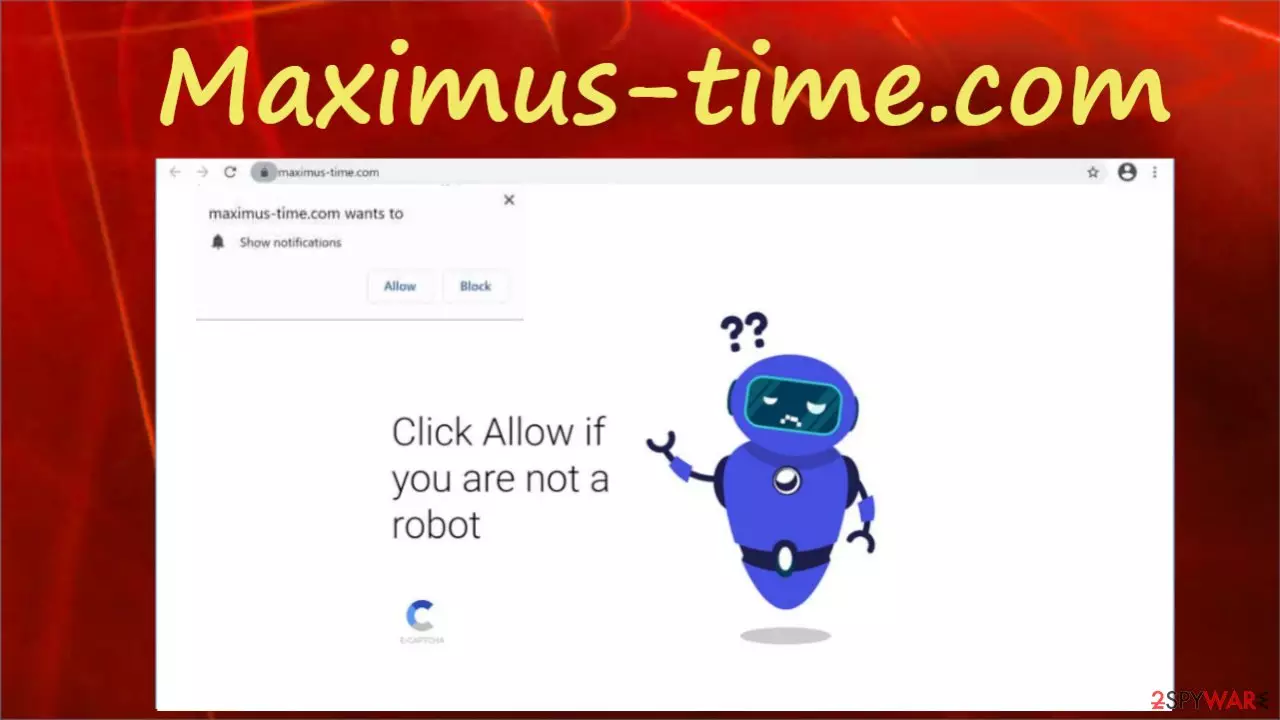
Maximus-time.com is an untrustworthy website, and you should not accept its notifications. Such pages show various backgrounds and misleading prompts to trick gullible people into pressing the Allow button. If you do that, ads in the form of notifications will be delivered directly to your desktop or screen.
If you didn't click on deceptive ads on questionable portals or type in the culprit's address manually, but you still see this shady website, the device you're using is infected with adware. You'll find out how to safely remove it by reading this article.
We'll also explain to you how to get rid of the annoying Maximus-time.com ads that pop up out of the blue if you've enabled its notifications. The good news is that adware is deemed a potentially unwanted program,[1] making it less dangerous than malware,[2] but you still need to act fast.
| name | Maximus-time.com |
|---|---|
| Type | Adware, redirect virus, PUP |
| IP address | 3.95.82.196 |
| Purpose | Trick users into enabling notifications so deceptive ads and sudden redirects would generate traffic to affiliated partners |
| Symptoms | The device in question is running slower; the browsing speed is decreased; new tabs with unknown pages open out of nowhere; ads are seen directly on the desktop or screen |
| Risks | Infection with malware, PUP installation, privacy issues, monetary losses |
| Distribution | Deceptive ads, software bundles, freeware, fake Flash Player updates |
| Elimination | Trustworthy security tools should always be used to remove cyber threats once and for all safely |
| System fix | The time-proven FortectIntego system repair software or similar tools should be used to repair any damage the system has sustained during the infection. This would guarantee a stable working environment |
Push notifications are a great service that lets legitimate sources such as web stores, news sites, and others bring their latest updates directly to their subscribers. At the same time, shady portals exploit this service to deliver tons of deceptive advertisements of their affiliated sites.
The worst part of these ads is that they are not that easy to close. In fact, sometimes it's impossible as clicking the “X” or “Remove” buttons either does nothing or opens an affiliated page. Furthermore, an ad for sale on laptops could redirect you to pages with gambling, scams, malware, porn, other PUPs, and so on.
By causing sudden redirects, Maximus-time.com virus might force you to visit such sites. A new tab with sponsored content might be opened on demand. And since threat actors behind such infection care only about money, the sponsored sites could have evil intentions.
That's why you should scan your device with a dependable security tool to remove any PUPs along with any suspicious entries or files. According to cybersecurity experts,[3] free anti-malware software such as MalwarebytesMalwarebytes or SpyHunterCombo Cleaner is more than capable of completing this task.
Once you've eliminated adware or other potentially unwanted programs that possibly caused the initial redirect to Maximus-time.com, you have to remove its notifications (if you've accepted them). We've posted free instructions for Chrome, Safari, and other browsers at the bottom of the page for your convenience.
Since cyber infections make alterations to system files and settings, you have to restore them, or your device might exhibit various abnormal behavior. The all-in-one FortectIntego system diagnostics tool will take care of all system irregularities and delete tracking cookies in the process.

Software bundles and fake Flash Player updates cause the most PUP infections
Cybercriminals are constantly searching for new ways to spread their vile creations. Two of the most popular ones are software bundles and fake Flash Player installers/updates. The former one is usually downloaded from third-party software vendors, but lately, legit developers have also started using this technique.
Thus the only way to avoid PUPs packed up in software bundles is to stay attentive when installing any new software. The next time you're doing it, please don't rush and pick the Advanced/Custom installation mode. Only then will you be able to deselect all unwanted, suspicious, untrustworthy apps from installation.
PUPs and even malware infections could be caught when people believe fake Flash Player update ads/prompts. Adobe ceased the support for this software. Cybercriminals still use these fake prompts to spread various infections, so please don't trust it if you ever encounter one. Close the tab, and never revisit the shady site.
Simple instructions to remove Maximus-time.com virus from affected machines
This can't be reiterated too much – never accept notifications from questionable sites you don't often visit and don't trust. You should remove adware, browser hijackers, and other PUPs as soon as any system irregularities or cyber threat symptoms are spotted.
The best way to remove any infection is to scan your device with a trustworthy anti-malware tool. First, update its virus database so it has the latest virus signatures and can identify the most recent threats. A proper AV tool will prevent you from visiting dangerous pages and stop malware at your doorstep.
To remove Maximus-time.com notification from your browser, use our free guidelines posted below. That will get rid of the annoying ads popping up on your screen or desktop. Afterward, perform system diagnostics to revert any changes infections might have made to the system of your device so you could enjoy it anew.
Uninstall from Windows
Uninstall from Windows 10/8:
- Type Control Panel into the Windows search box and open the result.
- Under Programs, select Uninstall a program.


Uninstall from Windows 7/XP:
- Click on Windows Start > Control Panel (Windows XP users should click on Add/Remove Programs).
- In Control Panel, select Programs > Uninstall a program.


Remove the unwanted program:
- In the Programs and Features window, look for any recently installed suspicious entries, select them, and click Uninstall.
- If User Account Control appears, click Yes to confirm, then complete the removal.


Delete from macOS
Remove the unwanted application:
- From the menu bar, select Go > Applications.
- In the Applications folder, look for any suspicious entries, then drag them to Trash (or right-click and pick Move to Trash).


Delete leftover files and folders:
- Select Go > Go to Folder.
- Enter /Library/Application Support and remove any suspicious folders related to the unwanted program.
- Repeat the same check in the /Library/LaunchAgents and /Library/LaunchDaemons folders, deleting any suspicious entries.

- Finally, empty the Trash to permanently remove the leftovers.

Remove from Microsoft Edge
Delete unwanted extensions from MS Edge:
- Select Menu (three horizontal dots at the top-right of the browser window) and pick Extensions.
- From the list, pick the extension and click on the Gear icon.
- Click Remove.


Clear cookies and other browser data:
- Click on the Menu (three horizontal dots at the top-right of the browser window) and select Settings > Privacy, search, and services..
- Under Clear browsing data, pick Choose what to clear.
- Select Cookies and other site data and Cached images and files. (apart from passwords, although you might want to include Media licenses as well, if applicable) and click on Clear.


Restore new tab and homepage settings:
- Click the menu icon and choose Settings.
- Then find On startup section.
- Click Remove next to any suspicious startup page.
Reset MS Edge if the above steps did not work:
- Press on Ctrl + Shift + Esc to open Task Manager.
- Click on More details arrow at the bottom of the window.
- Select Details tab.
- Now scroll down and locate every entry with Microsoft Edge name in it. Right-click on each of them and select End Task to stop MS Edge from running.


Instructions for Chromium-based Edge
Delete extensions from MS Edge (Chromium):
- Open Edge and click select Settings > Extensions.
- Delete unwanted extensions by clicking Remove.


Clear cache and site data:
- Click on Menu and go to Settings.
- Select Privacy, search and services.
- Under Clear browsing data, pick Choose what to clear.
- Under Time range, pick All time.
- Select Clear now.


Reset Chromium-based MS Edge:
- Click on Menu and select Settings.
- On the left side, pick Reset settings.
- Select Restore settings to their default values.
- Confirm with Reset.
- This will disable extensions and reset startup pages but will not delete bookmarks, saved passwords, or browsing history.


Remove from Mozilla Firefox (FF)
Remove dangerous extensions:
- Open Mozilla Firefox browser and click on the Menu (three horizontal lines at the top-right of the window).
- Select Add-ons.
- In here, select the unwanted extension and click Remove.


Reset the homepage:
- Click three horizontal lines at the top right corner to open the menu.
- Choose Settings.
- Under Home, set your preferred homepage and new tab settings.
Clear cookies and site data:
- Click Menu and pick Settings.
- Go to Privacy & Security section.
- Scroll down to locate Cookies and Site Data.
- Click on Clear Data...
- Select Cookies and Site Data and Temporary cached files and pages, then click Clear.


Reset Mozilla Firefox
If clearing the browser as explained above did not help, reset Mozilla Firefox:
- Open Mozilla Firefox browser and click the Menu.
- Go to Help and then choose Troubleshooting Information.

- Under Give Firefox a tune up section, click on Refresh Firefox...
- Once the pop-up shows up, confirm the action by pressing on Refresh Firefox.



Remove from Google Chrome
Delete malicious extensions from Google Chrome:
- Open Google Chrome, click on the Menu (three vertical dots at the top-right corner) and select More tools > Extensions.
- In the newly opened window, you will see all the installed extensions. Uninstall all suspicious extensions related to the unwanted program by clicking Remove.


Clear cache and web data from Chrome:
- Click on Menu and pick Settings.
- Under Privacy and security, select Clear browsing data.
- Select Browsing history, Cookies and other site data, as well as Cached images and files.
- Click Clear data.


Change your homepage:
- Click menu and choose Settings.
- Look for a suspicious site in the On startup section.
- Click on Open a specific or set of pages and click on three dots to find the Remove option.
Reset Google Chrome:
If the previous methods did not help you, reset Google Chrome to eliminate all the unwanted components:
- Click on Menu and select Settings.
- In the Settings, scroll down and click Advanced.
- Scroll down and locate Reset and clean up section.
- Now click Restore settings to their original defaults.
- Confirm with Reset settings.


Delete from Safari
Remove dangerous extensions:
- Open Safari, click Safari in the menu at the top-left of the screen, and select Preferences.
- Go to the Extensions tab, look for any suspicious entries, and click Uninstall to remove them.


Clear history and website data:
- Click Safari in the menu and pick Clear History.
- Set Clear to all history and confirm with Clear History.


Reset Safari:
- Click Safari in the menu and select Preferences > Advanced.
- Enable Show Develop menu in menu bar.
- From the menu bar, click Develop and select Empty Caches.


Did this guide help?
Be the first to comment