

17uoEtuihi6Lsg4hdedT7PUhF4FNgBPD2F is a dangerous clipper-hijacking malware that spreads via torrent sites

17uoEtuihi6Lsg4hdedT7PUhF4FNgBPD2F is a Trojan[1] that specializes in stealing funds from users' cryptocurrency wallets. The principle of the virus is relatively simple: it hijacks the clipboard data (which is why these types of infections are known as “clipper hijackers”) and replaces it with the cybercriminals' cryptocurrency wallet data.
Consequently, instead of transferring funds to their own wallets, victims end up making a transaction to cybercriminals' Bitcoin wallets. An alternative crypto wallet address can also sometimes be used – 3PxkHEMPaNMPMyiiHpHEj6ZgWzShh54N65.
17uoEtuihi6Lsg4hdedT7PUhF4FNgBPD2F malware otherwise would not show any signs or symptoms, hence it might not be noticed for a while. As a result, the affected users might lose thousands of dollars in Bitcoin if such sums are being transferred. In this article, we will explore the process and explain how to effectively remove the infection thoroughly.
| Name | 17uoEtuihi6Lsg4hdedT7PUhF4FNgBPD2F malware |
| Type | Trojan, clipper hijacker |
| Distribution | Torrents, software cracks, illegal websites |
| Function | To steal funds from users' Bitcoin cryptocurrency wallets |
| Symptoms | Due to malware's functionality, it is hardly possible to notice its malicious operations |
| Removal | Employ powerful SpyHunterCombo Cleaner security software to remove all the components from the system at once |
| System fix | After malware removal, make sure you clean your browsers and repair damage done to the system files. You can do this quickly with the FortectIntego PC repair and maintenance tool |
Distribution and avoidance
In order to be successful, malware authors employ several distribution methods – this guarantees that more people can be exposed to the infection. As a result, they can expect more funds to flow into their personal crypto-wallets.
Most commonly, users install 89N3PDyZzakoH7W6n8ZrjGDDktjh8iWFG6eKRvi3kvpQ malware when downloading illegal software installers or cracks from unsolicited websites. These sites are often poorly protected, and any registered user with a simple account can upload and share files. This serves as a perfect ground for malware authors.
It is not difficult to see why software cracks and illegal pirated apps work so well. Those who have security software installed on their machines often assume that the detection of a malicious file, such as RAR, EXE,[2] or RUN, is a false positive, which follows by disabling the warning and putting the file as an exception.
Therefore, you should not visit such websites, let alone download files from them. Purchase software that won't infect your system or instead rely on freeware[3] programs, although you should always be careful about potentially unwanted applications that are pretty common on third-party websites.
Trojans and clapboard hijackers explained
Trojans are usually identified by their distribution principles rather than functionality. Whenever users install a file they believe to be safe (a cracked program, fake Flash Player update, a malicious spam email attachment disguised as a valid MS Office document, etc.) but it ends up infecting their systems with malware, it is classified as a Trojan.
For this precise reason, Trojans can operate drastically differently, depending on the payload delivered in such a manner. Ransomware, for example, is often detected as a Trojan, as it is usually distributed via spam email attachments or software cracks. In this case, the function of the 17uoEtuihi6Lsg4hdedT7PUhF4FNgBPD2F virus is to steal funds from cryptocurrency wallets.
89N3PDyZzakoH7W6n8ZrjGDDktjh8iWFG6eKRvi3kvpQ is yet another clipboard hijacker we've recently discussed. This function of malware has been becoming more widespread recently, as Bitcoin and other cryptocurrency usage is constantly rising.
The malware can also come with additional functions, for example, keylogging, or might also allow the attackers to install additional payloads. Also, when downloading software from third-party websites, it might also contain potentially unwanted programs such as adware. We strongly recommend securing your device with powerful anti-virus tools to prevent infections of similar type and never ignore their warnings.
Removal steps explained
Scan with anti-malware
Malware removal should be performed as soon as possible. Once installed, Trojan can root itself deep into the system after dropping numerous files, which might be difficult to find without advanced IT knowledge.
Therefore, we strongly recommend you remove 17uoEtuihi6Lsg4hdedT7PUhF4FNgBPD2F malware with the help of powerful anti-malware software, such as SpyHunterCombo Cleaner or MalwarebytesMalwarebytes. By using it, you will ensure that all the malicious components are deleted at once, and none of the malware's processes are running in the background. Security software is also your first line of defense when it comes to initial malware attacks.
Remove unwanted programs and extensions
If you have downloaded a potentially unwanted program such as adware along with the virus, you should remove it as well. The most malicious apps can be eliminated by anti-malware software, although browser extensions/hijackers are not usually detected. Thus, you should check the extensions section on your browser and remove everything suspicious.
You should also remove the installed programs as follows:
- Enter Control Panel into the Windows search box and hit Enter or click on the search result.
- Under Programs, select Uninstall a program.

- From the list, find the entry of the suspicious program.
- Right-click on the application and select Uninstall.
- If User Account Control shows up, click Yes.
- Wait till uninstallation process is complete and click OK.



Repair damaged system files and clean your browsers
After malware elimination, we strongly recommend running a scan with a repair tool. It can clean your browsers and other leftover files for you instantaneously. In case malware has caused damage to your system files, it can repair them, consequently stopping crashes, errors, and other post-infection issues.
- Download FortectIntego
- Click on the ReimageRepair.exe
- If User Account Control (UAC) shows up, select Yes
- Press Install and wait till the program finishes the installation process
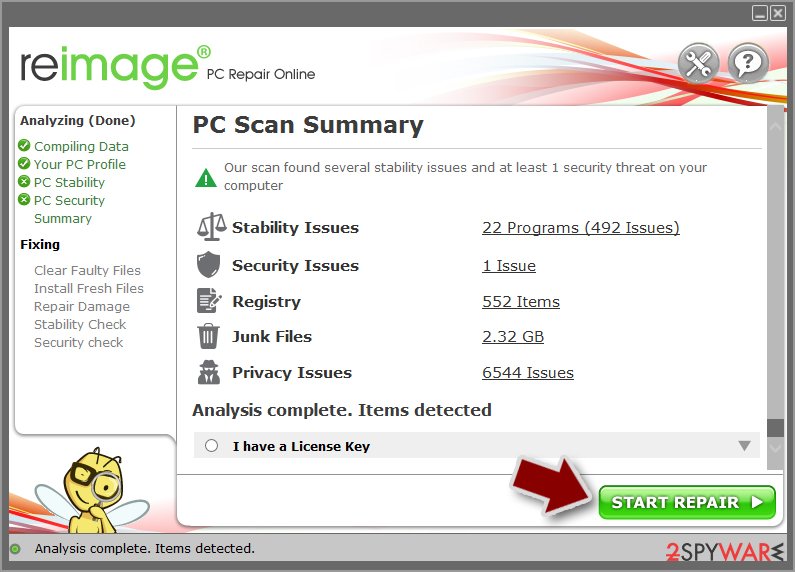
- The analysis of your machine will begin immediately
- Once complete, check the results – they will be listed in the Summary
- You can now click on each of the issues and fix them manually
- If you see many problems that you find difficult to fix, we recommend you purchase the license and fix them automatically.

Web browser cleaning is also a mandatory process, especially after malware/adware removal. If you would rather clean browsers manually, please follow these steps:
Google Chrome
- Click on Menu and pick Settings.
- Under Privacy and security, select Clear browsing data.
- Select Browsing history, Cookies, and other site data, as well as Cached images and files.
- Click Clear data.


Mozilla Firefox
- Click Menu and pick Options.
- Go to Privacy & Security section.
- Scroll down to locate Cookies and Site Data.
- Click on Clear Data…
- Select Cookies and Site Data, as well as Cached Web Content and press Clear.


MS Edge
- Click on Menu and go to Settings.
- Select Privacy and services.
- Under Clear browsing data, pick Choose what to clear.
- Under Time range, pick All time.
- Select Clear now.


Safari
- Click Safari > Clear History…
- From the drop-down menu under Clear, pick all history.
- Confirm with Clear History.


Did this guide help?
Be the first to comment