

Adslivetraining.com is a fake site that tricks users into subscribing to push notifications only to send intrusive ads later

Adslivetraining.com is one of the many thousand push notification phishing sites that may be found while using Google Chrome, Mozilla Firefox, Microsoft Edge, or another browser. This is not how most people recall the name of this website; rather, they remember it because they get distracting pop-up advertisements on their computer screens randomly.
Users are led to the site after clicking a misleading link, where they are then presented with a fake message that urges them to click the “Allow” button on the prompt. People may encounter phishing sites more frequently as a result of adware infestation on their PCs in some circumstances.
It is advisable to avoid clicking on ads from Adslivetraining.com since they may be deceptive or even harmful. Users could see get-rich-quick[1] scams, receive alerts about allegedly found malware, or be tricked into thinking they've won valuable gifts. If you fall for deception, you run the risk of downloading potentially harmful software or malware, losing money, or giving thieves access to your personal data.
| Name | Adslivetraining.com |
| Type | Push notifications, ads, pop-ups, scam |
| Distribution | Intrusive pop-ups can start showing up at some point after the “Allow” button is pressed within the notification prompt |
| Symptoms | Pop-ups show up on a regular basis on the screen – these ads often include inappropriate, scam, phishing, or other similar content |
| Risks | Advertisements displayed within push notifications might be deceptive and lead to harmful sites. You may wind up exposing your personal information, installing malicious software, or losing money |
| Removal | In order to block push notifications, access your browser settings. By running a scan with SpyHunterCombo Cleaner, you can check if your system is infected with malware or adware |
| Tips | As soon as you remove PUPs from the system, be sure to clean your browsers for better privacy. You may use FortectIntego to automatically achieve that |
Push notifications used by scammers to monetize illegally-inserted ads
A push notification API was created for legitimate uses, just like any other feature. For instance, a news website may ask visitors whether they would like to get alerts so they can stay up to date on the newest events; this gets their attention much more quickly. Because engagement by users increases, this is also good for the website.
According to Mozilla's research, 99% of push notification requests go unacknowledged, which makes sense given that most users don't particularly like them. The website's ability to deliver a pop-up at any moment might be viewed as being somewhat invasive. Thus, people simply choose not to accept notifications in the first place.
Unlike legitimate websites, which only ask users if they wish to allow notifications, rogue web pages use deceptive language that may convince users to believe anything other than what the prompt actually accomplishes. One of the messages fraudsters use most frequently, for instance, is the following:
Click Allow if you are not a robot
It's indeed not difficult to see how someone may mistakenly think that this request is the same as a captcha[2], for example. Users are just sent to other malicious websites where they would be asked for the same thing, so they may not hesitate to click “Allow” at this stage because they are quite acquainted with the procedure.

In fact, there are thousands of other websites that employ identical messages and images in order to make people subscribe to push notifications unintentionally – Domnews.online, Champse.click, and News-wuweci.cc are mere few websites that do this. if you have subscribed to push notifications from one of these scam sites, the unwanted activities can easily be stopped via browser settings – we explain how below.
How to remove Adslivetraining.com pop-up ads
If you have enabled push notifications from a dubious website, you may quickly reverse this choice. However, few individuals are aware that they must visit browser settings in order to permanently stop the bothersome behavior. If this describes you, please follow the directions below by choosing the proper browser guide:
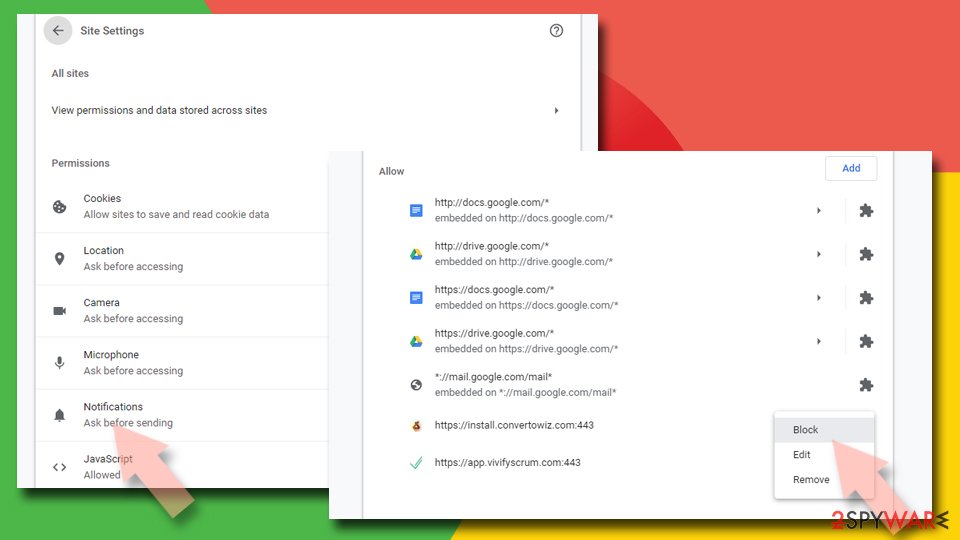
Google Chrome (desktop)
- Open the Google Chrome browser and go to Menu > Settings.
- Scroll down and click on Advanced.
- Locate the Privacy and security section and pick Site Settings > Notifications.
- Look at the Allow section and look for a suspicious URL.
- Click the three vertical dots next to it and pick Block. This should remove unwanted notifications from Google Chrome.

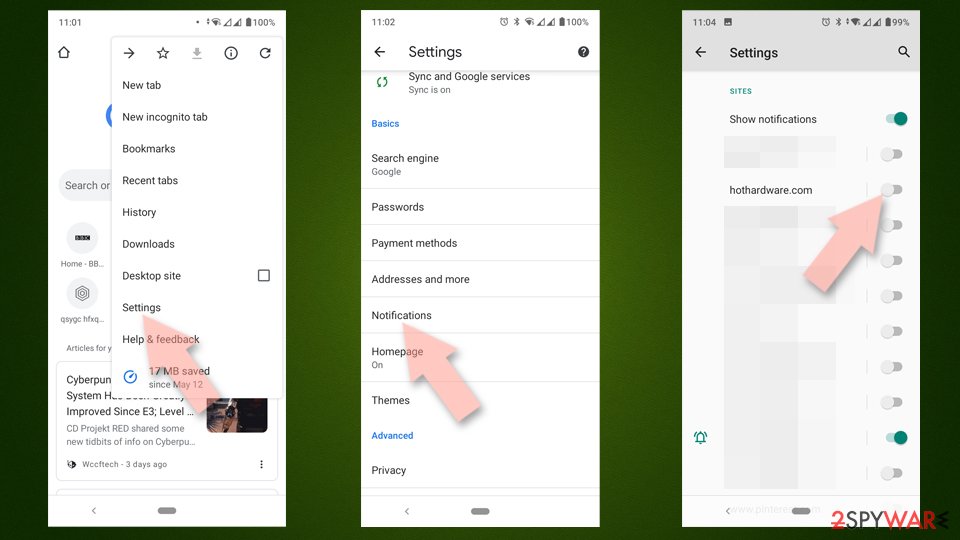
Google Chrome (Android)
- Open Google Chrome and tap on Settings (three vertical dots).
- Select Notifications.
- Scroll down to the Sites section.
- Locate the unwanted URL and toggle the button to the left (Off setting).

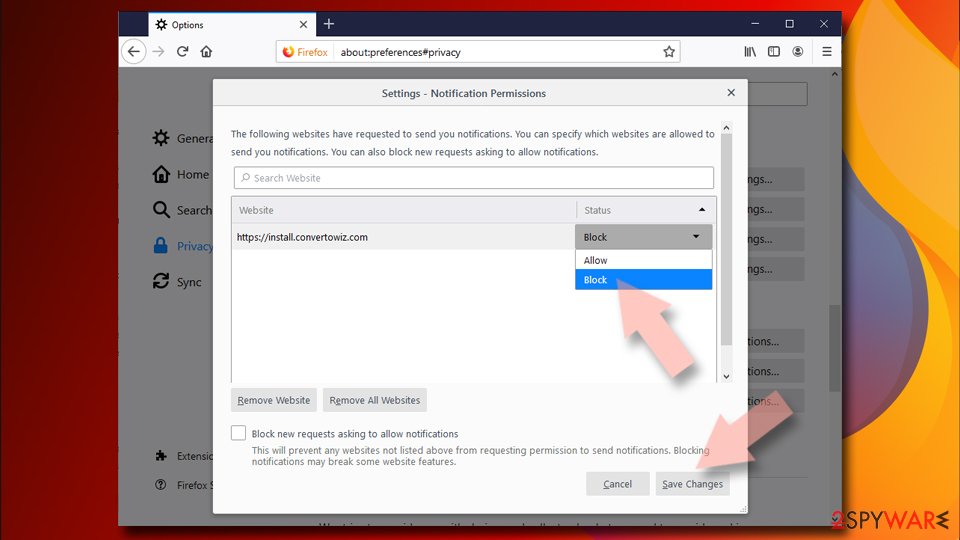
Mozilla Firefox
- Open Mozilla Firefox and go to Menu > Options.
- Click on Privacy & Security section.
- Under Permissions, you should be able to see Notifications. Click the Settings button next to it.
- In the Settings – Notification Permissions window, click on the drop-down menu by the URL in question.
- Select Block and then click on Save Changes. This should remove unwanted notifications from Mozilla Firefox.

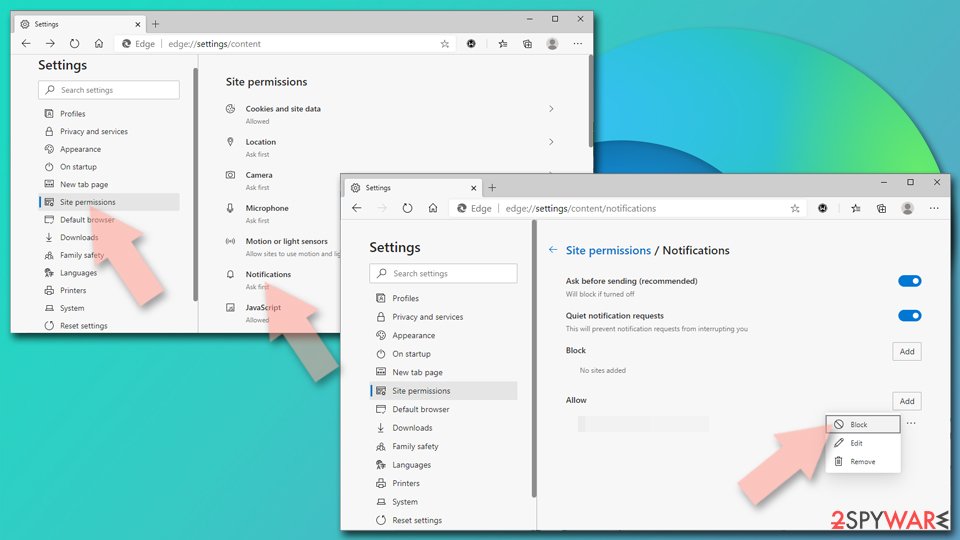
MS Edge (Chromium)
- Open Microsoft Edge, and go to Settings.
- Select Site permissions.
- Go to Notifications on the right.
- Under Allow, you will find the unwanted entry.
- Click on More actions and select Block.

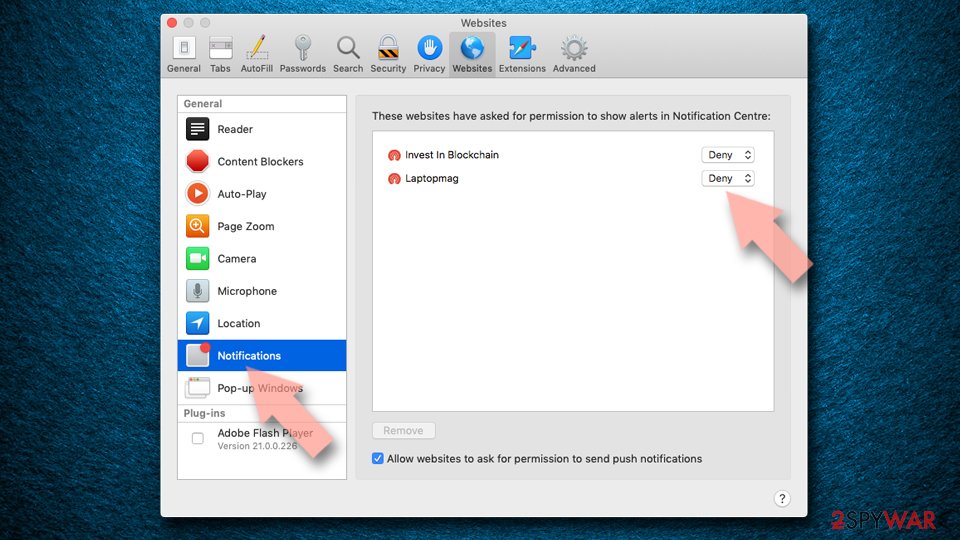
Safari
- Click on Safari > Preferences…
- Go to the Websites tab and, under General, select Notifications.
- Select the web address in question, click the drop-down menu and select Deny.

Internet Explorer
- Open Internet Explorer, and click on the Gear icon at the top-right of the window.
- Select Internet options and go to the Privacy tab.
- In the Pop-up Blocker section, click on Settings.
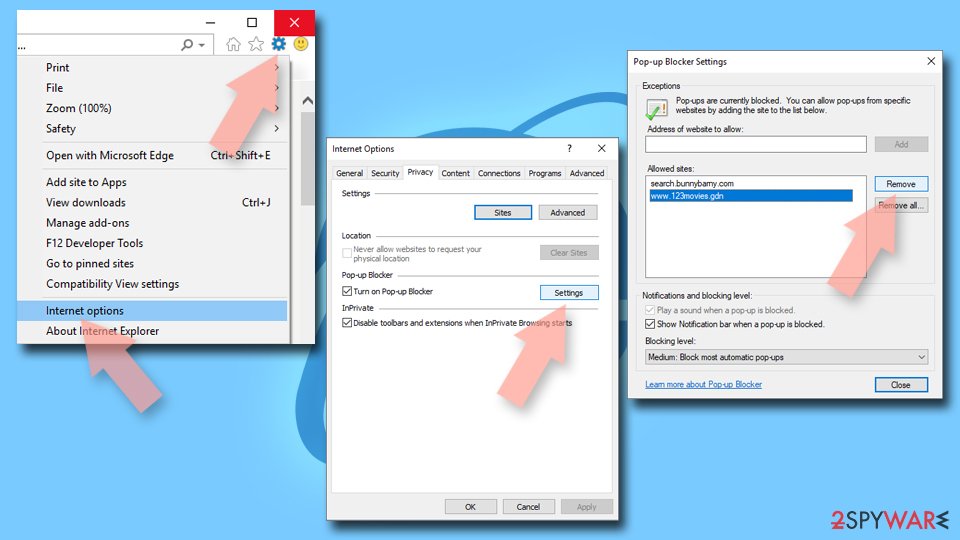
- Locate the web address in question under Allowed sites and pick Remove.

Don't forget to check your system for adware
The Adslivetraining.com push notification spam issue is not caused by a virus but by your permission to show notifications on this particular website. This is precisely why people do not find this activity gone after they perform a full system scan with security software, despite associating intrusive pop-ups with an infection.
However, it is important to realize that adware could be one of the main causes for you seeing suspicious phishing websites in the first place. Adware, which is frequently distributed through deceptive methods like bundling,[3] and other potentially unwanted programs can automatically start up intrusive adverts and reroute users to dangerous websites whenever they access the web.
Thus, if you haven't done so yet, you should go ahead and perform a full system scan with SpyHunterCombo Cleaner or MalwarebytesMalwarebytes. Please check the instructions below if manual adware removal appeals to you more. After virus removal, we also suggest conducting a scan with the FortectIntego repair and maintenance tool, which can repair virus damage, get rid of various browser trackers, and protect your privacy.
Uninstall from Windows
Uninstall from Windows 10/8:
- Type Control Panel into the Windows search box and open the result.
- Under Programs, select Uninstall a program.


Uninstall from Windows 7/XP:
- Click on Windows Start > Control Panel (Windows XP users should click on Add/Remove Programs).
- In Control Panel, select Programs > Uninstall a program.


Remove the unwanted program:
- In the Programs and Features window, look for any recently installed suspicious entries, select them, and click Uninstall.
- If User Account Control appears, click Yes to confirm, then complete the removal.


Delete from macOS
Remove the unwanted application:
- From the menu bar, select Go > Applications.
- In the Applications folder, look for any suspicious entries, then drag them to Trash (or right-click and pick Move to Trash).


Delete leftover files and folders:
- Select Go > Go to Folder.
- Enter /Library/Application Support and remove any suspicious folders related to the unwanted program.
- Repeat the same check in the /Library/LaunchAgents and /Library/LaunchDaemons folders, deleting any suspicious entries.

- Finally, empty the Trash to permanently remove the leftovers.

Remove from Microsoft Edge
Delete unwanted extensions from MS Edge:
- Select Menu (three horizontal dots at the top-right of the browser window) and pick Extensions.
- From the list, pick the extension and click on the Gear icon.
- Click Remove.


Clear cookies and other browser data:
- Click on the Menu (three horizontal dots at the top-right of the browser window) and select Settings > Privacy, search, and services..
- Under Clear browsing data, pick Choose what to clear.
- Select Cookies and other site data and Cached images and files. (apart from passwords, although you might want to include Media licenses as well, if applicable) and click on Clear.


Restore new tab and homepage settings:
- Click the menu icon and choose Settings.
- Then find On startup section.
- Click Remove next to any suspicious startup page.
Reset MS Edge if the above steps did not work:
- Press on Ctrl + Shift + Esc to open Task Manager.
- Click on More details arrow at the bottom of the window.
- Select Details tab.
- Now scroll down and locate every entry with Microsoft Edge name in it. Right-click on each of them and select End Task to stop MS Edge from running.


Instructions for Chromium-based Edge
Delete extensions from MS Edge (Chromium):
- Open Edge and click select Settings > Extensions.
- Delete unwanted extensions by clicking Remove.


Clear cache and site data:
- Click on Menu and go to Settings.
- Select Privacy, search and services.
- Under Clear browsing data, pick Choose what to clear.
- Under Time range, pick All time.
- Select Clear now.


Reset Chromium-based MS Edge:
- Click on Menu and select Settings.
- On the left side, pick Reset settings.
- Select Restore settings to their default values.
- Confirm with Reset.
- This will disable extensions and reset startup pages but will not delete bookmarks, saved passwords, or browsing history.


Remove from Mozilla Firefox (FF)
Remove dangerous extensions:
- Open Mozilla Firefox browser and click on the Menu (three horizontal lines at the top-right of the window).
- Select Add-ons.
- In here, select the unwanted extension and click Remove.


Reset the homepage:
- Click three horizontal lines at the top right corner to open the menu.
- Choose Settings.
- Under Home, set your preferred homepage and new tab settings.
Clear cookies and site data:
- Click Menu and pick Settings.
- Go to Privacy & Security section.
- Scroll down to locate Cookies and Site Data.
- Click on Clear Data...
- Select Cookies and Site Data and Temporary cached files and pages, then click Clear.


Reset Mozilla Firefox
If clearing the browser as explained above did not help, reset Mozilla Firefox:
- Open Mozilla Firefox browser and click the Menu.
- Go to Help and then choose Troubleshooting Information.

- Under Give Firefox a tune up section, click on Refresh Firefox...
- Once the pop-up shows up, confirm the action by pressing on Refresh Firefox.



Remove from Google Chrome
Delete malicious extensions from Google Chrome:
- Open Google Chrome, click on the Menu (three vertical dots at the top-right corner) and select More tools > Extensions.
- In the newly opened window, you will see all the installed extensions. Uninstall all suspicious extensions related to the unwanted program by clicking Remove.


Clear cache and web data from Chrome:
- Click on Menu and pick Settings.
- Under Privacy and security, select Clear browsing data.
- Select Browsing history, Cookies and other site data, as well as Cached images and files.
- Click Clear data.


Change your homepage:
- Click menu and choose Settings.
- Look for a suspicious site in the On startup section.
- Click on Open a specific or set of pages and click on three dots to find the Remove option.
Reset Google Chrome:
If the previous methods did not help you, reset Google Chrome to eliminate all the unwanted components:
- Click on Menu and select Settings.
- In the Settings, scroll down and click Advanced.
- Scroll down and locate Reset and clean up section.
- Now click Restore settings to their original defaults.
- Confirm with Reset settings.


Delete from Safari
Remove dangerous extensions:
- Open Safari, click Safari in the menu at the top-left of the screen, and select Preferences.
- Go to the Extensions tab, look for any suspicious entries, and click Uninstall to remove them.


Clear history and website data:
- Click Safari in the menu and pick Clear History.
- Set Clear to all history and confirm with Clear History.


Reset Safari:
- Click Safari in the menu and select Preferences > Advanced.
- Enable Show Develop menu in menu bar.
- From the menu bar, click Develop and select Empty Caches.


Did this guide help?
Be the first to comment