

How could my computer get infected with Vital Browser Helper?
Vital Browser Helper is spread via bundling method, which allows to pack several programs into one. It is an excellent way to trick PC users – when users download a free program off the web and install it, they usually rush through the installation process in order to finish it faster. Do not make such mistake! On top of that, do not be deceived and do not trust that ”default” or ”standard” installation settings are trustworthy, because these options are exactly the point where you agree to install additional apps. Of course, you will likely won’t be notified about the existence of such bonus apps; so, as a result, you will end up with potentially unwanted programs (PUP) in your system. But there’s a way to avoid such situation, and it takes just a few minutes more. You should opt for ”advanced” or ”custom” installation options instead. In case ads by Vital Browser Helper have already seamlessly invaded your system, you can install an anti-spyware program like FortectIntego, which will clean your system from such computer parasites.
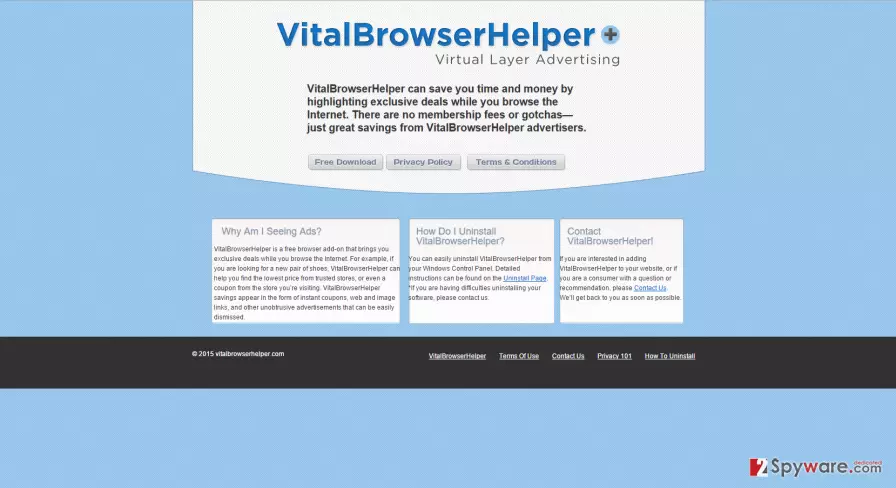
How does Vital Browser Helper present itself and is it a trustworthy application?
The official website of this PUP claims that ”VitalBrowserHelper can save you time and money by highlighting exclusive deals while you browse the Internet […] it is a free browser add-on that brings you exclusive deals while you browse the Internet. For example, if you are looking for a new pair of shoes, VitalBrowserHelper can help you find the lowest price from trusted stores or even a coupon from the store you’re visiting. VitalBrowserHelper savings appear in the form of instant coupons, web and image links” At the first glance, the description sounds appealing and harmless at all – because who doesn’t want to save time and money while shopping, right?
As a matter of fact, our researchers have found some suspicious-sounding statements in the Terms of Use on the official VitalBrowser Helper page, such as: ”company provides the software “as is,” “with all faults,” and without any warranty whatsoever […] the entire risk as to the quality and performance of the content or software is with you […] company is not liable to you or any other person for any incidental, consequential, special, indirect, punitive or exemplary damages, including, without limitation, equipment downtime, loss of data, or lost profits, even if company has been advised of the possibility of such damages.“ Simply said, the company is not reliable for any damages you will experience if you will click on the ads provided by their third-party partners.
What damages can Vital Browser Helper hijack cause to my computer?
Because Vital Browser Helper is sponsored by third-party partners, the aim of this program is to boost their web traffic. In order to do that, VitalBrowserHelper collects non-personal information about you, for example, websites that you visit, your search queries, and so on. Based on this information, this adware selects targeted advertisements for you and show them on your browser’s window. This will cause a slowdown of your computer because these ads demand computer resources to be loaded. More than that, as we have already mentioned, it is very likely that if you click on these advertisements, you may be redirected to questionable websites. Do not trust any ”amazing” and ”free” offers to install updates or programs to your computer. Sometimes even one click is enough to initiate an execution of a malicious program.
How to remove Vital Browser Helper?
If you ar tired of intrusive Vital Browser Helper ads and you wish to get rid of them, there are two ways to uninstall it – you can either do it by yourself, or you can get a reliable anti-malware which will detect and eliminate PUPs from your computer. If you want to do it manually, we have provided detailed instructions on how to remove it below the article. Follow them and you will delete Vital Browser Helper virus for good. And remember – try to be more attentive when you install freeware or shareware!
Uninstall from Windows
Uninstall from Windows 10/8:
- Type Control Panel into the Windows search box and open the result.
- Under Programs, select Uninstall a program.


Uninstall from Windows 7/XP:
- Click on Windows Start > Control Panel (Windows XP users should click on Add/Remove Programs).
- In Control Panel, select Programs > Uninstall a program.


Remove the unwanted program:
- In the Programs and Features window, look for any recently installed suspicious entries, select them, and click Uninstall.
- If User Account Control appears, click Yes to confirm, then complete the removal.


Delete from macOS
Remove the unwanted application:
- From the menu bar, select Go > Applications.
- In the Applications folder, look for any suspicious entries, then drag them to Trash (or right-click and pick Move to Trash).


Delete leftover files and folders:
- Select Go > Go to Folder.
- Enter /Library/Application Support and remove any suspicious folders related to the unwanted program.
- Repeat the same check in the /Library/LaunchAgents and /Library/LaunchDaemons folders, deleting any suspicious entries.

- Finally, empty the Trash to permanently remove the leftovers.

Remove from Microsoft Edge
Delete unwanted extensions from MS Edge:
- Select Menu (three horizontal dots at the top-right of the browser window) and pick Extensions.
- From the list, pick the extension and click on the Gear icon.
- Click Remove.


Clear cookies and other browser data:
- Click on the Menu (three horizontal dots at the top-right of the browser window) and select Settings > Privacy, search, and services..
- Under Clear browsing data, pick Choose what to clear.
- Select Cookies and other site data and Cached images and files. (apart from passwords, although you might want to include Media licenses as well, if applicable) and click on Clear.


Restore new tab and homepage settings:
- Click the menu icon and choose Settings.
- Then find On startup section.
- Click Remove next to any suspicious startup page.
Reset MS Edge if the above steps did not work:
- Press on Ctrl + Shift + Esc to open Task Manager.
- Click on More details arrow at the bottom of the window.
- Select Details tab.
- Now scroll down and locate every entry with Microsoft Edge name in it. Right-click on each of them and select End Task to stop MS Edge from running.


Instructions for Chromium-based Edge
Delete extensions from MS Edge (Chromium):
- Open Edge and click select Settings > Extensions.
- Delete unwanted extensions by clicking Remove.


Clear cache and site data:
- Click on Menu and go to Settings.
- Select Privacy, search and services.
- Under Clear browsing data, pick Choose what to clear.
- Under Time range, pick All time.
- Select Clear now.


Reset Chromium-based MS Edge:
- Click on Menu and select Settings.
- On the left side, pick Reset settings.
- Select Restore settings to their default values.
- Confirm with Reset.
- This will disable extensions and reset startup pages but will not delete bookmarks, saved passwords, or browsing history.


Remove from Mozilla Firefox (FF)
Remove dangerous extensions:
- Open Mozilla Firefox browser and click on the Menu (three horizontal lines at the top-right of the window).
- Select Add-ons.
- In here, select the unwanted extension and click Remove.


Reset the homepage:
- Click three horizontal lines at the top right corner to open the menu.
- Choose Settings.
- Under Home, set your preferred homepage and new tab settings.
Clear cookies and site data:
- Click Menu and pick Settings.
- Go to Privacy & Security section.
- Scroll down to locate Cookies and Site Data.
- Click on Clear Data...
- Select Cookies and Site Data and Temporary cached files and pages, then click Clear.


Reset Mozilla Firefox
If clearing the browser as explained above did not help, reset Mozilla Firefox:
- Open Mozilla Firefox browser and click the Menu.
- Go to Help and then choose Troubleshooting Information.

- Under Give Firefox a tune up section, click on Refresh Firefox...
- Once the pop-up shows up, confirm the action by pressing on Refresh Firefox.



Remove from Google Chrome
Delete malicious extensions from Google Chrome:
- Open Google Chrome, click on the Menu (three vertical dots at the top-right corner) and select More tools > Extensions.
- In the newly opened window, you will see all the installed extensions. Uninstall all suspicious extensions related to the unwanted program by clicking Remove.


Clear cache and web data from Chrome:
- Click on Menu and pick Settings.
- Under Privacy and security, select Clear browsing data.
- Select Browsing history, Cookies and other site data, as well as Cached images and files.
- Click Clear data.


Change your homepage:
- Click menu and choose Settings.
- Look for a suspicious site in the On startup section.
- Click on Open a specific or set of pages and click on three dots to find the Remove option.
Reset Google Chrome:
If the previous methods did not help you, reset Google Chrome to eliminate all the unwanted components:
- Click on Menu and select Settings.
- In the Settings, scroll down and click Advanced.
- Scroll down and locate Reset and clean up section.
- Now click Restore settings to their original defaults.
- Confirm with Reset settings.


Delete from Safari
Remove dangerous extensions:
- Open Safari, click Safari in the menu at the top-left of the screen, and select Preferences.
- Go to the Extensions tab, look for any suspicious entries, and click Uninstall to remove them.


Clear history and website data:
- Click Safari in the menu and pick Clear History.
- Set Clear to all history and confirm with Clear History.


Reset Safari:
- Click Safari in the menu and select Preferences > Advanced.
- Enable Show Develop menu in menu bar.
- From the menu bar, click Develop and select Empty Caches.


Did this guide help?
Be the first to comment