

What kind of application is it and what are Adwaresystemwarning.com ads?
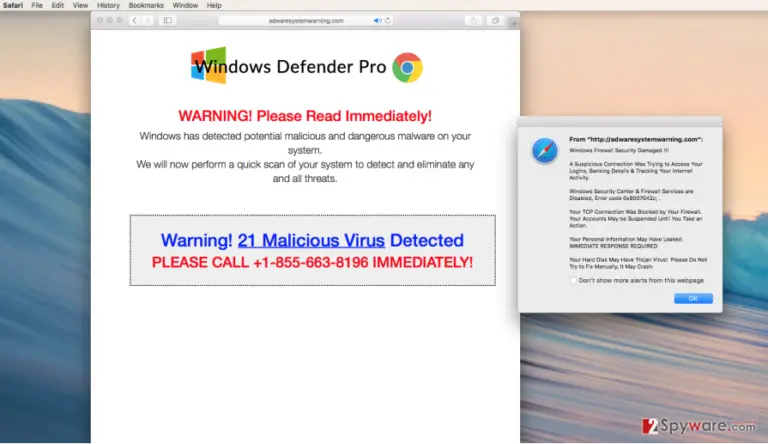
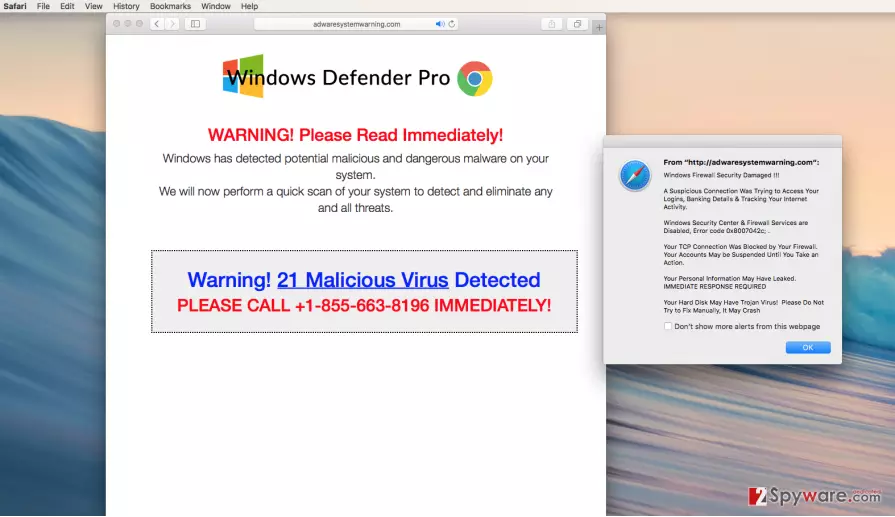
Adwaresystemwarning.com is a rogue application that displays fake and intrusive alert messages stating that a specific number of viruses were found on your computer. Adwaresystemwarning.com site can show up in a pop-up window, which displays such message:
Windows has detected potential malicious and dangerous malware on your system.
We will now perform a quick scan of your system to detect and eliminate any and all threats.
Then it imitates a fake load-up scanning process by “Windows Defender Pro” and generates a pop-up message that claims your Windows Firewall Security has been damaged. No matter how many times you will try to close this pop-up, it will appear again and again. It also tries to frighten you by saying that some cyber-criminals were attempting to access your personal information, banking details, and other sensitive information. It suggests a support number:
+1-855-663-8196
Do NOT call this number. It might be a premium-rate number, which may tear off enormous amounts of money for a single minute of a call. The only mission of this fake support service is to block computer your activities on the web by showing never-ending warning and alert messages and to try to convince you that your computer is badly infected. Do these Internet pop-ups look reliable for you? We highly doubt it. Therefore, you should not believe what they say. If you want to get truthful information about your computer safety level, we recommend to scan it with a trustworthy anti-spyware program, for example, FortectIntego. Proceed to the next paragraph if you want to get to know why these ads by Adwaresystemwarning.com have started to appear on your screen.
How did Adwaresystemwarning.com hijack my computer?
Adwaresystemwarning.com ads and alerts can be tiresome. The good side of these warning messages is that they do not reveal accurate information about your computer security status – Adwaresystemwarning.com scam application displays a random number of “malicious viruses detected,” while in reality the only virus is the Adwaresystemwarning.com adware itself. If you are wondering how this rogue application could enter your computer system, try to remember if you have installed any free programs recently. Commonly free programs contain various attachments, which can include potentially unwanted applications like adware, browser hijackers, and numerous different extensions. It is easy to reject such attachments from installing by selecting Advanced or Custom installation method and deselecting suggestions to install optional apps. Unfortunately, if this Adwaresystemwarning.com virus is already torturing you with annoying pop-ups, proceed to the page 2 and find instructions how to remove it.
FAQ:
Question. How to eliminate these fake computer support messages? It seems impossible to close them. They appear again and again! These pop-up alerts claim to be delivered from Adwaresystemwarning.com page. I believe it is not worth to be trusted. Should I worry about my computer safety or not?
Answer: Adwaresystemwarning.com is a rogue and critical application. Do not believe what its fake alerts say – the support number it provides is only a tool to “legally” steal money from computer users because it is a premium-rate phone number. So if you do not want to receive a huge phone bill at the end of the month, skip this fake support service. As we have already mentioned, you should investigate your system with a reliable anti-spyware software in order to obtain real information whether your computer is infected or not.
As Adwaresystemwarning.com virus clearly has nothing to do on your system, we suggest removing it with the same program that we have recommended. Alternatively, you can uninstall it by using this manual removal guide that we have prepared for you:
Uninstall from Windows
Uninstall from Windows 10/8:
- Type Control Panel into the Windows search box and open the result.
- Under Programs, select Uninstall a program.


Uninstall from Windows 7/XP:
- Click on Windows Start > Control Panel (Windows XP users should click on Add/Remove Programs).
- In Control Panel, select Programs > Uninstall a program.


Remove the unwanted program:
- In the Programs and Features window, look for any recently installed suspicious entries, select them, and click Uninstall.
- If User Account Control appears, click Yes to confirm, then complete the removal.


Delete from macOS
Remove the unwanted application:
- From the menu bar, select Go > Applications.
- In the Applications folder, look for any suspicious entries, then drag them to Trash (or right-click and pick Move to Trash).


Delete leftover files and folders:
- Select Go > Go to Folder.
- Enter /Library/Application Support and remove any suspicious folders related to the unwanted program.
- Repeat the same check in the /Library/LaunchAgents and /Library/LaunchDaemons folders, deleting any suspicious entries.

- Finally, empty the Trash to permanently remove the leftovers.

Remove from Microsoft Edge
Delete unwanted extensions from MS Edge:
- Select Menu (three horizontal dots at the top-right of the browser window) and pick Extensions.
- From the list, pick the extension and click on the Gear icon.
- Click Remove.


Clear cookies and other browser data:
- Click on the Menu (three horizontal dots at the top-right of the browser window) and select Settings > Privacy, search, and services..
- Under Clear browsing data, pick Choose what to clear.
- Select Cookies and other site data and Cached images and files. (apart from passwords, although you might want to include Media licenses as well, if applicable) and click on Clear.


Restore new tab and homepage settings:
- Click the menu icon and choose Settings.
- Then find On startup section.
- Click Remove next to any suspicious startup page.
Reset MS Edge if the above steps did not work:
- Press on Ctrl + Shift + Esc to open Task Manager.
- Click on More details arrow at the bottom of the window.
- Select Details tab.
- Now scroll down and locate every entry with Microsoft Edge name in it. Right-click on each of them and select End Task to stop MS Edge from running.


Instructions for Chromium-based Edge
Delete extensions from MS Edge (Chromium):
- Open Edge and click select Settings > Extensions.
- Delete unwanted extensions by clicking Remove.


Clear cache and site data:
- Click on Menu and go to Settings.
- Select Privacy, search and services.
- Under Clear browsing data, pick Choose what to clear.
- Under Time range, pick All time.
- Select Clear now.


Reset Chromium-based MS Edge:
- Click on Menu and select Settings.
- On the left side, pick Reset settings.
- Select Restore settings to their default values.
- Confirm with Reset.
- This will disable extensions and reset startup pages but will not delete bookmarks, saved passwords, or browsing history.


Remove from Mozilla Firefox (FF)
Remove dangerous extensions:
- Open Mozilla Firefox browser and click on the Menu (three horizontal lines at the top-right of the window).
- Select Add-ons.
- In here, select the unwanted extension and click Remove.


Reset the homepage:
- Click three horizontal lines at the top right corner to open the menu.
- Choose Settings.
- Under Home, set your preferred homepage and new tab settings.
Clear cookies and site data:
- Click Menu and pick Settings.
- Go to Privacy & Security section.
- Scroll down to locate Cookies and Site Data.
- Click on Clear Data...
- Select Cookies and Site Data and Temporary cached files and pages, then click Clear.


Reset Mozilla Firefox
If clearing the browser as explained above did not help, reset Mozilla Firefox:
- Open Mozilla Firefox browser and click the Menu.
- Go to Help and then choose Troubleshooting Information.

- Under Give Firefox a tune up section, click on Refresh Firefox...
- Once the pop-up shows up, confirm the action by pressing on Refresh Firefox.



Remove from Google Chrome
Delete malicious extensions from Google Chrome:
- Open Google Chrome, click on the Menu (three vertical dots at the top-right corner) and select More tools > Extensions.
- In the newly opened window, you will see all the installed extensions. Uninstall all suspicious extensions related to the unwanted program by clicking Remove.


Clear cache and web data from Chrome:
- Click on Menu and pick Settings.
- Under Privacy and security, select Clear browsing data.
- Select Browsing history, Cookies and other site data, as well as Cached images and files.
- Click Clear data.


Change your homepage:
- Click menu and choose Settings.
- Look for a suspicious site in the On startup section.
- Click on Open a specific or set of pages and click on three dots to find the Remove option.
Reset Google Chrome:
If the previous methods did not help you, reset Google Chrome to eliminate all the unwanted components:
- Click on Menu and select Settings.
- In the Settings, scroll down and click Advanced.
- Scroll down and locate Reset and clean up section.
- Now click Restore settings to their original defaults.
- Confirm with Reset settings.


Delete from Safari
Remove dangerous extensions:
- Open Safari, click Safari in the menu at the top-left of the screen, and select Preferences.
- Go to the Extensions tab, look for any suspicious entries, and click Uninstall to remove them.


Clear history and website data:
- Click Safari in the menu and pick Clear History.
- Set Clear to all history and confirm with Clear History.


Reset Safari:
- Click Safari in the menu and select Preferences > Advanced.
- Enable Show Develop menu in menu bar.
- From the menu bar, click Develop and select Empty Caches.


Did this guide help?
4 comments
maddd
scam alerts caused by malware, remove this fake support provider from your address book!!! also uninstall this hoax virus from your computer as well or otherwise it starts to display warning messages over and over again! i know it because i have just uninstalled it. thanks for the removal guide, 2-spyware!
peter
adware?! it is a virus! adware is not THAT annoying as this virus is. I hardly could remove it, so I said screw it and got SpyHunter. My computer is all clean now.
Python
This does not show real computer viruses. I opened my antivirus and scannedthe computer, and there were no viruses except of this program! I deleted it, I believe you sshould do the same
adamkeigh
Was easy to remove, thank you