

Audio To Audio Toolbar – a potentially unwanted program that hijacks your browsers without permission
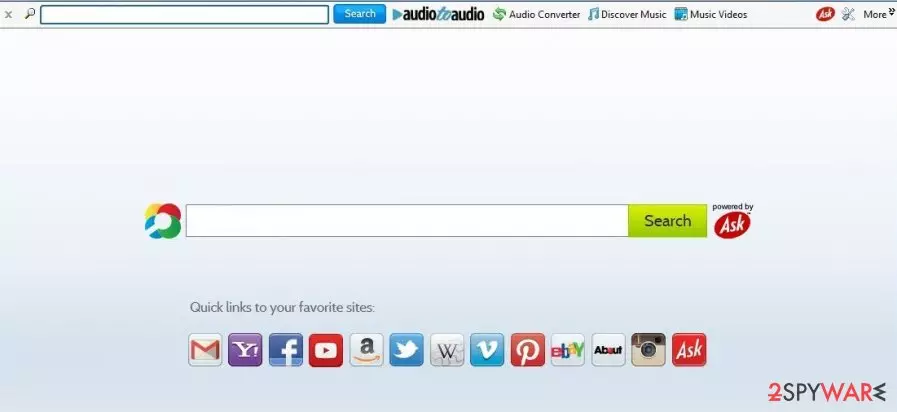
Audio To Audio Toolbar (you can also find it as AudioToAudio Toolbar) is a controversial program, which can surprisingly show up in any web browser, including:
- Google Chrome
- Mozilla Firefox
- MS Edge
- Internet Explorer
- Safari, etc.
In most cases, this program looks like a typical toolbar, which offers improving people's browsing experience. However, you should be very careful with it because it has been noticed that this program promotes third-party links via its search engine (Ask Search).
First of all, you should be aware that Audio To Audio Toolbar may alter your start page and the default search engine and set it to a customized Ask Search version (for example, search.myway.com). Besides, it may initiate browser's redirects to its affiliate websites by showing altered search results or by showing commercial ads once people start searching the web. This quote from this software's Terms of Use:
MS Products may provide access to search results or other links to Third Party Partner websites or resources. […]
You hereby acknowledge and agree that by using an MS Product you may be exposed to Content that may be offensive, indecent or objectionable in your community. […]
MS Products are exposed to various security issues, and should be regarded as unsecure. By accepting this Agreement, you acknowledge and accept that the MS Products and any information you download or offer to share by means of an MS Product, may be exposed to unauthorized access, interception, corruption, damage or misuse, and should be regarded as insecure. You accept all responsibility for such security risks and any damage resulting therefrom.
Please, be careful with Audio To Audio Toolbar because you can never know what websites it promotes. While some of the websites are safe, some can be filled with questionable or even unsafe content, and that is why security experts recommend not to browse through such sites.
Finally, this program may simply start collecting information about your browsing habits. Such information includes:
- search terms,
- mostly visited websites,
- IP address and other technical data
- installed apps
- approximate location, and similar information.
It is important to note that such data might be not only tracked and collected, but also shared with partners and unknown third parties. Therefore, if you value your privacy, you should uninstall FunWebProducts from your device as soon as possible.
Install new apps attentively to avoid PUPs
Audio To Audio Toolbar can be downloaded from the Internet just like any other toolbar. Its download link can be found on its official website, also on CNET, Brothersoft, Softonic and other legitimate download websites.
However, we have already warned you about its suspicious activities that should make you think twice before installing it. Besides, it has been revealed that it can also be installed on your machine in a bundle with freeware and shareware.
The MS Products may integrate, be integrated into, bundled, or be provided in connection with third-party services, feeds, and/or content.
To avoid installing this app, you should spend more time on freeware's installation and carefully monitor this process. For that, we recommend choosing Custom or Advanced installation. If Audio To Audio Toolbar manages to enter the system, it initiates several changes in system settings and starts interrupting into people's browsing. We highly recommend avoiding such programs and removing them from the system.
Recently, the developer of this program contacted us asking us to remove this post from the 2-spyware.com website. We believe that we shouldn't do that as long as our instructions help users to remove Audio To Audio Toolbar from their systems if they desire to do so.
Nevertheless, we have recently decided to make a revision of this and other posts that are related to this developer. We claim that all of them are described properly.
Delete FunWebProducts from your computer
While potentially unwanted programs such as browser hijackers or adware are generally not considered malicious by security experts, they are generally useless and often fail to fulfill the promised functions and features. Therefore, there is no need to consider whether to perform FunWebProducts removal or not.
There are two ways you can uninstall potentially unwanted applications from your system:
- scan your device with powerful anti-malware
- use the instructions below for manual elimination.
However, possibly the best way to remove FunWebProducts is by combining both methods. Ensure you clean all the web browsers properly – eliminate all the suspicious extensions and clear web data. A full system scan with anti-malware can guarantee that your machine is protected and virus-free.
Uninstall from Windows
Uninstall from Windows 10/8:
- Type Control Panel into the Windows search box and open the result.
- Under Programs, select Uninstall a program.


Uninstall from Windows 7/XP:
- Click on Windows Start > Control Panel (Windows XP users should click on Add/Remove Programs).
- In Control Panel, select Programs > Uninstall a program.


Remove the unwanted program:
- In the Programs and Features window, look for any recently installed suspicious entries, select them, and click Uninstall.
- If User Account Control appears, click Yes to confirm, then complete the removal.


Delete from macOS
Remove the unwanted application:
- From the menu bar, select Go > Applications.
- In the Applications folder, look for any suspicious entries, then drag them to Trash (or right-click and pick Move to Trash).


Delete leftover files and folders:
- Select Go > Go to Folder.
- Enter /Library/Application Support and remove any suspicious folders related to the unwanted program.
- Repeat the same check in the /Library/LaunchAgents and /Library/LaunchDaemons folders, deleting any suspicious entries.

- Finally, empty the Trash to permanently remove the leftovers.

Reset Internet Explorer
Remove dangerous add-ons:
- Open Internet Explorer, click on the Gear icon (IE menu) on the top-right corner of the browser
- Pick Manage Add-ons.
- You will see a Manage Add-ons window. Here, look for suspicious plugins. Click on these entries and select Disable.


Change your homepage if it was altered:
- Open IE and click on the Gear icon.
- Select Internet Options.
- In the General tab, delete the Home page address and replace it by your preferred one (for example, Google.com).
- Click Apply and then select OK.


Delete temporary files:
- Press on the Gear icon and select Internet Options.
- Under Browsing history, click Delete...
- Select relevant fields and press Delete.


Reset Internet Explorer:
- Click on Gear icon > Internet options and select Advanced tab.
- Select Reset.
- In the new window, check Delete personal settings and select Reset.


Remove from Microsoft Edge
Delete unwanted extensions from MS Edge:
- Select Menu (three horizontal dots at the top-right of the browser window) and pick Extensions.
- From the list, pick the extension and click on the Gear icon.
- Click Remove.


Clear cookies and other browser data:
- Click on the Menu (three horizontal dots at the top-right of the browser window) and select Settings > Privacy, search, and services..
- Under Clear browsing data, pick Choose what to clear.
- Select Cookies and other site data and Cached images and files. (apart from passwords, although you might want to include Media licenses as well, if applicable) and click on Clear.


Restore new tab and homepage settings:
- Click the menu icon and choose Settings.
- Then find On startup section.
- Click Remove next to any suspicious startup page.
Reset MS Edge if the above steps did not work:
- Press on Ctrl + Shift + Esc to open Task Manager.
- Click on More details arrow at the bottom of the window.
- Select Details tab.
- Now scroll down and locate every entry with Microsoft Edge name in it. Right-click on each of them and select End Task to stop MS Edge from running.


Instructions for Chromium-based Edge
Delete extensions from MS Edge (Chromium):
- Open Edge and click select Settings > Extensions.
- Delete unwanted extensions by clicking Remove.


Clear cache and site data:
- Click on Menu and go to Settings.
- Select Privacy, search and services.
- Under Clear browsing data, pick Choose what to clear.
- Under Time range, pick All time.
- Select Clear now.


Reset Chromium-based MS Edge:
- Click on Menu and select Settings.
- On the left side, pick Reset settings.
- Select Restore settings to their default values.
- Confirm with Reset.
- This will disable extensions and reset startup pages but will not delete bookmarks, saved passwords, or browsing history.


Remove from Mozilla Firefox (FF)
Remove dangerous extensions:
- Open Mozilla Firefox browser and click on the Menu (three horizontal lines at the top-right of the window).
- Select Add-ons.
- In here, select the unwanted extension and click Remove.


Reset the homepage:
- Click three horizontal lines at the top right corner to open the menu.
- Choose Settings.
- Under Home, set your preferred homepage and new tab settings.
Clear cookies and site data:
- Click Menu and pick Settings.
- Go to Privacy & Security section.
- Scroll down to locate Cookies and Site Data.
- Click on Clear Data...
- Select Cookies and Site Data and Temporary cached files and pages, then click Clear.


Reset Mozilla Firefox
If clearing the browser as explained above did not help, reset Mozilla Firefox:
- Open Mozilla Firefox browser and click the Menu.
- Go to Help and then choose Troubleshooting Information.

- Under Give Firefox a tune up section, click on Refresh Firefox...
- Once the pop-up shows up, confirm the action by pressing on Refresh Firefox.



Remove from Google Chrome
Delete malicious extensions from Google Chrome:
- Open Google Chrome, click on the Menu (three vertical dots at the top-right corner) and select More tools > Extensions.
- In the newly opened window, you will see all the installed extensions. Uninstall all suspicious extensions related to the unwanted program by clicking Remove.


Clear cache and web data from Chrome:
- Click on Menu and pick Settings.
- Under Privacy and security, select Clear browsing data.
- Select Browsing history, Cookies and other site data, as well as Cached images and files.
- Click Clear data.


Change your homepage:
- Click menu and choose Settings.
- Look for a suspicious site in the On startup section.
- Click on Open a specific or set of pages and click on three dots to find the Remove option.
Reset Google Chrome:
If the previous methods did not help you, reset Google Chrome to eliminate all the unwanted components:
- Click on Menu and select Settings.
- In the Settings, scroll down and click Advanced.
- Scroll down and locate Reset and clean up section.
- Now click Restore settings to their original defaults.
- Confirm with Reset settings.


Delete from Safari
Remove dangerous extensions:
- Open Safari, click Safari in the menu at the top-left of the screen, and select Preferences.
- Go to the Extensions tab, look for any suspicious entries, and click Uninstall to remove them.


Clear history and website data:
- Click Safari in the menu and pick Clear History.
- Set Clear to all history and confirm with Clear History.


Reset Safari:
- Click Safari in the menu and select Preferences > Advanced.
- Enable Show Develop menu in menu bar.
- From the menu bar, click Develop and select Empty Caches.


Did this guide help?
1 comment
Bill
I have looked in Unistall programs and could not find a listing for Audio to Audio or anything installed on the date it downloaded it. I think this version is embedded in the browser. Are you aware of a newer version?
Now what? You might need to update this removal procedure!