

Bestsearch-online.com is a questionable search engine that aims to control what users see
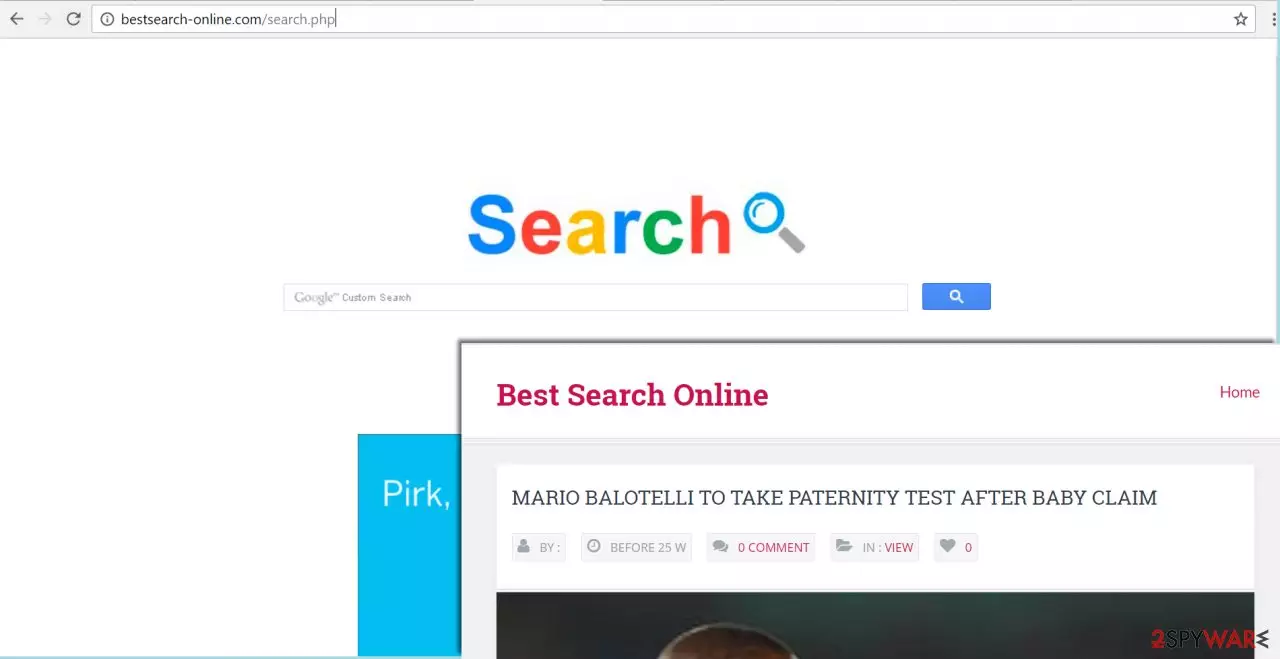
Bestsearch-online.com virus is a browser hijacker[1] that sneaks inside computers secretly, takes over all installed web browsers, and starts unwanted activities. First of all, it modifies browsers’ settings and changes homepage, default search engine, and sometimes new tab’s URL to its domain – Bestsearch-online.com/search.php. Every time users launch the browser this bogus search engine appears on the screen.
At first, it might look similar to Google; however, they have nothing in common. The hijacker alters search results and includes suspicious third-party links instead of organic and relevant results. This activity is beneficial for the developers because they generate revenue from boosting traffic to the various websites; however, users might end up with unpleasant consequences.
| Name | Bestsearch-online.com |
|---|---|
| Type | Browser hijacker, potentially unwanted application |
| Problems | The system gets affected by the PUP and speed significantly suffers |
| Distribution | Other programs can lead to the installation of such an intruder. Deceptive content, torrent sites, and software bundling also responsible for the distribution of such threats |
| Elimination | Your machine requires a proper system scan to find all pieces of the unwanted application |
| Recovery | Running the tool like FortectIntego can help fix virus damage and repair functions of the machine |
Clicking on these search results can take users to hazardous places on the Internet, where they might be offered to install some freeware or shareware, asked for some personal or private information, and so on. Bestsearch-online.com redirect issues are really concerning because you might accidentally meet malware, ransomware[2], Trojan horse[3], or lose personal details, such as bank logins or credit card information. Besides, it can also initiate sudden and unexpected redirects to the shady promotional website. If you ever end up on a suspicious site, leave it immediately.
Another drawback of this browser hijacker is that it continuously collects certain information about you. It does not track personal data[4] such as your full name and surname unless you willingly provide it to it, but it can dig out a lot of important information such as your IP address, geolocation of the device that is infected with it, your browsing history, search queries, technical information and more.
Such data is used to select certain third-party links and ads to integrate within search results. If your privacy and safety mean something to you, better remove the Bestsearch-online.com virus without hesitation. This vague program hardly deserves your trust. For the malware termination, it’s better to use an automatic spyware removal tool like SpyHunterCombo Cleaner, MalwarebytesMalwarebytes, but of course, you can opt for the manual removal option and delete it by yourself.
Information about hijacker’s distribution technique
The fact of a hijack usually surprises computer users; however, what more surprises that it almost always happens with users’ permissions. The fact is, browser hijackers are technically not viruses, and they are even identified as legitimate programs. Well, at least the vast majority of them are.
Therefore, to categorize them, spyware and malware researchers can only use the term “potentially unwanted programs.” However, the activity of such programs is highly disturbing, so we believe that all computer users deserve to know that it only takes a minute or so to ensure that browser hijackers and similar potentially unwanted programs don’t get into the system.
You only need to read feedback about programs that you’re planning to install beforehand and choose Custom or Advanced settings when installing them. This setup will provide you with a list of suggested software that can be installed along with your preferred program. Deselect these offers and continue[5].
Bestsearch-online.com virus removal options
Browser hijackers are small, but very annoying pieces of software that can disrupt browsing sessions on a daily basis. Such activity is nerve-wracking, and usually, computer users wish to get rid of such programs as soon as possible. If you want to remove the infection the fastest way possible, use anti-malware software.
Your chosen professional program eliminates this computer infection within several seconds, and you will be able to enjoy browsing the Internet again. Additionally, you can get rid of the hijacker on your own. If you would like to carry out Bestsearch-online.com removal on your own, please use the instructions that our team has written for you. These are presented below.
Uninstall from Windows
Uninstall from Windows 10/8:
- Type Control Panel into the Windows search box and open the result.
- Under Programs, select Uninstall a program.


Uninstall from Windows 7/XP:
- Click on Windows Start > Control Panel (Windows XP users should click on Add/Remove Programs).
- In Control Panel, select Programs > Uninstall a program.


Remove the unwanted program:
- In the Programs and Features window, look for any recently installed suspicious entries, select them, and click Uninstall.
- If User Account Control appears, click Yes to confirm, then complete the removal.


Delete from macOS
Remove the unwanted application:
- From the menu bar, select Go > Applications.
- In the Applications folder, look for any suspicious entries, then drag them to Trash (or right-click and pick Move to Trash).


Delete leftover files and folders:
- Select Go > Go to Folder.
- Enter /Library/Application Support and remove any suspicious folders related to the unwanted program.
- Repeat the same check in the /Library/LaunchAgents and /Library/LaunchDaemons folders, deleting any suspicious entries.

- Finally, empty the Trash to permanently remove the leftovers.

Remove from Microsoft Edge
Delete unwanted extensions from MS Edge:
- Select Menu (three horizontal dots at the top-right of the browser window) and pick Extensions.
- From the list, pick the extension and click on the Gear icon.
- Click Remove.


Clear cookies and other browser data:
- Click on the Menu (three horizontal dots at the top-right of the browser window) and select Settings > Privacy, search, and services..
- Under Clear browsing data, pick Choose what to clear.
- Select Cookies and other site data and Cached images and files. (apart from passwords, although you might want to include Media licenses as well, if applicable) and click on Clear.


Restore new tab and homepage settings:
- Click the menu icon and choose Settings.
- Then find On startup section.
- Click Remove next to any suspicious startup page.
Reset MS Edge if the above steps did not work:
- Press on Ctrl + Shift + Esc to open Task Manager.
- Click on More details arrow at the bottom of the window.
- Select Details tab.
- Now scroll down and locate every entry with Microsoft Edge name in it. Right-click on each of them and select End Task to stop MS Edge from running.


Instructions for Chromium-based Edge
Delete extensions from MS Edge (Chromium):
- Open Edge and click select Settings > Extensions.
- Delete unwanted extensions by clicking Remove.


Clear cache and site data:
- Click on Menu and go to Settings.
- Select Privacy, search and services.
- Under Clear browsing data, pick Choose what to clear.
- Under Time range, pick All time.
- Select Clear now.


Reset Chromium-based MS Edge:
- Click on Menu and select Settings.
- On the left side, pick Reset settings.
- Select Restore settings to their default values.
- Confirm with Reset.
- This will disable extensions and reset startup pages but will not delete bookmarks, saved passwords, or browsing history.


Remove from Mozilla Firefox (FF)
Remove dangerous extensions:
- Open Mozilla Firefox browser and click on the Menu (three horizontal lines at the top-right of the window).
- Select Add-ons.
- In here, select the unwanted extension and click Remove.


Reset the homepage:
- Click three horizontal lines at the top right corner to open the menu.
- Choose Settings.
- Under Home, set your preferred homepage and new tab settings.
Clear cookies and site data:
- Click Menu and pick Settings.
- Go to Privacy & Security section.
- Scroll down to locate Cookies and Site Data.
- Click on Clear Data...
- Select Cookies and Site Data and Temporary cached files and pages, then click Clear.


Reset Mozilla Firefox
If clearing the browser as explained above did not help, reset Mozilla Firefox:
- Open Mozilla Firefox browser and click the Menu.
- Go to Help and then choose Troubleshooting Information.

- Under Give Firefox a tune up section, click on Refresh Firefox...
- Once the pop-up shows up, confirm the action by pressing on Refresh Firefox.



Remove from Google Chrome
Delete malicious extensions from Google Chrome:
- Open Google Chrome, click on the Menu (three vertical dots at the top-right corner) and select More tools > Extensions.
- In the newly opened window, you will see all the installed extensions. Uninstall all suspicious extensions related to the unwanted program by clicking Remove.


Clear cache and web data from Chrome:
- Click on Menu and pick Settings.
- Under Privacy and security, select Clear browsing data.
- Select Browsing history, Cookies and other site data, as well as Cached images and files.
- Click Clear data.


Change your homepage:
- Click menu and choose Settings.
- Look for a suspicious site in the On startup section.
- Click on Open a specific or set of pages and click on three dots to find the Remove option.
Reset Google Chrome:
If the previous methods did not help you, reset Google Chrome to eliminate all the unwanted components:
- Click on Menu and select Settings.
- In the Settings, scroll down and click Advanced.
- Scroll down and locate Reset and clean up section.
- Now click Restore settings to their original defaults.
- Confirm with Reset settings.


Delete from Safari
Remove dangerous extensions:
- Open Safari, click Safari in the menu at the top-left of the screen, and select Preferences.
- Go to the Extensions tab, look for any suspicious entries, and click Uninstall to remove them.


Clear history and website data:
- Click Safari in the menu and pick Clear History.
- Set Clear to all history and confirm with Clear History.


Reset Safari:
- Click Safari in the menu and select Preferences > Advanced.
- Enable Show Develop menu in menu bar.
- From the menu bar, click Develop and select Empty Caches.


Did this guide help?
4 comments
Marvellous
Deceptive search engine... don t use it, I warn you...
vidmantU
helo and thanks for the halp, I have removd virus from computah and browsers real quick...
Derreck
This is totally not the best search online. Its the worstsearch-online.com virus!
borris
Good guide! :)