

Eaes.2track.info is a malicious website that displays porn and malicious content to users
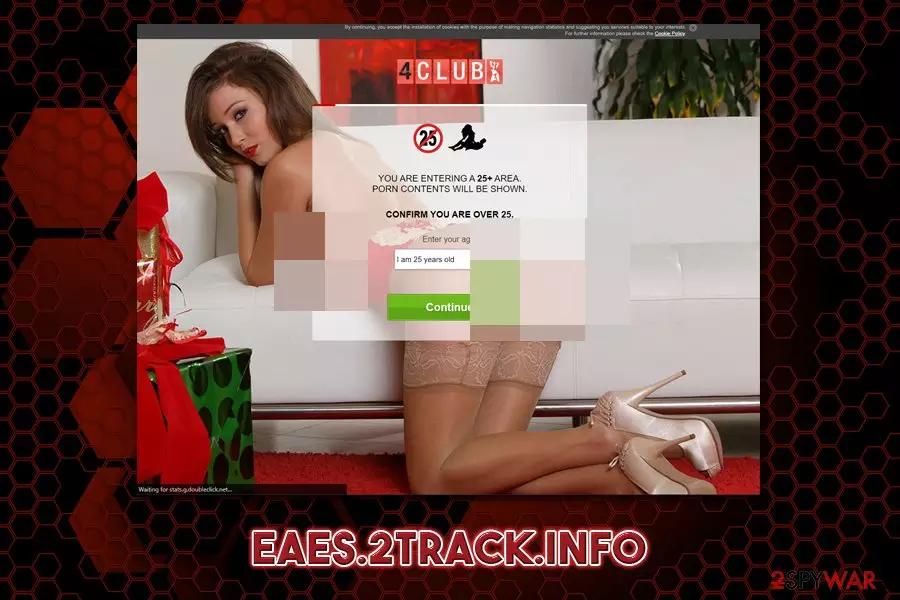
Eaes.2track.info is a website of dubious content that users can encounter at any time during their web browsing sessions. While this activity might not be caused by a browser or computer infection, in most cases, the unwanted activity is related to a browser extension called Auto Refresh. If that is the case, even a browser reset will not help users to get rid of Eaes.2track.info redirects, as all the add-ons are installed on the browser automatically as soon as Google Account is connected.
In most cases, potentially unwanted programs are distributed via deceptive ways, such as software bundle packages or fake Flash Player update prompts.[1] Once installed, the app hijacks the web browser by changing its settings, as well as appending a malicious extension. Soon after that, the Eaes.2track.info virus begins to deliver unwanted ads, such as pop-ups, in-text links, banners, deals, and redirects. To make matters worse, some of the potentially unwanted apps are capable of collecting a variety of personal information and selling it to third-parties.
| Name | Eaes.2track.info |
| Type | Adware, redirect virus, potentially unwanted programs |
| Related | Auto Refresh, Riskware.bit.coin.miner |
| Distribution | Potentially unwanted applications can be downloaded on various websites intentionally, while in most cases users install them via software bundle packages or fake Flash update prompts |
| Symptoms | Symptoms may vary depending on the extension/application that is causing the unwanted behavior. However, users can often frequent redirects to the Eaes.2track.info, which leads to porn sites, increased amounts of ads, changed homepage and new tab URL, etc. |
| Risks | Browser redirects are extremely dangerous as they can lead to malware-laden, scam, and inappropriate websites. As a result, users might infect their machine with malicious software, disclose sensitive information (credit card details, logins, etc.) to cybercriminals, suffer financial losses or identity theft |
| Removal | To stop the redirects, you have to eliminate potentially unwanted program installed on your computer or web browser – you can either do it manually or automatically – check the instructions below |
| Fix | Virus damage fix can be performed with tools like FortectIntego |
There are hundreds of thousands of malicious websites around, and Eaes.2track.info is one of them. In most cases, such sites are compiled to provide monetary benefits for certain parties, e.g., the developers of Auto Refresh browser extension. Each time users click on sponsored links, download and install applications (that might also be malicious), profits are gained.
However, quite often, shady extensions or applications choose advertising campaigns that are not safe, hence how users end up seeing Eaes.2track.info ads and redirects. In any case, the website uses X-rated material that is inappropriate to certain age groups and can be offensive. Therefore, it is important to make sure that unwanted browser behavior is stopped on time.
In most cases, malicious apps that bring users to Eaes.2track.info are installed behind the back, during the installation of freeware applications downloaded from third-party websites. Also, many might install apps like AutoRefresh for their functionality, i.e., website refresh function that can be set to occur at certain intervals. In many cases, such browser extensions operate without causing any troubles for users, although bad behavior can start seemingly out of nowhere.
This usually comes down to decisions that the developers of the app make, especially when it comes to the advertising networks that are related to it. As a result, users might experience abrupt redirects to Eaes.2track.info and similar sites, all while thinking that they did not install any new applications.
As soon as the Eaes.2track.info virus gets on the system, it changes web browser settings of Google Chrome, Mozilla Firefox, MS Edge, Safari, or another web browser. While symptoms of the infection may vary, most commonly experienced signs include:
- Redirects to Eaes.2track.info and similar malicious sites;
- Changed new tab and homepage URL of the web browser;
- Sponsored search results in search results;
- Slower operation of the web browser;
- Inability to access certain websites via the web browser, etc.
Unfortunately, many of the potentially unwanted programs that are related to Eaes.2track.info are related to malicious behavior, such as information recording and sharing it with third-parties for profits. While in most cases, the recorded data includes IP addresses, geo-locations, browser information, timestamps, visited websites, bookmarks, and other non personally identifiable information, some malicious apps record names, emails, passwords, login credentials, etc. As a result, users might end up suffering from such consequences as financial losses and identity theft.

If you wonder how to remove Eaes.2track.info from your web browser, you should uninstall a potentially unwanted program that is associated with the redirects. As mentioned before, the suspicious browser extension is the most likely culprit, although programs installed on the system can also be the cause.
Eaes.2track.info removal from Chrome or another browser highly depends on which application is causing unwanted browser behavior. You can uninstall extensions easily by right-clicking on them. However, some malicious apps use various persistence techniques that prevent users from uninstalling them. In such a case, you can reset the web browser or employ powerful anti-malware software that would find and eliminate all the PUPs, malware, and the leftover components. Finally, we recommend using FortectIntego to keep your system running smoothly after the infection.
Potentially unwanted programs clutter your computer and browser – avoid them at all costs
Potentially unwanted programs are very sneaky and can range from completely harmless to those that are trying to extort money or sell their private data to third-parties. Besides, some can use various mechanisms to prevent users from removing them from the system in usual ways. In other words, some PUPs resemble malware more closely and can seriously compromise users' online safety, making the machine more prone to more serious infections.
While it is best to stay away from third-party programs, many can be really useful and help users customize web browsing experience, making it more convenient. In some cases, however, these apps tend to cause harm and barely provide any benefits. Security experts from dieviren.de[2] provide the following tips that could help you to stay away from potentially dangerous applications that would clutter your machine:
- Install security software that would warn you about potentially unwanted programs;
- If possible, only download apps from official sources such as Microsoft Store (although you should still be careful, as malicious apps managed to slip past built-in Google's defenses many times before they were pulled out);[3]
- Before downloading apps from third-parties, find forum posts, blogs, articles, and other information that would help you decide whether the app is trustworthy;
- During the installation process, ensure that Privacy Policy and ToS are provided;
- When prompted, pick Advanced/Custom settings instead of Recommended/Quick ones;
- Remove ticks from pre-ticked boxes and watch out of misplaced buttons and other tricks.
Get rid of Eaes.2track.info redirects
As previously mentioned, Eaes.2track.info removal might differ, as the related application might be installed on Mac or Windows computer, or be attached as an extension to the web browser. Since the situation can differ to each individual, we first recommend checking your browser for unwanted extensions – get rid of Auto Refresh and everything else that you do not recognize or find suspicious.

However, if Eaes.2track.info virus redirects continue, you must investigate further. There is a high chance that your machine is actually infected with the malicious program – you can use our manual instructions provided below or scanning the device with security software that is set to recognize PUPs.
Finally, we also provide the instructions on how to reset all the installed browsers – sometimes, it might be the only way to remove Eaes.2track.info completely.
Uninstall from Windows
Uninstall from Windows 10/8:
- Type Control Panel into the Windows search box and open the result.
- Under Programs, select Uninstall a program.


Uninstall from Windows 7/XP:
- Click on Windows Start > Control Panel (Windows XP users should click on Add/Remove Programs).
- In Control Panel, select Programs > Uninstall a program.


Remove the unwanted program:
- In the Programs and Features window, look for any recently installed suspicious entries, select them, and click Uninstall.
- If User Account Control appears, click Yes to confirm, then complete the removal.


Delete from macOS
Remove the unwanted application:
- From the menu bar, select Go > Applications.
- In the Applications folder, look for any suspicious entries, then drag them to Trash (or right-click and pick Move to Trash).


Delete leftover files and folders:
- Select Go > Go to Folder.
- Enter /Library/Application Support and remove any suspicious folders related to the unwanted program.
- Repeat the same check in the /Library/LaunchAgents and /Library/LaunchDaemons folders, deleting any suspicious entries.

- Finally, empty the Trash to permanently remove the leftovers.

Reset Internet Explorer
Remove dangerous add-ons:
- Open Internet Explorer, click on the Gear icon (IE menu) on the top-right corner of the browser
- Pick Manage Add-ons.
- You will see a Manage Add-ons window. Here, look for suspicious plugins. Click on these entries and select Disable.


Change your homepage if it was altered:
- Open IE and click on the Gear icon.
- Select Internet Options.
- In the General tab, delete the Home page address and replace it by your preferred one (for example, Google.com).
- Click Apply and then select OK.


Delete temporary files:
- Press on the Gear icon and select Internet Options.
- Under Browsing history, click Delete...
- Select relevant fields and press Delete.


Reset Internet Explorer:
- Click on Gear icon > Internet options and select Advanced tab.
- Select Reset.
- In the new window, check Delete personal settings and select Reset.


Remove from Microsoft Edge
Delete unwanted extensions from MS Edge:
- Select Menu (three horizontal dots at the top-right of the browser window) and pick Extensions.
- From the list, pick the extension and click on the Gear icon.
- Click Remove.


Clear cookies and other browser data:
- Click on the Menu (three horizontal dots at the top-right of the browser window) and select Settings > Privacy, search, and services..
- Under Clear browsing data, pick Choose what to clear.
- Select Cookies and other site data and Cached images and files. (apart from passwords, although you might want to include Media licenses as well, if applicable) and click on Clear.


Restore new tab and homepage settings:
- Click the menu icon and choose Settings.
- Then find On startup section.
- Click Remove next to any suspicious startup page.
Reset MS Edge if the above steps did not work:
- Press on Ctrl + Shift + Esc to open Task Manager.
- Click on More details arrow at the bottom of the window.
- Select Details tab.
- Now scroll down and locate every entry with Microsoft Edge name in it. Right-click on each of them and select End Task to stop MS Edge from running.


Instructions for Chromium-based Edge
Delete extensions from MS Edge (Chromium):
- Open Edge and click select Settings > Extensions.
- Delete unwanted extensions by clicking Remove.


Clear cache and site data:
- Click on Menu and go to Settings.
- Select Privacy, search and services.
- Under Clear browsing data, pick Choose what to clear.
- Under Time range, pick All time.
- Select Clear now.


Reset Chromium-based MS Edge:
- Click on Menu and select Settings.
- On the left side, pick Reset settings.
- Select Restore settings to their default values.
- Confirm with Reset.
- This will disable extensions and reset startup pages but will not delete bookmarks, saved passwords, or browsing history.


Remove from Mozilla Firefox (FF)
Remove dangerous extensions:
- Open Mozilla Firefox browser and click on the Menu (three horizontal lines at the top-right of the window).
- Select Add-ons.
- In here, select the unwanted extension and click Remove.


Reset the homepage:
- Click three horizontal lines at the top right corner to open the menu.
- Choose Settings.
- Under Home, set your preferred homepage and new tab settings.
Clear cookies and site data:
- Click Menu and pick Settings.
- Go to Privacy & Security section.
- Scroll down to locate Cookies and Site Data.
- Click on Clear Data...
- Select Cookies and Site Data and Temporary cached files and pages, then click Clear.


Reset Mozilla Firefox
If clearing the browser as explained above did not help, reset Mozilla Firefox:
- Open Mozilla Firefox browser and click the Menu.
- Go to Help and then choose Troubleshooting Information.

- Under Give Firefox a tune up section, click on Refresh Firefox...
- Once the pop-up shows up, confirm the action by pressing on Refresh Firefox.



Remove from Google Chrome
Delete malicious extensions from Google Chrome:
- Open Google Chrome, click on the Menu (three vertical dots at the top-right corner) and select More tools > Extensions.
- In the newly opened window, you will see all the installed extensions. Uninstall all suspicious extensions related to the unwanted program by clicking Remove.


Clear cache and web data from Chrome:
- Click on Menu and pick Settings.
- Under Privacy and security, select Clear browsing data.
- Select Browsing history, Cookies and other site data, as well as Cached images and files.
- Click Clear data.


Change your homepage:
- Click menu and choose Settings.
- Look for a suspicious site in the On startup section.
- Click on Open a specific or set of pages and click on three dots to find the Remove option.
Reset Google Chrome:
If the previous methods did not help you, reset Google Chrome to eliminate all the unwanted components:
- Click on Menu and select Settings.
- In the Settings, scroll down and click Advanced.
- Scroll down and locate Reset and clean up section.
- Now click Restore settings to their original defaults.
- Confirm with Reset settings.


Delete from Safari
Remove dangerous extensions:
- Open Safari, click Safari in the menu at the top-left of the screen, and select Preferences.
- Go to the Extensions tab, look for any suspicious entries, and click Uninstall to remove them.


Clear history and website data:
- Click Safari in the menu and pick Clear History.
- Set Clear to all history and confirm with Clear History.


Reset Safari:
- Click Safari in the menu and select Preferences > Advanced.
- Enable Show Develop menu in menu bar.
- From the menu bar, click Develop and select Empty Caches.


Did this guide help?
Be the first to comment