

Is Iadah.com a practical website?
Iadah.com virus happens to be the browser hijacker oriented at a French audience. What is more, it has already its British counterpart – iadah.co.uk. You may mistake either of these websites to be practical. However, you should not get deluded by these hijackers as they may only disrupt your daily browsing by showing irrelevant product ads and irritate with offers to scan your device. Even if you happen to be very patient, keep in mind that the hijacker may install annoying and useless add-ons. They do not only distract you, but they use up PC processing resources. Therefore, we suggest starting Iadah.com removal right away. FortectIntego helps you do that effectively.
Like any other browser hijacker, the search engine attracts users with the shortcuts to news portals, shopping web pages, and social networks. Though this peculiarity may seem beneficial, soon you realize the drawbacks of this hijacker. Regardless of the research topic, you might get distracted by the ads offering to purchase health care and beauty products. The hijacker also employs cookies, pixels and other tracking technologies to identify your preferences. This data might be used not only for statistical but marketing purposes as well. As a result, the computer screen might be bombarded with personalized offers. Such regular pop-ups also negatively affect browser’s performance.
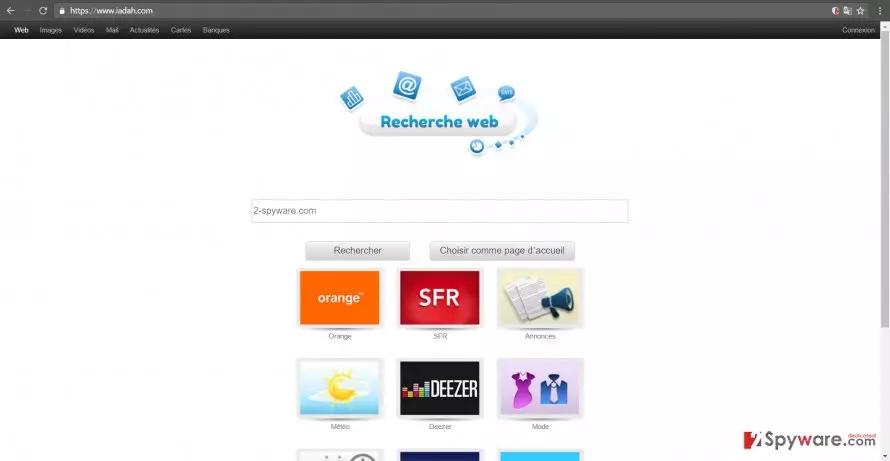
Since the hijacker is supported by the third-parties, you might also experience Iadah.com redirect tendency. In short, you might be misguided to the domains enhanced with flickering ads and offers to buy a new smartphone with 50% discount. Nevertheless, such domains might have a more negative effect than you expect. They might be infected with more or less damaging viruses. If you decided to remove Iadah.com from the device, simply deleting the URL from browser’s settings might be insufficient since the hijacker employs additional elements. They are responsible for keeping the hijacker on the device. In addition, you might accidentally install Iadah toolbar which only worsens the situation.
When did the hijacker infect my device?
Some might be surprised that similar programs spread via freeware. Therefore, there is a chance to facilitate Iadah.com hijack if you are about to install a new video editor, Skype or even Adobe Flash Player. The latter apps often happen to be the disguise for questionable toolbars and third-party search engines. What is more, users speed up the infection processes as they rush through the installation processes without even taking a second look at the possible attachments. As a result, they accidentally install unnecessary programs. Next time you decide to renew your software collection, opt for “Custom” settings. Likewise, you will be able to detect irrelevant applications before they enter the device.
How quickly can I uninstall the PUP?
There are two options how to remove Iadah.com virus completely – automatically and manually. The latter method might take some more time in comparison with the first one. Nonetheless, it might be as effective as the first one if you carefully and precisely follow the instructions. Therefore, meddling with guidelines might become tiresome activity. In that case, you can start Iadah.com removal with the help of an anti-spyware application. This utility will root out all related registry values and other elements. What is more, it comes in handy warding off more serious viruses. Lastly, you may combine these two methods for the ultimate elimination.
Uninstall from Windows
Uninstall from Windows 10/8:
- Type Control Panel into the Windows search box and open the result.
- Under Programs, select Uninstall a program.


Uninstall from Windows 7/XP:
- Click on Windows Start > Control Panel (Windows XP users should click on Add/Remove Programs).
- In Control Panel, select Programs > Uninstall a program.


Remove the unwanted program:
- In the Programs and Features window, look for any recently installed suspicious entries, select them, and click Uninstall.
- If User Account Control appears, click Yes to confirm, then complete the removal.


Delete from macOS
Remove the unwanted application:
- From the menu bar, select Go > Applications.
- In the Applications folder, look for any suspicious entries, then drag them to Trash (or right-click and pick Move to Trash).


Delete leftover files and folders:
- Select Go > Go to Folder.
- Enter /Library/Application Support and remove any suspicious folders related to the unwanted program.
- Repeat the same check in the /Library/LaunchAgents and /Library/LaunchDaemons folders, deleting any suspicious entries.

- Finally, empty the Trash to permanently remove the leftovers.

Reset Internet Explorer
Remove dangerous add-ons:
- Open Internet Explorer, click on the Gear icon (IE menu) on the top-right corner of the browser
- Pick Manage Add-ons.
- You will see a Manage Add-ons window. Here, look for suspicious plugins. Click on these entries and select Disable.


Change your homepage if it was altered:
- Open IE and click on the Gear icon.
- Select Internet Options.
- In the General tab, delete the Home page address and replace it by your preferred one (for example, Google.com).
- Click Apply and then select OK.


Delete temporary files:
- Press on the Gear icon and select Internet Options.
- Under Browsing history, click Delete...
- Select relevant fields and press Delete.


Reset Internet Explorer:
- Click on Gear icon > Internet options and select Advanced tab.
- Select Reset.
- In the new window, check Delete personal settings and select Reset.


Remove from Microsoft Edge
Delete unwanted extensions from MS Edge:
- Select Menu (three horizontal dots at the top-right of the browser window) and pick Extensions.
- From the list, pick the extension and click on the Gear icon.
- Click Remove.


Clear cookies and other browser data:
- Click on the Menu (three horizontal dots at the top-right of the browser window) and select Settings > Privacy, search, and services..
- Under Clear browsing data, pick Choose what to clear.
- Select Cookies and other site data and Cached images and files. (apart from passwords, although you might want to include Media licenses as well, if applicable) and click on Clear.


Restore new tab and homepage settings:
- Click the menu icon and choose Settings.
- Then find On startup section.
- Click Remove next to any suspicious startup page.
Reset MS Edge if the above steps did not work:
- Press on Ctrl + Shift + Esc to open Task Manager.
- Click on More details arrow at the bottom of the window.
- Select Details tab.
- Now scroll down and locate every entry with Microsoft Edge name in it. Right-click on each of them and select End Task to stop MS Edge from running.


Instructions for Chromium-based Edge
Delete extensions from MS Edge (Chromium):
- Open Edge and click select Settings > Extensions.
- Delete unwanted extensions by clicking Remove.


Clear cache and site data:
- Click on Menu and go to Settings.
- Select Privacy, search and services.
- Under Clear browsing data, pick Choose what to clear.
- Under Time range, pick All time.
- Select Clear now.


Reset Chromium-based MS Edge:
- Click on Menu and select Settings.
- On the left side, pick Reset settings.
- Select Restore settings to their default values.
- Confirm with Reset.
- This will disable extensions and reset startup pages but will not delete bookmarks, saved passwords, or browsing history.


Remove from Mozilla Firefox (FF)
Remove dangerous extensions:
- Open Mozilla Firefox browser and click on the Menu (three horizontal lines at the top-right of the window).
- Select Add-ons.
- In here, select the unwanted extension and click Remove.


Reset the homepage:
- Click three horizontal lines at the top right corner to open the menu.
- Choose Settings.
- Under Home, set your preferred homepage and new tab settings.
Clear cookies and site data:
- Click Menu and pick Settings.
- Go to Privacy & Security section.
- Scroll down to locate Cookies and Site Data.
- Click on Clear Data...
- Select Cookies and Site Data and Temporary cached files and pages, then click Clear.


Reset Mozilla Firefox
If clearing the browser as explained above did not help, reset Mozilla Firefox:
- Open Mozilla Firefox browser and click the Menu.
- Go to Help and then choose Troubleshooting Information.

- Under Give Firefox a tune up section, click on Refresh Firefox...
- Once the pop-up shows up, confirm the action by pressing on Refresh Firefox.



Remove from Google Chrome
Delete malicious extensions from Google Chrome:
- Open Google Chrome, click on the Menu (three vertical dots at the top-right corner) and select More tools > Extensions.
- In the newly opened window, you will see all the installed extensions. Uninstall all suspicious extensions related to the unwanted program by clicking Remove.


Clear cache and web data from Chrome:
- Click on Menu and pick Settings.
- Under Privacy and security, select Clear browsing data.
- Select Browsing history, Cookies and other site data, as well as Cached images and files.
- Click Clear data.


Change your homepage:
- Click menu and choose Settings.
- Look for a suspicious site in the On startup section.
- Click on Open a specific or set of pages and click on three dots to find the Remove option.
Reset Google Chrome:
If the previous methods did not help you, reset Google Chrome to eliminate all the unwanted components:
- Click on Menu and select Settings.
- In the Settings, scroll down and click Advanced.
- Scroll down and locate Reset and clean up section.
- Now click Restore settings to their original defaults.
- Confirm with Reset settings.


Delete from Safari
Remove dangerous extensions:
- Open Safari, click Safari in the menu at the top-left of the screen, and select Preferences.
- Go to the Extensions tab, look for any suspicious entries, and click Uninstall to remove them.


Clear history and website data:
- Click Safari in the menu and pick Clear History.
- Set Clear to all history and confirm with Clear History.


Reset Safari:
- Click Safari in the menu and select Preferences > Advanced.
- Enable Show Develop menu in menu bar.
- From the menu bar, click Develop and select Empty Caches.


Did this guide help?
2 comments
frownyman
It doesnt look fishy for me at all.
nemoPR
Thanks for the tutorial.