

Loadstart.net is the program that triggers issues with the speed and performance
Loadstart.net virus may trick credulous users that it is an ordinary search engine. It presents quick access to such shopping domains, including Amazon, Aliexpress, and social networks. Nevertheless, it does not take long for you to notice its bothersome features.
Besides misguiding you to affiliated domains, it crams the computer screen with annoying pop-ups and commercial offers. What is more, your email Inbox might be stuffed with newsletters from various commercial companies. Excessive advertising is not the only frustrating phenomenon.
The PUP may add unwanted toolbars and plug-ins to your browser. Therefore, virus researchers have classified the browsing tool as a browser hijacker. Therefore, remove Loadstart.net right away.
For that purpose, SpyHunterCombo Cleaner, MalwarebytesMalwarebytes comes in handy. We do not recommend delaying the process because the hijacker may cause further inconveniences. You might also remove Loadstart.net manually. More information is provided below. Do not forget about the system damage and PC repair tool like FortectIntego.
The Internet is updated with countless search engine alternatives every day. Thus, users, picking the right browsing tool, might get puzzled. However, such variety does not suggest that all promoted products are safe to use and efficient in performance. Speaking of http://loadstart.net, it belongs to the series of Plus network browser hijackers.
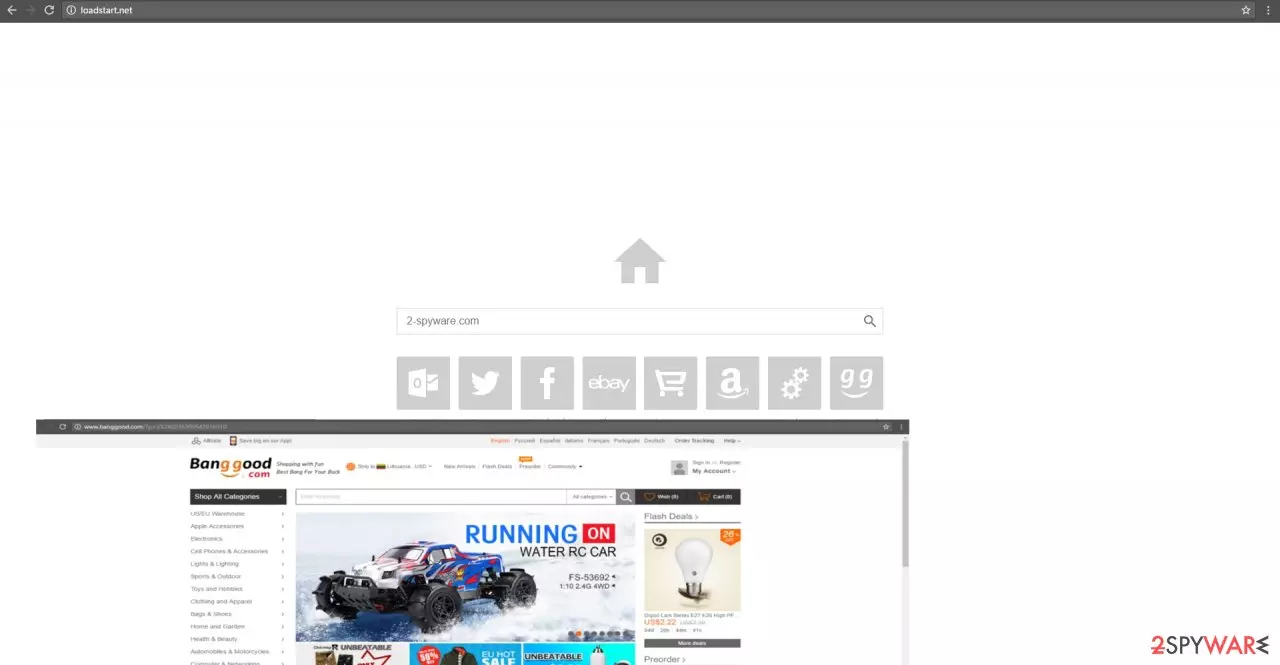
They might seem as ordinary search engines. In order to attract a wider range of users, they offer to access popular shopping and social networks right from the home page of Load Start. If you have an attentive eye, you might notice different search results in comparison to those offered by Google. Moreover, there are fewer of them.
The main problem is not the number of presented search targets but their quality. If you are used to employing an additional security plug-in, you may get disappointed after finding out that this PUP poorly communicates with it. In other words, the extension does not accept the search engine as a reliable one, and you are deprived of the ability to identify whether each search result is secure.
Additionally, Loadstart.net redirect might become another frustrating tendency. The provisions of the privacy policy state that the owner of this hijacker might even share and use your personal details, such as full name, phone number, email, and home address for marketing purposes and share it with affiliated third-parties.
As a result, you may get redirected to their domains. However, the phenomenon to misguide you with other domains other than your preferred web pages is highly annoying. Moreover, you should worry about your privacy as well.
PUPs get pre-bundled for a quick distribution
You might have accidentally installed the PUP on your own while installing a new application. Specifically, Loadstart.net hijack occurred when you were installing a new application. Usually, the hijackers cling to free pdf viewers, file converters, and media players.
If you have downloaded one of them, you missed the pre-checked attachment. As a result, the hijacker successfully tiptoed into your computer. If you do not want to meddle with a PUP again, use our advice. After starting the installation process, select “Custom” settings. Later on, spot unnecessary applications and unmark them.
Eliminating the Loadstart.net PUP involves anti-malware tools
Luckily, it is not difficult to remove the virus. For those, who are in a rush, we suggest opting for the automatic elimination method. An anti-spyware application ensures complete Loadstart.net removal. Keep the software updated, and it will assist in blocking and deleting more serious threats.
Your caution plays a significant role as well. Avoid surfing gaming and torrent sharing domains as they often attract vivid virtual threats. Check the program’s, you are interested in, privacy policy as well. Lastly, if you want to remove Loadstart.net manually, you can find the guide displayed below.
Uninstall from Windows
Uninstall from Windows 10/8:
- Type Control Panel into the Windows search box and open the result.
- Under Programs, select Uninstall a program.


Uninstall from Windows 7/XP:
- Click on Windows Start > Control Panel (Windows XP users should click on Add/Remove Programs).
- In Control Panel, select Programs > Uninstall a program.


Remove the unwanted program:
- In the Programs and Features window, look for any recently installed suspicious entries, select them, and click Uninstall.
- If User Account Control appears, click Yes to confirm, then complete the removal.


Delete from macOS
Remove the unwanted application:
- From the menu bar, select Go > Applications.
- In the Applications folder, look for any suspicious entries, then drag them to Trash (or right-click and pick Move to Trash).


Delete leftover files and folders:
- Select Go > Go to Folder.
- Enter /Library/Application Support and remove any suspicious folders related to the unwanted program.
- Repeat the same check in the /Library/LaunchAgents and /Library/LaunchDaemons folders, deleting any suspicious entries.

- Finally, empty the Trash to permanently remove the leftovers.

Remove from Microsoft Edge
Delete unwanted extensions from MS Edge:
- Select Menu (three horizontal dots at the top-right of the browser window) and pick Extensions.
- From the list, pick the extension and click on the Gear icon.
- Click Remove.


Clear cookies and other browser data:
- Click on the Menu (three horizontal dots at the top-right of the browser window) and select Settings > Privacy, search, and services..
- Under Clear browsing data, pick Choose what to clear.
- Select Cookies and other site data and Cached images and files. (apart from passwords, although you might want to include Media licenses as well, if applicable) and click on Clear.


Restore new tab and homepage settings:
- Click the menu icon and choose Settings.
- Then find On startup section.
- Click Remove next to any suspicious startup page.
Reset MS Edge if the above steps did not work:
- Press on Ctrl + Shift + Esc to open Task Manager.
- Click on More details arrow at the bottom of the window.
- Select Details tab.
- Now scroll down and locate every entry with Microsoft Edge name in it. Right-click on each of them and select End Task to stop MS Edge from running.


Instructions for Chromium-based Edge
Delete extensions from MS Edge (Chromium):
- Open Edge and click select Settings > Extensions.
- Delete unwanted extensions by clicking Remove.


Clear cache and site data:
- Click on Menu and go to Settings.
- Select Privacy, search and services.
- Under Clear browsing data, pick Choose what to clear.
- Under Time range, pick All time.
- Select Clear now.


Reset Chromium-based MS Edge:
- Click on Menu and select Settings.
- On the left side, pick Reset settings.
- Select Restore settings to their default values.
- Confirm with Reset.
- This will disable extensions and reset startup pages but will not delete bookmarks, saved passwords, or browsing history.


Remove from Mozilla Firefox (FF)
Remove dangerous extensions:
- Open Mozilla Firefox browser and click on the Menu (three horizontal lines at the top-right of the window).
- Select Add-ons.
- In here, select the unwanted extension and click Remove.


Reset the homepage:
- Click three horizontal lines at the top right corner to open the menu.
- Choose Settings.
- Under Home, set your preferred homepage and new tab settings.
Clear cookies and site data:
- Click Menu and pick Settings.
- Go to Privacy & Security section.
- Scroll down to locate Cookies and Site Data.
- Click on Clear Data...
- Select Cookies and Site Data and Temporary cached files and pages, then click Clear.


Reset Mozilla Firefox
If clearing the browser as explained above did not help, reset Mozilla Firefox:
- Open Mozilla Firefox browser and click the Menu.
- Go to Help and then choose Troubleshooting Information.

- Under Give Firefox a tune up section, click on Refresh Firefox...
- Once the pop-up shows up, confirm the action by pressing on Refresh Firefox.



Remove from Google Chrome
Delete malicious extensions from Google Chrome:
- Open Google Chrome, click on the Menu (three vertical dots at the top-right corner) and select More tools > Extensions.
- In the newly opened window, you will see all the installed extensions. Uninstall all suspicious extensions related to the unwanted program by clicking Remove.


Clear cache and web data from Chrome:
- Click on Menu and pick Settings.
- Under Privacy and security, select Clear browsing data.
- Select Browsing history, Cookies and other site data, as well as Cached images and files.
- Click Clear data.


Change your homepage:
- Click menu and choose Settings.
- Look for a suspicious site in the On startup section.
- Click on Open a specific or set of pages and click on three dots to find the Remove option.
Reset Google Chrome:
If the previous methods did not help you, reset Google Chrome to eliminate all the unwanted components:
- Click on Menu and select Settings.
- In the Settings, scroll down and click Advanced.
- Scroll down and locate Reset and clean up section.
- Now click Restore settings to their original defaults.
- Confirm with Reset settings.


Delete from Safari
Remove dangerous extensions:
- Open Safari, click Safari in the menu at the top-left of the screen, and select Preferences.
- Go to the Extensions tab, look for any suspicious entries, and click Uninstall to remove them.


Clear history and website data:
- Click Safari in the menu and pick Clear History.
- Set Clear to all history and confirm with Clear History.


Reset Safari:
- Click Safari in the menu and select Preferences > Advanced.
- Enable Show Develop menu in menu bar.
- From the menu bar, click Develop and select Empty Caches.


Did this guide help?
3 comments
Sionelkit
Using the same bait, huh? Its getting boring already.
drckernel0000
I suppose there is no such thing as privacy on the Web anymore...
KathyRog
Those secretly embedded files are the real thing...luckily, got rid of them all.