

Can you escape from Login Email Now by SaferBrowser virus?
If checking the email account regularly is a must, you might be looking for software which enables to do that quickly. Login Email Now virus may seem to provide you such ability. Nonetheless, we are sorry to disappoint you, but this application is adware. Users, who are already familiar with Safer Browser hijackers, may already get unpleasant associations. Anything that comes from this online company is of questionable benefit. The primary aim of the current application is to display advertisements and redirect you to advertising or gaming sites. In addition, the adware spies on your online activities. If you dislike the idea of constantly being under watch, make a rush to remove Login Email Now virus from the device.
Mainly, this PUP operates as a plug-in which enables you to the access to the required email accounts just with one click. However, this utility might cause more damage than you expect. In order to deliver such utility, Login Email Now by SaferBrowser adware needs to save your passwords and have more information about your email accounts. Needless to say, such data might also contain some sensitive information, i.e., private details. Though the adware disclaims of specifically collecting personal information, it is not liable if the non-personally identifiable information, which they collect, includes it. What is more, such data might be shared with third parties. All the information which is related to emails should not fall into the hands of advertising companies. If this happens, get prepared for a vivid stream of Login Email Now ads flooding your browser.
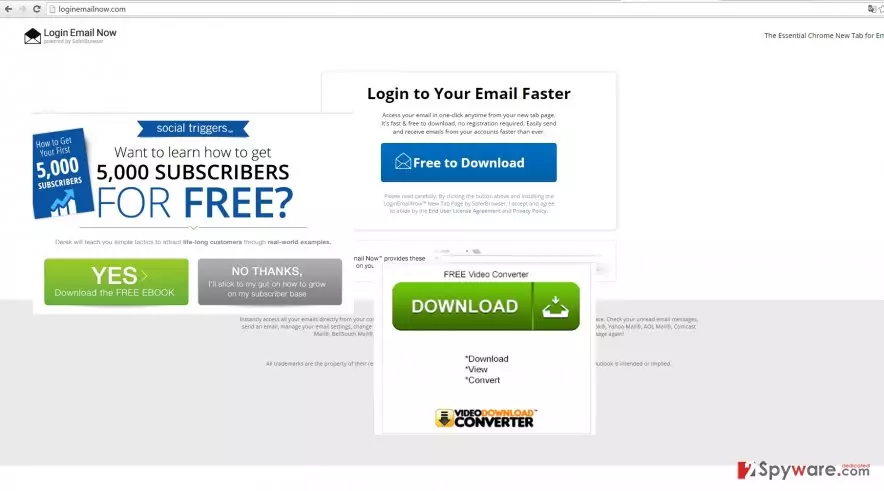
Usually, adware programs have other highly despised peculiarity. It is a matter of time when the ads of Login Email Now by SaferBrowser redirect you to questionable domains. You might find yourself in a domain filled with distractive and annoying ads or gaming commercial offers. However, in some cases, you might get mislead to pornographic websites or web pages offering to purchase useless security programs. In either case, restrain clicking on any links or downloading any programs while Login Email Now by SaferBrowser resides on the computer. Instead of a security program, you might download a tool which is “enhanced” with malignant files. Do not delay Login Email Now removal. For that purpose, FortectIntego comes in handy.
When did I install this application?
It is not surprising if you installed the program right from its website. Alternatively, the program might have invaded your computer without your direct consent. Login Email Now hijack happens at times when users jump through the installation settings by clicking “Next” button. Therefore, the add-on containing the adware within remains unnoticed. In order to spot it, you need to pay a little more attention while installing new software. Instead of “Recommended,” opt for “Custom” settings. Only when you are sure that no irrelevant applications will not installed, click the “Install” button.
Remove Login Email Now by SaferBrowser from the computer
There are two ways how you can delete Login Email Now by SaferBrowser virus. The elimination encompasses manual or automatic elimination. We advise you to choose the latter as it will save your time and energy. Moreover, the anti-spyware application is more apt in detecting potentially malevolent files. When the security program is running, you can be sure that your computer will be free of adware, browser hijackers, and other unwanted PUPs. Moreover, the application provides powerful protection against more serious viruses like trojans and ransomware. Finally, you can find manual Login Email Now by SaferBrowser removal guidelines below.
Uninstall from Windows
Uninstall from Windows 10/8:
- Type Control Panel into the Windows search box and open the result.
- Under Programs, select Uninstall a program.


Uninstall from Windows 7/XP:
- Click on Windows Start > Control Panel (Windows XP users should click on Add/Remove Programs).
- In Control Panel, select Programs > Uninstall a program.


Remove the unwanted program:
- In the Programs and Features window, look for any recently installed suspicious entries, select them, and click Uninstall.
- If User Account Control appears, click Yes to confirm, then complete the removal.


Delete from macOS
Remove the unwanted application:
- From the menu bar, select Go > Applications.
- In the Applications folder, look for any suspicious entries, then drag them to Trash (or right-click and pick Move to Trash).


Delete leftover files and folders:
- Select Go > Go to Folder.
- Enter /Library/Application Support and remove any suspicious folders related to the unwanted program.
- Repeat the same check in the /Library/LaunchAgents and /Library/LaunchDaemons folders, deleting any suspicious entries.

- Finally, empty the Trash to permanently remove the leftovers.

Remove from Microsoft Edge
Delete unwanted extensions from MS Edge:
- Select Menu (three horizontal dots at the top-right of the browser window) and pick Extensions.
- From the list, pick the extension and click on the Gear icon.
- Click Remove.


Clear cookies and other browser data:
- Click on the Menu (three horizontal dots at the top-right of the browser window) and select Settings > Privacy, search, and services..
- Under Clear browsing data, pick Choose what to clear.
- Select Cookies and other site data and Cached images and files. (apart from passwords, although you might want to include Media licenses as well, if applicable) and click on Clear.


Restore new tab and homepage settings:
- Click the menu icon and choose Settings.
- Then find On startup section.
- Click Remove next to any suspicious startup page.
Reset MS Edge if the above steps did not work:
- Press on Ctrl + Shift + Esc to open Task Manager.
- Click on More details arrow at the bottom of the window.
- Select Details tab.
- Now scroll down and locate every entry with Microsoft Edge name in it. Right-click on each of them and select End Task to stop MS Edge from running.


Instructions for Chromium-based Edge
Delete extensions from MS Edge (Chromium):
- Open Edge and click select Settings > Extensions.
- Delete unwanted extensions by clicking Remove.


Clear cache and site data:
- Click on Menu and go to Settings.
- Select Privacy, search and services.
- Under Clear browsing data, pick Choose what to clear.
- Under Time range, pick All time.
- Select Clear now.


Reset Chromium-based MS Edge:
- Click on Menu and select Settings.
- On the left side, pick Reset settings.
- Select Restore settings to their default values.
- Confirm with Reset.
- This will disable extensions and reset startup pages but will not delete bookmarks, saved passwords, or browsing history.


Remove from Mozilla Firefox (FF)
Remove dangerous extensions:
- Open Mozilla Firefox browser and click on the Menu (three horizontal lines at the top-right of the window).
- Select Add-ons.
- In here, select the unwanted extension and click Remove.


Reset the homepage:
- Click three horizontal lines at the top right corner to open the menu.
- Choose Settings.
- Under Home, set your preferred homepage and new tab settings.
Clear cookies and site data:
- Click Menu and pick Settings.
- Go to Privacy & Security section.
- Scroll down to locate Cookies and Site Data.
- Click on Clear Data...
- Select Cookies and Site Data and Temporary cached files and pages, then click Clear.


Reset Mozilla Firefox
If clearing the browser as explained above did not help, reset Mozilla Firefox:
- Open Mozilla Firefox browser and click the Menu.
- Go to Help and then choose Troubleshooting Information.

- Under Give Firefox a tune up section, click on Refresh Firefox...
- Once the pop-up shows up, confirm the action by pressing on Refresh Firefox.



Remove from Google Chrome
Delete malicious extensions from Google Chrome:
- Open Google Chrome, click on the Menu (three vertical dots at the top-right corner) and select More tools > Extensions.
- In the newly opened window, you will see all the installed extensions. Uninstall all suspicious extensions related to the unwanted program by clicking Remove.


Clear cache and web data from Chrome:
- Click on Menu and pick Settings.
- Under Privacy and security, select Clear browsing data.
- Select Browsing history, Cookies and other site data, as well as Cached images and files.
- Click Clear data.


Change your homepage:
- Click menu and choose Settings.
- Look for a suspicious site in the On startup section.
- Click on Open a specific or set of pages and click on three dots to find the Remove option.
Reset Google Chrome:
If the previous methods did not help you, reset Google Chrome to eliminate all the unwanted components:
- Click on Menu and select Settings.
- In the Settings, scroll down and click Advanced.
- Scroll down and locate Reset and clean up section.
- Now click Restore settings to their original defaults.
- Confirm with Reset settings.


Delete from Safari
Remove dangerous extensions:
- Open Safari, click Safari in the menu at the top-left of the screen, and select Preferences.
- Go to the Extensions tab, look for any suspicious entries, and click Uninstall to remove them.


Clear history and website data:
- Click Safari in the menu and pick Clear History.
- Set Clear to all history and confirm with Clear History.


Reset Safari:
- Click Safari in the menu and select Preferences > Advanced.
- Enable Show Develop menu in menu bar.
- From the menu bar, click Develop and select Empty Caches.


Did this guide help?
3 comments
Deborah92
I kept using this program until those pop-ups got really annoying.
Willa
Where did it come from in the first place even though I didnt install anything?
Casey
Everyone should know that such programs cause more trouble than benefit.