

LoveServer ransomware creates an encrypted backup, wants a ransom
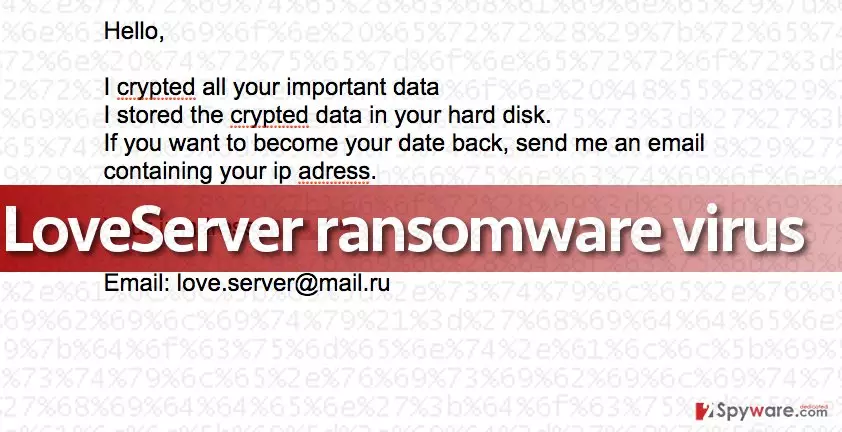
A new type of ransomware has emerged, and LoveServer virus belongs to it. It appears that it uses open-source ransomware known as TrueCrypt[1] technique, except the fact that LoveServer malware is used for malicious purposes. This new virus doesn’t simply encrypt files and append certain extensions to them. Instead, it puts all target files into one that is called BACKUP DON’T DELETE. This file is colossal, because it stores a lot of victim’s files, sadly, they are encrypted, and so they are inaccessible. LoveServer ransomware also saves a ransom note called R-E-A-D-M-E.TXT on the desktop, and it contains the following lines:
Hello,
I crypted all your important data
I stored the crypted data in your hard disk.
If you want to become your date back, send me an email containing your ip address.Your ip adress: XX.XXX.XXX.XXX
Email: love.server@mail.ru
Similar viruses were spotted back in 2014, but attackers were using different emails such as serverlock@yandex.com or file.recover@mail.ru. Earlier ransomware authors used to demand about 50 USD for data decryption tool, but now they ask for more. We highly recommend you to think whether your files are worth a couple of hundred or thousand dollars. Maybe you have a backup or store the most valuable data in a USB or another removable drive[2]? If so, you can recover it for free. Besides, there are some tools that might help you to restore the rest of encrypted data. Before you start taking any actions regarding data decryption, remove LoveServer ransomware first. For that, we recommend using the FortectIntego software. In case you do not have a backup and this filthy ransomware has ruined your files, we suggest waiting. Nowadays, malware experts manage to find flaws in ransomware’s code that allow them to create free decryption applications[3]. Luckily, it happens quite frequently.
Why did my computer get attacked by this virus?
LoveServer malware typically reaches target systems via exploit kits, malvertising, and email[4]. So please, do not open vague-looking electronic letters that unknown people send to you. They might look professionally written and reliable, but if they deliver you some links or attachments, better think twice before opening them. Otherwise, your computer can get immediately infected with destructive programs that will take away your precious files. What is more, ransomware can get into the system using vulnerabilities of an outdated software, so make sure you update all your programs on time. Finally, avoid visiting questionable websites, and if you do, please do not download any content from them, and avoid clicking on ads and banners they present. The highest risk of catching a ransomware-type infection hides in gambling/adult content sites[5]!
Effective way to remove LoveServer ransomware
If you’re wondering what is the best way to remove LoveServer virus, we can answer that for you. The best way to remove ransomware is to use anti-malware software. Anti-malware, unlike antivirus, does not only eliminate the most severe viruses, but also annoying ad-supported programs, browser hijackers, and other pests. So if you want to keep your computer nice and clean, better think about automatic LoveServer removal. To start the anti-malware or antivirus on a computer that has been contaminated with it, one must start it in a Safe Mode with Networking.
Did this guide help?
4 comments
Enya
Still no official decryptor? ;/
ZFire
Thanks for the help. I have deleted the virus and recovered my files from a backup! :D yayz
infected
Why did it put all of these into one single file? thats so strange. Not a typical ransomware, huh?
U2u
definitely unique...