

Mapsnow.co – a browser hijacker which installs the Maps Now extension on Google Chrome
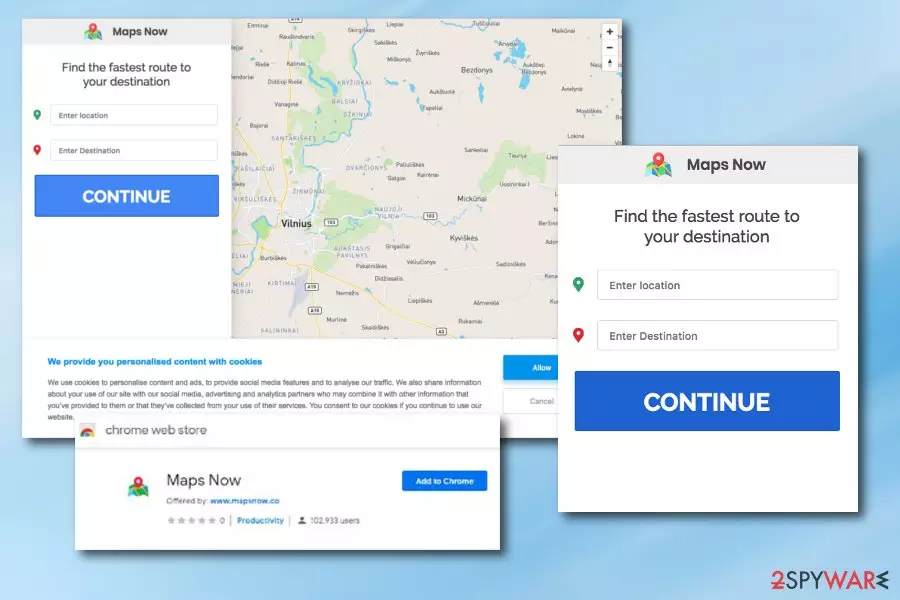
Mapsnow.co is a tool that appears useful because it offers needed mapping and direction services, but this is PUA that you don't need on the PC. This browser-hijacking app[1] installs on the machine without users' permission as an extension on the Google Chrome web browser.
The Maps Now extension can even be found on the Google Chrome Web Store. However, this does not make the program proper for using as browser hijackers have various annoying features which intrude users and harden their browsing work. Mapsnow.co can change the browser's search engine, new tab URL, and homepage to its own. If this happens, the infected user is forced to browse via the new search engine which might provide misleading search query results.
Additionally, browser-hijacking applications are capable of redirecting the user to developer-sponsored websites, advertising useless products and services. Mapsnow.co virus is called like that because it remains persistent on the system and keeps on running due to added files and browser content.
| Name | Mapsnow.co |
|---|---|
| Type | Browser hijacker |
| Extension | Maps Now |
| Target | Google Chrome browser |
| Main changes | This PUP modifies the homepage, new tab URL, and search engine of the infected web browser. Also, it performs unpleasant activities such as advertising and redirecting |
| Distribution ways | The browser hijacker can come from unsafe websites and their hyperlinks, or it can be installed together with regular software |
| Detection possibilities | You can use a tool such as FortectIntego to detect the potentially unwanted program |
| Elimination | For elimination purposes, view our below-provided step-by-step guide or choose reputable anti-malware |
Mapsnow.co virus might be called this way due to its ability to sneak in the system unnoticed and start performing rogue changes without the user's permission. If you have spotted the activity of this application, you will definitely recognize the Maps Now extension in your Google Chrome web browser. However, in some cases, other browsing apps such as Firefox, Edge, Explorer, and Safari can also be affected by this browser hijacker.
If you are a victim of Mapsnow.co, there is a big possibility that you will receive changes and experience activities such as:
- modification of the browser's homepage, new tab URL, search engine.
- redirecting to developer-sponsored websites.
- receiving frequent pop-up notifications that advertise rogue products.
- browser slowdowns and crashes due to all the intrusive activities.
We suggest performing the Mapsnow.co removal as soon as you spot this program in your computer system. However, note that you need to detect all suspicious-looking content in order to get rid of the browser-hijacking application permanently.
We offer to use a PUP detection tool such as FortectIntego which will scan your entire computer system and show the results. After that, you can perform the elimination by using our manual guide or by performing the process with reputable anti-malware.

You need to remove Mapsnow.co virus from your Windows computer and Google Chrome web browser if you want to reverse all changes that were done by the browser-hijacking app. Cleaning all infected locations in your computer is very important as if you miss a single PUP-related component, the browser hijacker might renew its activity within the next computer reboot, and we guess you do not want that happening.
Not fully disclosed data tracking issue regarding the PUAs
You need to know that Mapsnow.co is capable of collecting some data about your browsing activity and habits which brings benefits for the developers.
This browser-hijacking application can gather all details such as search requests performed, search queries entered, saved bookmarks, IP addresses, geolocation,[2] most visited pages, etc. Once collected, this data is passed to other third-parties in order to receive some income.
Mapsnow.co discloses this information tracking issue on the official website, but it is not clear what this data may be used for. In most cases, potentially unwanted program developers track such details for their malvertising campaigns later. It is possible that users' information gets shared with people responsible for commercial content that you cannot get rid of that easily.
The Privacy Policy states:
We gather Personal Information and Non-Personal you provide to us directly or that is obtained from you use of our Services. “Personal Information” means information, such as your first and last name, email address, physical address, telephone number, billing information, or social security number, that is able to personally identify you. “Non-Personal Information” means information that is not capable of personally identifying you.
Nevertheless, we recommend eliminating this intruder as soon as possible, so all these issues can be the thing of the past and your machine can run normally again without any interruptions from advertisements or suspicious browser extensions. Uninstall Mapsnow.co from your Chrome or any other extensions, toolbars added by the threat and scan the machine using FortectIntego to get rid of virus damage.

Browser hijackers come from other software or infected third-party websites
According to NoVirus.uk computer specialists,[3] browser-hijacking applications are very sneaky programs which can be injected wherever throughout the Internet sphere. However, the most common distribution technique is a deceptive marketing technique called “bundling”.[4] By using this method, developers inject the browser-hijacking content into some type of free software and users download the PUP as additional content during the downloading process.
Continuously, browser hijackers can be distributed thru unprotected websites and their infected hyperlinks/advertisements. Suspicious content is easy to inject into sources which lack recommended protection. When the user clicks on an infected link or ad, the potentially unwanted or malicious payload is downloaded to the computer system. For further protection, you should consider downloading/installing a reliable antivirus tool on your machine.
Perform the Mapsnow.co browser hijacker removal process by using our step-by-step guide or computer software
If you are a highly-experienced user in the cyber threat removal sphere, you can remove Mapsnow.co virus by yourself. However, if you need some help with this process, check out our step-by-step guidelines which are displayed below this article. It is very important to investigate web browsers such as Google Chrome, Mozilla Firefox, Internet Explorer, Microsoft Edge, and Safari as no suspicious-looking content should be left in the computer system and browsing apps.
The Mapsnow.co removal is a responsible process to carry out. If you think that the skills you have are not enough to complete the elimination safely and effectively, you should consider using reliable anti-malware tools then. Just make sure that you pick a trustable program and it will do the entire job for you in a couple of minutes of time.
Uninstall from Windows
Uninstall from Windows 10/8:
- Type Control Panel into the Windows search box and open the result.
- Under Programs, select Uninstall a program.


Uninstall from Windows 7/XP:
- Click on Windows Start > Control Panel (Windows XP users should click on Add/Remove Programs).
- In Control Panel, select Programs > Uninstall a program.


Remove the unwanted program:
- In the Programs and Features window, look for any recently installed suspicious entries, select them, and click Uninstall.
- If User Account Control appears, click Yes to confirm, then complete the removal.


Reset Internet Explorer
Remove dangerous add-ons:
- Open Internet Explorer, click on the Gear icon (IE menu) on the top-right corner of the browser
- Pick Manage Add-ons.
- You will see a Manage Add-ons window. Here, look for suspicious plugins. Click on these entries and select Disable.


Change your homepage if it was altered:
- Open IE and click on the Gear icon.
- Select Internet Options.
- In the General tab, delete the Home page address and replace it by your preferred one (for example, Google.com).
- Click Apply and then select OK.


Delete temporary files:
- Press on the Gear icon and select Internet Options.
- Under Browsing history, click Delete...
- Select relevant fields and press Delete.


Reset Internet Explorer:
- Click on Gear icon > Internet options and select Advanced tab.
- Select Reset.
- In the new window, check Delete personal settings and select Reset.


Remove from Microsoft Edge
Delete unwanted extensions from MS Edge:
- Select Menu (three horizontal dots at the top-right of the browser window) and pick Extensions.
- From the list, pick the extension and click on the Gear icon.
- Click Remove.


Clear cookies and other browser data:
- Click on the Menu (three horizontal dots at the top-right of the browser window) and select Settings > Privacy, search, and services..
- Under Clear browsing data, pick Choose what to clear.
- Select Cookies and other site data and Cached images and files. (apart from passwords, although you might want to include Media licenses as well, if applicable) and click on Clear.


Restore new tab and homepage settings:
- Click the menu icon and choose Settings.
- Then find On startup section.
- Click Remove next to any suspicious startup page.
Reset MS Edge if the above steps did not work:
- Press on Ctrl + Shift + Esc to open Task Manager.
- Click on More details arrow at the bottom of the window.
- Select Details tab.
- Now scroll down and locate every entry with Microsoft Edge name in it. Right-click on each of them and select End Task to stop MS Edge from running.


Instructions for Chromium-based Edge
Delete extensions from MS Edge (Chromium):
- Open Edge and click select Settings > Extensions.
- Delete unwanted extensions by clicking Remove.


Clear cache and site data:
- Click on Menu and go to Settings.
- Select Privacy, search and services.
- Under Clear browsing data, pick Choose what to clear.
- Under Time range, pick All time.
- Select Clear now.


Reset Chromium-based MS Edge:
- Click on Menu and select Settings.
- On the left side, pick Reset settings.
- Select Restore settings to their default values.
- Confirm with Reset.
- This will disable extensions and reset startup pages but will not delete bookmarks, saved passwords, or browsing history.


Remove from Mozilla Firefox (FF)
Remove dangerous extensions:
- Open Mozilla Firefox browser and click on the Menu (three horizontal lines at the top-right of the window).
- Select Add-ons.
- In here, select the unwanted extension and click Remove.


Reset the homepage:
- Click three horizontal lines at the top right corner to open the menu.
- Choose Settings.
- Under Home, set your preferred homepage and new tab settings.
Clear cookies and site data:
- Click Menu and pick Settings.
- Go to Privacy & Security section.
- Scroll down to locate Cookies and Site Data.
- Click on Clear Data...
- Select Cookies and Site Data and Temporary cached files and pages, then click Clear.


Reset Mozilla Firefox
If clearing the browser as explained above did not help, reset Mozilla Firefox:
- Open Mozilla Firefox browser and click the Menu.
- Go to Help and then choose Troubleshooting Information.

- Under Give Firefox a tune up section, click on Refresh Firefox...
- Once the pop-up shows up, confirm the action by pressing on Refresh Firefox.



Remove from Google Chrome
Delete malicious extensions from Google Chrome:
- Open Google Chrome, click on the Menu (three vertical dots at the top-right corner) and select More tools > Extensions.
- In the newly opened window, you will see all the installed extensions. Uninstall all suspicious extensions related to the unwanted program by clicking Remove.


Clear cache and web data from Chrome:
- Click on Menu and pick Settings.
- Under Privacy and security, select Clear browsing data.
- Select Browsing history, Cookies and other site data, as well as Cached images and files.
- Click Clear data.


Change your homepage:
- Click menu and choose Settings.
- Look for a suspicious site in the On startup section.
- Click on Open a specific or set of pages and click on three dots to find the Remove option.
Reset Google Chrome:
If the previous methods did not help you, reset Google Chrome to eliminate all the unwanted components:
- Click on Menu and select Settings.
- In the Settings, scroll down and click Advanced.
- Scroll down and locate Reset and clean up section.
- Now click Restore settings to their original defaults.
- Confirm with Reset settings.


Delete from Safari
Remove dangerous extensions:
- Open Safari, click Safari in the menu at the top-left of the screen, and select Preferences.
- Go to the Extensions tab, look for any suspicious entries, and click Uninstall to remove them.


Clear history and website data:
- Click Safari in the menu and pick Clear History.
- Set Clear to all history and confirm with Clear History.


Reset Safari:
- Click Safari in the menu and select Preferences > Advanced.
- Enable Show Develop menu in menu bar.
- From the menu bar, click Develop and select Empty Caches.


Did this guide help?
Be the first to comment