

How to react when Mybestvideosearch.com virus attacks your computer?
Mybestvideosearch.com is a URL of a potentially dangerous search engine, which can be set as your home or new tab page and replace your default search engine in case Mybestvideosearch.com virus slithers into your PC. This program is classified as a browser hijacker, and it is assigned to potentially unwanted programs’ (PUP) category due to its questionable functionality. We doubt that any of its users find it useful, as this program seems to act a bit like a scareware.
The page itself looks safe and does not look suspicious at all. It provides a web search engine, and, just like Google search, it presents different sections of search – Web, Images, Videos, and News. However, none of these sections seem to be working, at least not yet. We have discovered that no matter what our search query is, this dubious search engine always delivers same search results, which seem to be sponsored links. What is more, these hyperlinks are entirely deceptive – for instance, if it provides a search result that supposedly came from Walmart site, it does not mean that it is going to open it after you click it. We have discovered that Mybestvideosearch.com redirects users to questionable and possibly rogue sites such as bestofferonlineuse.com, virus-alert-report.com, 70search.com, and so on. We want to warn you that some of these questionable websites can be phishing, so make sure you do not download any files, programs from them, and also do NOT reveal any personal details on such websites, especially your credit card details.
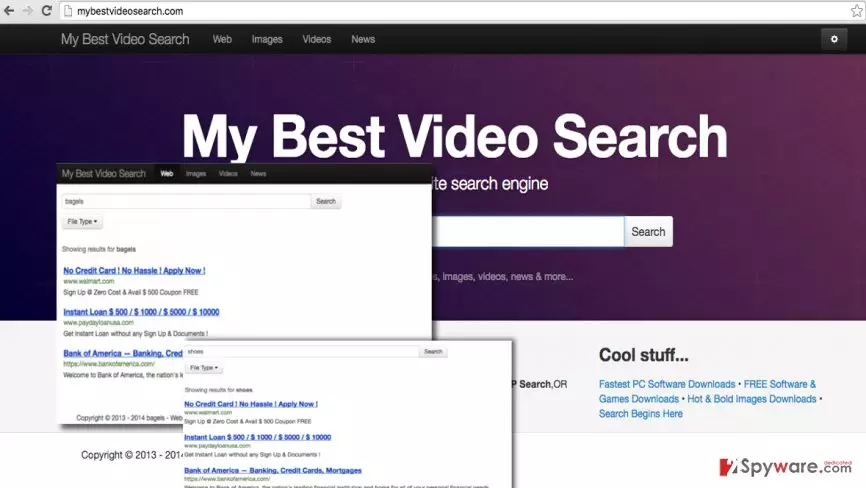
If you have noticed such suspicious activity of Mybestvideosearch.com redirect virus already, make sure you remove this program from your computer as fast as you can. If you are not willing to waste your time trying to delete it manually, then remove Mybestvideosearch.com with FortectIntego or a similar anti-spyware software.
How did it enter your computer system?
Mybestvideosearch.com browser hijacker spreads with a help of other untrustworthy programs, so we would like to advise you to watch what programs you download to your computer, and especially pay attention to their installation processes because frequently free programs are supplemented with a few bonus components that typically appear to be potentially unwanted programs. For example, this browser hijacker spreads with NowUSeeIt Player, which is also a PUP.
You should double-check the reliability of the website that offers you free programs and also monitor their installation carefully. If you think that installing a computer program is an extremely easy thing to do and that all it takes is just a few clicks during the installation, you are wrong. When you open an installer, you have to read Privacy Policy and EULA documents first, and then adjust installation settings in a proper way. Do not think that Default or Standard settings (that are usually pre-selected for you) are reliable. In fact, these installation modes conceal all bonus components and install them silently. If you want to see these additions and opt them out, choose Advanced or Custom option instead.
How to remove Mybestvideosearch.com from the computer?
Removing Mybestvideosearch.com virus can be quite a challenging, especially if you have never done it before. However, that is why we are here for you – we have prepared clear and easy-to-follow instructions that will help you to uninstall this browser hijacker manually. Removal instructions are given below. In case you want to implement automatic Mybestvideosearch.com removal, then you will have to install an anti-spyware program and scan your computer system with it. We recommend using these programs:
Uninstall from Windows
Uninstall from Windows 10/8:
- Type Control Panel into the Windows search box and open the result.
- Under Programs, select Uninstall a program.


Uninstall from Windows 7/XP:
- Click on Windows Start > Control Panel (Windows XP users should click on Add/Remove Programs).
- In Control Panel, select Programs > Uninstall a program.


Remove the unwanted program:
- In the Programs and Features window, look for any recently installed suspicious entries, select them, and click Uninstall.
- If User Account Control appears, click Yes to confirm, then complete the removal.


Delete from macOS
Remove the unwanted application:
- From the menu bar, select Go > Applications.
- In the Applications folder, look for any suspicious entries, then drag them to Trash (or right-click and pick Move to Trash).


Delete leftover files and folders:
- Select Go > Go to Folder.
- Enter /Library/Application Support and remove any suspicious folders related to the unwanted program.
- Repeat the same check in the /Library/LaunchAgents and /Library/LaunchDaemons folders, deleting any suspicious entries.

- Finally, empty the Trash to permanently remove the leftovers.

Remove from Microsoft Edge
Delete unwanted extensions from MS Edge:
- Select Menu (three horizontal dots at the top-right of the browser window) and pick Extensions.
- From the list, pick the extension and click on the Gear icon.
- Click Remove.


Clear cookies and other browser data:
- Click on the Menu (three horizontal dots at the top-right of the browser window) and select Settings > Privacy, search, and services..
- Under Clear browsing data, pick Choose what to clear.
- Select Cookies and other site data and Cached images and files. (apart from passwords, although you might want to include Media licenses as well, if applicable) and click on Clear.


Restore new tab and homepage settings:
- Click the menu icon and choose Settings.
- Then find On startup section.
- Click Remove next to any suspicious startup page.
Reset MS Edge if the above steps did not work:
- Press on Ctrl + Shift + Esc to open Task Manager.
- Click on More details arrow at the bottom of the window.
- Select Details tab.
- Now scroll down and locate every entry with Microsoft Edge name in it. Right-click on each of them and select End Task to stop MS Edge from running.


Instructions for Chromium-based Edge
Delete extensions from MS Edge (Chromium):
- Open Edge and click select Settings > Extensions.
- Delete unwanted extensions by clicking Remove.


Clear cache and site data:
- Click on Menu and go to Settings.
- Select Privacy, search and services.
- Under Clear browsing data, pick Choose what to clear.
- Under Time range, pick All time.
- Select Clear now.


Reset Chromium-based MS Edge:
- Click on Menu and select Settings.
- On the left side, pick Reset settings.
- Select Restore settings to their default values.
- Confirm with Reset.
- This will disable extensions and reset startup pages but will not delete bookmarks, saved passwords, or browsing history.


Remove from Mozilla Firefox (FF)
Remove dangerous extensions:
- Open Mozilla Firefox browser and click on the Menu (three horizontal lines at the top-right of the window).
- Select Add-ons.
- In here, select the unwanted extension and click Remove.


Reset the homepage:
- Click three horizontal lines at the top right corner to open the menu.
- Choose Settings.
- Under Home, set your preferred homepage and new tab settings.
Clear cookies and site data:
- Click Menu and pick Settings.
- Go to Privacy & Security section.
- Scroll down to locate Cookies and Site Data.
- Click on Clear Data...
- Select Cookies and Site Data and Temporary cached files and pages, then click Clear.


Reset Mozilla Firefox
If clearing the browser as explained above did not help, reset Mozilla Firefox:
- Open Mozilla Firefox browser and click the Menu.
- Go to Help and then choose Troubleshooting Information.

- Under Give Firefox a tune up section, click on Refresh Firefox...
- Once the pop-up shows up, confirm the action by pressing on Refresh Firefox.



Remove from Google Chrome
Delete malicious extensions from Google Chrome:
- Open Google Chrome, click on the Menu (three vertical dots at the top-right corner) and select More tools > Extensions.
- In the newly opened window, you will see all the installed extensions. Uninstall all suspicious extensions related to the unwanted program by clicking Remove.


Clear cache and web data from Chrome:
- Click on Menu and pick Settings.
- Under Privacy and security, select Clear browsing data.
- Select Browsing history, Cookies and other site data, as well as Cached images and files.
- Click Clear data.


Change your homepage:
- Click menu and choose Settings.
- Look for a suspicious site in the On startup section.
- Click on Open a specific or set of pages and click on three dots to find the Remove option.
Reset Google Chrome:
If the previous methods did not help you, reset Google Chrome to eliminate all the unwanted components:
- Click on Menu and select Settings.
- In the Settings, scroll down and click Advanced.
- Scroll down and locate Reset and clean up section.
- Now click Restore settings to their original defaults.
- Confirm with Reset settings.


Delete from Safari
Remove dangerous extensions:
- Open Safari, click Safari in the menu at the top-left of the screen, and select Preferences.
- Go to the Extensions tab, look for any suspicious entries, and click Uninstall to remove them.


Clear history and website data:
- Click Safari in the menu and pick Clear History.
- Set Clear to all history and confirm with Clear History.


Reset Safari:
- Click Safari in the menu and select Preferences > Advanced.
- Enable Show Develop menu in menu bar.
- From the menu bar, click Develop and select Empty Caches.


Did this guide help?
4 comments
boris
Thanks for explaining. I could not remove it from my browser for a long time!
joan
Finally ! This anti-spyware software works really well, it cleaned my computer and removed filthy Mybestvideosearch virus in less than 15 minutes. thank you very much for recommending it:)
Blazzing
i AM SHOCKED! How could this virus enter my computer without asking for my permission in a DIRECT WAY? it should be illegal to spread programs like that!
Elvira19
just kicked this piece of junk from my computer!