

Myprivatesearch.com redirect virus – how to get rid of it?
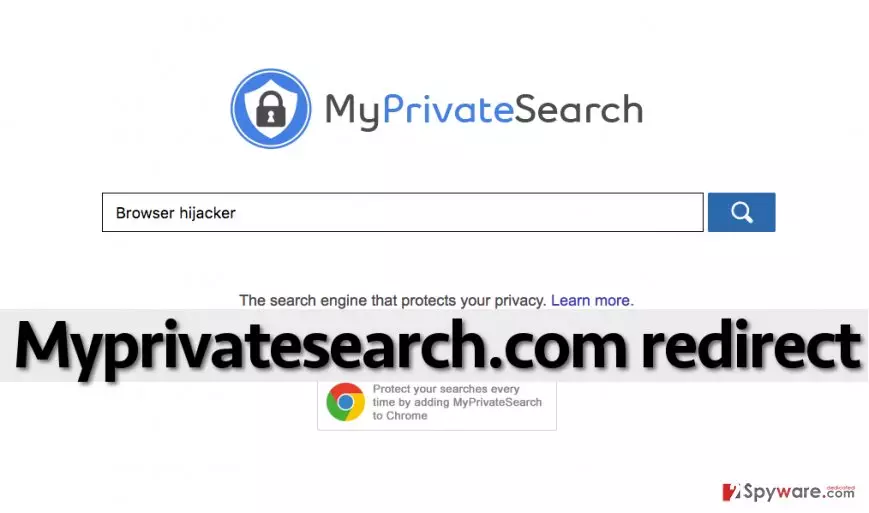
Has Myprivatesearch.com virus affected your Chrome browser? If so, you might want to perform some changes in your browser to restore your previous homepage. Sadly, this is not going to be an easy thing to do. It appears that this potentially unwanted program (PUP) adds MyPrivateSearch extension to Chrome, inserts PHPSESSID cookie to track user’s search activity, and might carry out more adjustments on the affected PC. If you have become a victim of this browser hijacker, you probably know what kind of website it sets as Chrome homepage. Users who are planning to install this program should know that it sets a suspicious search engine to appear on Chrome’s start page. It is highly advisable to avoid using this search engine, because its search results can trigger redirects to unknown Internet sites. Some of these sites might be entirely legitimate, but others can provide harmful content, so it goes without saying that you should avoid visiting such sites.
The purpose of this search engine is to generate pay-per-click revenue. That is why this search engine provides “Ads related to [user’s search query] above regular search results. It wants the user to click on them and visit third-party websites that it promotes. Sadly, we have already stated that these sites can be insecure, so we advise you to be careful when browsing through them. For your own sake, we recommend thinking about Myprivatesearch.com removal. There are many more trustworthy search engines available on world wide web, including Google, Bing, or Yahoo. However, before you attempt to set any of these sites as your new homepage, remove Myprivatesearch.com first. We highly recommend using FortectIntego for that. It is also possible to delete this program manually, but we do not recommend choosing this removal option unless you are an advanced PC user.
How does this program spread?
Are you surprised because Myprivatesearch.com hijack happened without your knowledge? If so, you probably do not know how such programs spread. They are mostly distributed with a help of software distribution method called bundling. This method allows to pack several programs together and spread them as one. Typically, it is impossible to identify which program is bundled and which one is not – for that, the user needs to check program’s installation settings. Only Advanced and Custom settings provide information about these additions, so make sure you pick one of these rather than Default or Standard option. Users make mistake when they give priority to installation settings marked as “recommended. ” Exactly these settings typically hide proposals to install additional software along the preferred one.
The best Myprivatesearch.com removal method
If you seek to remove Myprivatesearch.com virus from your system, you probably wonder what is the best way to do it. To be honest, there are only two ways to remove this browser hijacker from the system. You can employ an automatic spyware removal program like FortectIntego and let it scan your system, find components of PUPs and malware, and eliminate them automatically. However, you can go the harder way and try to remove this potentially unwanted program manually. For that, you should carefully follow comprehensive Myprivatesearch.com removal instructions. We have prepared such instructions for you – these are provided below this article.
Uninstall from Windows
Uninstall from Windows 10/8:
- Type Control Panel into the Windows search box and open the result.
- Under Programs, select Uninstall a program.


Uninstall from Windows 7/XP:
- Click on Windows Start > Control Panel (Windows XP users should click on Add/Remove Programs).
- In Control Panel, select Programs > Uninstall a program.


Remove the unwanted program:
- In the Programs and Features window, look for any recently installed suspicious entries, select them, and click Uninstall.
- If User Account Control appears, click Yes to confirm, then complete the removal.


Delete from macOS
Remove the unwanted application:
- From the menu bar, select Go > Applications.
- In the Applications folder, look for any suspicious entries, then drag them to Trash (or right-click and pick Move to Trash).


Delete leftover files and folders:
- Select Go > Go to Folder.
- Enter /Library/Application Support and remove any suspicious folders related to the unwanted program.
- Repeat the same check in the /Library/LaunchAgents and /Library/LaunchDaemons folders, deleting any suspicious entries.

- Finally, empty the Trash to permanently remove the leftovers.

Remove from Google Chrome
Delete malicious extensions from Google Chrome:
- Open Google Chrome, click on the Menu (three vertical dots at the top-right corner) and select More tools > Extensions.
- In the newly opened window, you will see all the installed extensions. Uninstall all suspicious extensions related to the unwanted program by clicking Remove.


Clear cache and web data from Chrome:
- Click on Menu and pick Settings.
- Under Privacy and security, select Clear browsing data.
- Select Browsing history, Cookies and other site data, as well as Cached images and files.
- Click Clear data.


Change your homepage:
- Click menu and choose Settings.
- Look for a suspicious site in the On startup section.
- Click on Open a specific or set of pages and click on three dots to find the Remove option.
Reset Google Chrome:
If the previous methods did not help you, reset Google Chrome to eliminate all the unwanted components:
- Click on Menu and select Settings.
- In the Settings, scroll down and click Advanced.
- Scroll down and locate Reset and clean up section.
- Now click Restore settings to their original defaults.
- Confirm with Reset settings.


Did this guide help?
3 comments
bells
This virus spreads along with goPrivate extension.
Borisso
This has disappeared after I removed MyPrivateSearch extension :)
Antidote
Reimage removed this and several other PUPs from my browser, cleaned cookies as well. I find it useful - i dont like to delete computer parasites manually. Im just lazy :p its much easier