

NewTab.Pro – a browser hijacker that records your browsing habbits
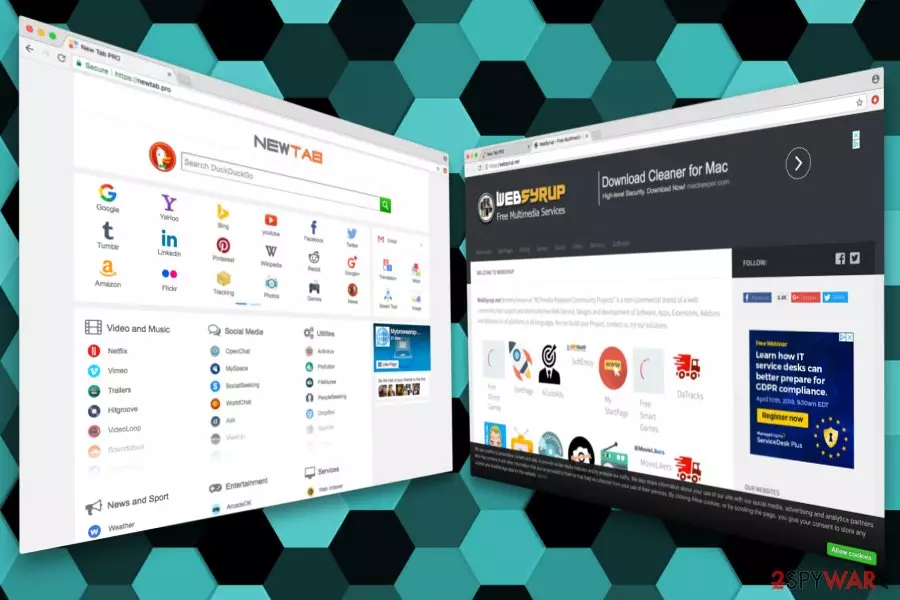
NewTab.Pro is a questionable application that gets into users’ PC without permission. Therefore, it is classified as a browser hijacker.[1] These type of add-ons are not precisely malicious as they do not compromise computer files. However, unwanted modifications to each of the browsers, invasive advertising techniques and questionable redirecting tendencies leave users unsatisfied, to say the least.
Visually, the browser hijacker looks extremely attractive as it implements multiple quick action buttons to most popular domains in the world, such as Google, Bing, Facebook, Amazon, Flickr, YouTube, and many others. Even more, the website authors defined categories for links provided (News and Sport, Entertainment, Utilities, etc.).
Additionally, the application uses a trusted-by-users search engine – DuckDuckGo. Even if DuckDuckGo is a reliable search tool that protects users’ privacy, it does not mean that NewTab does the same. Keep reading this article, and you will find out why its removal is essential for your computer and visual safety.
| SUMMARY | |
| Name | NewTab.Pro |
|---|---|
| Type | Browser Hijacker |
| Danger Level | Low |
| Distribution | Software bundling, fake Flash Player updates |
| Symptoms | Altered browser settings, ads, redirects, etc. |
| Removal | Run a full system scan with reliable anti-malware software |
| System health | Use the FortectIntego software to repair virus damage |
Soon after Google Chrome, Internet Explorer, Mozilla Firefox or Safari gets hijacked, the compromised search engine stars emitting these symptoms:
- startup page and new tab URL altered to hxxps://newtab.pro;
- redirects lead to commercial content and suspicious websites;
- excessive amounts of ads displayed on both legitimate sites and questionable ones;
- search results altered;
- additional browser extensions installed;
- inability to use the desired search engine;
- a slowdown in Google Chrome, Internet Explorer, Mozilla Firefox, Safari or other browsers.
Do not forget that all these modifications are performed to acquire the monetary benefit, and the developers do not care about users’ or their browsing experience whatsoever. Therefore, your daily web browsing sessions might become a real nightmare as your browser is bombarded with unnecessary ads and pop-ups.
Additionally, NewTab.Pro hijack can result in malware[2] infections. Typically, PUP developers declare that they are not responsible for any damages, data loss or other harm caused by third-party content. Therefore, ending up on the malware-ridden website is just a question of time. Only one simple click might initiate JavaScripts to install malware on your computer.
One more alarming feature about this dubious website is that it is extremely deceptive when it comes to privacy policy. They do not disclose what type of data is collected, and not much of information is provided in general. Additionally, developers always urge users to contact “Data Controller.” It is not mentioned how that should be achieved. Please read the following information on the Privacy Policy:
The owner does not provide a list of Personal Data types collected. <…>
Failure to provide certain Personal Data may make it impossible for this Application to provide its services. Users are responsible for any Personal Data of third parties obtained, published or shared through this Application and confirm that they have the third party's consent to provide the Data to the Owner.
As you can see, the collected information is not disclosed; therefore, it can be anything from your email address to your banking details. It also seems like if you decline to publish certain personal data, you will not be able to operate the application entirely.
Therefore, we highly encourage you to remove NewTab.Pro virus as soon as possible. To do that quickly we suggest you install SpyHunterCombo Cleaner or MalwarebytesMalwarebytes – either of these trustworthy anti-malware tools can eliminate all the PUPs that affect your PC in just a few minutes.
If you're not willing to install any applications and perform the removal yourself, it's your choice. But at least let us help you by providing guidelines. They're posted at the bottom of the article. Once the browser hijacker is removed, perform system tune-up with FortectIntego app to repair all system inconsistencies.

Do not let free software developers infect your machine with unwanted programs
Research shows[3] that users are quite careless when it comes to internet safety. Therefore, they do not check important information stated on EULA or Privacy Policy of the program, rush through installation steps while clicking “Next” button without looking, etc.
Free software and PUP developers are aware of these actions on behalf of users. Therefore, they employ bundling to deliver questionable programs to as many users' PCs as possible. To avoid this deceptive marketing campaign, do the following:
- Do not rush the installation of a new program;
- Read through EULA/Privacy policy carefully;
- Pick Advanced/Custom installation mode instead of Recommended/Quick one;
- Eliminate any tick marks by add-ons, toolbars, system optimizers, media players and similar useless software.
Remove NewTab.Pro from your device
If you want to use DuckDuckGo as your search engine, go to your browser settings and set it manually. You do not need a questionable browser hijacker to use its functionality. Additionally, you can just as easily create Bookmarks yourself, simply add it to your Favorite/Bookmark bar. All that said, remove NewTab.Pro as it is an utterly useless add-on.
Its removal can be performed manually or automatically. Only proceed with the manual elimination if you know what you are doing. We provided a professional guide below, so make sure to check it out. If you still find the procedure too complicated, opt for the automatic one.
Anyone can perform automatic NewTab.Pro virus removal, so you don’t have to worry if you correctly performed the elimination steps. Simply download one of the programs mentioned below and bring it up to date. Then, perform a full system scan and reset every browser you possess.
Uninstall from Windows
Uninstall from Windows 10/8:
- Type Control Panel into the Windows search box and open the result.
- Under Programs, select Uninstall a program.


Uninstall from Windows 7/XP:
- Click on Windows Start > Control Panel (Windows XP users should click on Add/Remove Programs).
- In Control Panel, select Programs > Uninstall a program.


Remove the unwanted program:
- In the Programs and Features window, look for any recently installed suspicious entries, select them, and click Uninstall.
- If User Account Control appears, click Yes to confirm, then complete the removal.


Delete from macOS
Remove the unwanted application:
- From the menu bar, select Go > Applications.
- In the Applications folder, look for any suspicious entries, then drag them to Trash (or right-click and pick Move to Trash).


Delete leftover files and folders:
- Select Go > Go to Folder.
- Enter /Library/Application Support and remove any suspicious folders related to the unwanted program.
- Repeat the same check in the /Library/LaunchAgents and /Library/LaunchDaemons folders, deleting any suspicious entries.

- Finally, empty the Trash to permanently remove the leftovers.

Remove from Microsoft Edge
Delete unwanted extensions from MS Edge:
- Select Menu (three horizontal dots at the top-right of the browser window) and pick Extensions.
- From the list, pick the extension and click on the Gear icon.
- Click Remove.


Clear cookies and other browser data:
- Click on the Menu (three horizontal dots at the top-right of the browser window) and select Settings > Privacy, search, and services..
- Under Clear browsing data, pick Choose what to clear.
- Select Cookies and other site data and Cached images and files. (apart from passwords, although you might want to include Media licenses as well, if applicable) and click on Clear.


Restore new tab and homepage settings:
- Click the menu icon and choose Settings.
- Then find On startup section.
- Click Remove next to any suspicious startup page.
Reset MS Edge if the above steps did not work:
- Press on Ctrl + Shift + Esc to open Task Manager.
- Click on More details arrow at the bottom of the window.
- Select Details tab.
- Now scroll down and locate every entry with Microsoft Edge name in it. Right-click on each of them and select End Task to stop MS Edge from running.


Instructions for Chromium-based Edge
Delete extensions from MS Edge (Chromium):
- Open Edge and click select Settings > Extensions.
- Delete unwanted extensions by clicking Remove.


Clear cache and site data:
- Click on Menu and go to Settings.
- Select Privacy, search and services.
- Under Clear browsing data, pick Choose what to clear.
- Under Time range, pick All time.
- Select Clear now.


Reset Chromium-based MS Edge:
- Click on Menu and select Settings.
- On the left side, pick Reset settings.
- Select Restore settings to their default values.
- Confirm with Reset.
- This will disable extensions and reset startup pages but will not delete bookmarks, saved passwords, or browsing history.


Remove from Mozilla Firefox (FF)
Remove dangerous extensions:
- Open Mozilla Firefox browser and click on the Menu (three horizontal lines at the top-right of the window).
- Select Add-ons.
- In here, select the unwanted extension and click Remove.


Reset the homepage:
- Click three horizontal lines at the top right corner to open the menu.
- Choose Settings.
- Under Home, set your preferred homepage and new tab settings.
Clear cookies and site data:
- Click Menu and pick Settings.
- Go to Privacy & Security section.
- Scroll down to locate Cookies and Site Data.
- Click on Clear Data...
- Select Cookies and Site Data and Temporary cached files and pages, then click Clear.


Reset Mozilla Firefox
If clearing the browser as explained above did not help, reset Mozilla Firefox:
- Open Mozilla Firefox browser and click the Menu.
- Go to Help and then choose Troubleshooting Information.

- Under Give Firefox a tune up section, click on Refresh Firefox...
- Once the pop-up shows up, confirm the action by pressing on Refresh Firefox.



Remove from Google Chrome
Delete malicious extensions from Google Chrome:
- Open Google Chrome, click on the Menu (three vertical dots at the top-right corner) and select More tools > Extensions.
- In the newly opened window, you will see all the installed extensions. Uninstall all suspicious extensions related to the unwanted program by clicking Remove.


Clear cache and web data from Chrome:
- Click on Menu and pick Settings.
- Under Privacy and security, select Clear browsing data.
- Select Browsing history, Cookies and other site data, as well as Cached images and files.
- Click Clear data.


Change your homepage:
- Click menu and choose Settings.
- Look for a suspicious site in the On startup section.
- Click on Open a specific or set of pages and click on three dots to find the Remove option.
Reset Google Chrome:
If the previous methods did not help you, reset Google Chrome to eliminate all the unwanted components:
- Click on Menu and select Settings.
- In the Settings, scroll down and click Advanced.
- Scroll down and locate Reset and clean up section.
- Now click Restore settings to their original defaults.
- Confirm with Reset settings.


Delete from Safari
Remove dangerous extensions:
- Open Safari, click Safari in the menu at the top-left of the screen, and select Preferences.
- Go to the Extensions tab, look for any suspicious entries, and click Uninstall to remove them.


Clear history and website data:
- Click Safari in the menu and pick Clear History.
- Set Clear to all history and confirm with Clear History.


Reset Safari:
- Click Safari in the menu and select Preferences > Advanced.
- Enable Show Develop menu in menu bar.
- From the menu bar, click Develop and select Empty Caches.


Did this guide help?
Be the first to comment