

The basic facts about Norton Security Scan Tech Support virus:
Norton Security Scan Tech Support virus is a cyber infection that generates fake support messages. Such online notifications can easily catch your off guard that is why they look so frightening to many computer users. You can be shocked when warning alert pops up on your computer screen out of the blue. However, if it happens, you should not panic or take any rash moves. Make sure if it’s a real warning. Maybe, it’s just the Norton Security Scan Tech Support malware that’s behind it. Once this Trojan gets into your computer, it displays a misleading scan window that warns about serious computer threats being detected. How did it end up on your computer? Probably, with the last freeware you have installed. Furthermore, this virus can easily trick you because it pretends to be Norton Security Scan. Probably most of you know that Norton is a well-known and trustworthy antivirus software developer. However, this fake scan is NOT related to Norton production or the Symantec company in any way. Therefore, if you noticed this alert, you should not hesitate and remove Norton Security Scan Tech Support from your PC. Use FortectIntego or other virus-fighting software for the elimination.
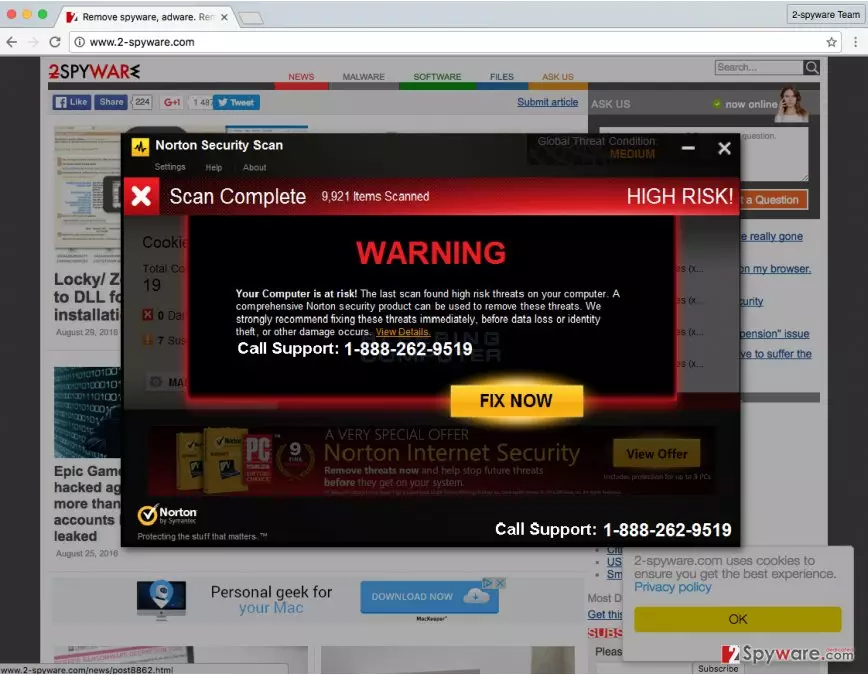
Norton Security Scan Tech Support Scam is created for scaring computer users into thinking that there are some urgent computer issues that need to be taken care of. In the warning, victims are threatened with data loss, identity theft and other possible damage. Also, it provides a support telephone number 1-888-262-9519. The Norton Security Scan Tech Support “staff” is waiting for your call just to tell about “serious” computer issues and suggest you to purchase a support service or additional software. You should not consider buying their services or software. More importantly, you should not call them in the first place. These calls might be ridiculously expensive, and your next phone bill might shock you. Remember, that no matter how serious they look, such warnings can be a scam. You don’t need to buy anything. The only thing you need to do is perform the Norton Security Scan Tech Support removal which is free and simple. Moreover, if you want to protect your computer in the future, you should install reliable antivirus software, instead of trusting random notifications delivered by programs you haven’t installed.
How does it spread?
Norton Security Scan Tech Support hijack might occur when you download freeware from the Internet. Usually, potentially unwanted programs spread bundled with other software. Bear in mind that PUPs might be bundled even with well-known and reliable freeware. To prevent them from getting into the computer, you should always choose “Advanced” or “Custom” installation settings. Then, you can see what additional programs are suggested for you. Deselect all additional programs and continue installation. Moreover, you should always read the Privacy Policy and license agreements provided by the developers. If you cannot deselect optional programs and license agreement looks shady, do not continue installation. It’s not safe to use this software, and you should look for an alternative program.
Norton Security Scan Tech Support removal:
If this potentially unwanted program ended up on your computer, it might be that you are currently considering its removal. The virus can easily get into your computer, but it can be easily removed as well. You can carry out the Norton Security Scan Tech Support removal automatically or manually. For automatic removal, you should use reliable antivirus software and scan your PC. Moreover, you can remove Norton Security Scan Tech Support manually. In order to help you, we have prepared a step-by-step guide below. For the safety and health of your computer, follow this guide very carefully. Otherwise, use the automatic virus elimination.
Uninstall from Windows
Uninstall from Windows 10/8:
- Type Control Panel into the Windows search box and open the result.
- Under Programs, select Uninstall a program.


Uninstall from Windows 7/XP:
- Click on Windows Start > Control Panel (Windows XP users should click on Add/Remove Programs).
- In Control Panel, select Programs > Uninstall a program.


Remove the unwanted program:
- In the Programs and Features window, look for any recently installed suspicious entries, select them, and click Uninstall.
- If User Account Control appears, click Yes to confirm, then complete the removal.


Delete from macOS
Remove the unwanted application:
- From the menu bar, select Go > Applications.
- In the Applications folder, look for any suspicious entries, then drag them to Trash (or right-click and pick Move to Trash).


Delete leftover files and folders:
- Select Go > Go to Folder.
- Enter /Library/Application Support and remove any suspicious folders related to the unwanted program.
- Repeat the same check in the /Library/LaunchAgents and /Library/LaunchDaemons folders, deleting any suspicious entries.

- Finally, empty the Trash to permanently remove the leftovers.

Reset Internet Explorer
Remove dangerous add-ons:
- Open Internet Explorer, click on the Gear icon (IE menu) on the top-right corner of the browser
- Pick Manage Add-ons.
- You will see a Manage Add-ons window. Here, look for suspicious plugins. Click on these entries and select Disable.


Change your homepage if it was altered:
- Open IE and click on the Gear icon.
- Select Internet Options.
- In the General tab, delete the Home page address and replace it by your preferred one (for example, Google.com).
- Click Apply and then select OK.


Delete temporary files:
- Press on the Gear icon and select Internet Options.
- Under Browsing history, click Delete...
- Select relevant fields and press Delete.


Reset Internet Explorer:
- Click on Gear icon > Internet options and select Advanced tab.
- Select Reset.
- In the new window, check Delete personal settings and select Reset.


Remove from Microsoft Edge
Delete unwanted extensions from MS Edge:
- Select Menu (three horizontal dots at the top-right of the browser window) and pick Extensions.
- From the list, pick the extension and click on the Gear icon.
- Click Remove.


Clear cookies and other browser data:
- Click on the Menu (three horizontal dots at the top-right of the browser window) and select Settings > Privacy, search, and services..
- Under Clear browsing data, pick Choose what to clear.
- Select Cookies and other site data and Cached images and files. (apart from passwords, although you might want to include Media licenses as well, if applicable) and click on Clear.


Restore new tab and homepage settings:
- Click the menu icon and choose Settings.
- Then find On startup section.
- Click Remove next to any suspicious startup page.
Reset MS Edge if the above steps did not work:
- Press on Ctrl + Shift + Esc to open Task Manager.
- Click on More details arrow at the bottom of the window.
- Select Details tab.
- Now scroll down and locate every entry with Microsoft Edge name in it. Right-click on each of them and select End Task to stop MS Edge from running.


Instructions for Chromium-based Edge
Delete extensions from MS Edge (Chromium):
- Open Edge and click select Settings > Extensions.
- Delete unwanted extensions by clicking Remove.


Clear cache and site data:
- Click on Menu and go to Settings.
- Select Privacy, search and services.
- Under Clear browsing data, pick Choose what to clear.
- Under Time range, pick All time.
- Select Clear now.


Reset Chromium-based MS Edge:
- Click on Menu and select Settings.
- On the left side, pick Reset settings.
- Select Restore settings to their default values.
- Confirm with Reset.
- This will disable extensions and reset startup pages but will not delete bookmarks, saved passwords, or browsing history.


Remove from Mozilla Firefox (FF)
Remove dangerous extensions:
- Open Mozilla Firefox browser and click on the Menu (three horizontal lines at the top-right of the window).
- Select Add-ons.
- In here, select the unwanted extension and click Remove.


Reset the homepage:
- Click three horizontal lines at the top right corner to open the menu.
- Choose Settings.
- Under Home, set your preferred homepage and new tab settings.
Clear cookies and site data:
- Click Menu and pick Settings.
- Go to Privacy & Security section.
- Scroll down to locate Cookies and Site Data.
- Click on Clear Data...
- Select Cookies and Site Data and Temporary cached files and pages, then click Clear.


Reset Mozilla Firefox
If clearing the browser as explained above did not help, reset Mozilla Firefox:
- Open Mozilla Firefox browser and click the Menu.
- Go to Help and then choose Troubleshooting Information.

- Under Give Firefox a tune up section, click on Refresh Firefox...
- Once the pop-up shows up, confirm the action by pressing on Refresh Firefox.



Remove from Google Chrome
Delete malicious extensions from Google Chrome:
- Open Google Chrome, click on the Menu (three vertical dots at the top-right corner) and select More tools > Extensions.
- In the newly opened window, you will see all the installed extensions. Uninstall all suspicious extensions related to the unwanted program by clicking Remove.


Clear cache and web data from Chrome:
- Click on Menu and pick Settings.
- Under Privacy and security, select Clear browsing data.
- Select Browsing history, Cookies and other site data, as well as Cached images and files.
- Click Clear data.


Change your homepage:
- Click menu and choose Settings.
- Look for a suspicious site in the On startup section.
- Click on Open a specific or set of pages and click on three dots to find the Remove option.
Reset Google Chrome:
If the previous methods did not help you, reset Google Chrome to eliminate all the unwanted components:
- Click on Menu and select Settings.
- In the Settings, scroll down and click Advanced.
- Scroll down and locate Reset and clean up section.
- Now click Restore settings to their original defaults.
- Confirm with Reset settings.


Delete from Safari
Remove dangerous extensions:
- Open Safari, click Safari in the menu at the top-left of the screen, and select Preferences.
- Go to the Extensions tab, look for any suspicious entries, and click Uninstall to remove them.


Clear history and website data:
- Click Safari in the menu and pick Clear History.
- Set Clear to all history and confirm with Clear History.


Reset Safari:
- Click Safari in the menu and select Preferences > Advanced.
- Enable Show Develop menu in menu bar.
- From the menu bar, click Develop and select Empty Caches.


Did this guide help?
Be the first to comment