

Ourcommonnews.com asks users if they are not robots to trick them into subscribing to annoying ads

Ourcommonnews.com is a misleading website you might come across accidentally when browsing the web. However, you are likely to know this URL from strange pop-ups that have been showing up on your desktop, regardless of what you are doing online – browsing social media, streaming a video, or playing an online game.
The activity occurs due to permission you gave Ourcommonnews.com to show you push notifications. Once granted, you provide the website unlimited access, allowing it to use the push notification API[1] to send you information without restrictions, as long as the browser is being used or is idling in the background. Pop-ups would go away every time the browser is closed down, although this is a far from the optimal way of getting rid of them.
It is important to remove push notifications from malicious websites because you might otherwise be exposed to misleading messages or malicious links. As a result, you may suffer from computer infections, personal data disclosure to unknown parties, or financial losses due to various scam encounters.
Scam tactics used
It is obvious that users do not voluntarily enable push notifications from malicious websites – nobody likes fake ads and malicious links being delivered directly to their screens. However, since many people end up on scam websites by accident, they tend not to think much about what they are currently seeing, and simply proceed with the suggested instructions. In the case of Ourcommonnews.com, you might expect one of the following messages upon entry:
- Press “Allow” to verify, that you are not a robot
- Can't play this video! Perhaps your browser doesn't allow video playback. Please click the Allow button to watch the video
- Click “Allow” to win a prize and get it in our shop!
- Click “Allow” to start downloading
- Please tap Allow to continue
Crooks are portraying the push notification feature as something entirely different – it is allegedly used to confirm users not being robots, or that browser is somehow restricting video playback. Scammers simply try to give users an incentive to click the “Allow” button without giving them a proper explanation of what it actually does.
In these situations, please remember that accepting the proposal via the prompt would always result in that particular website being able to send push notifications to you. Reputable websites would not hide their content behind any kind of permissions, including asking users to enable notifications. The best thing to do here is to leave the page.

| Name | Ourcommonnews.com |
| Type | Push notifications, ads, scam, pop-ups |
| Distribution | Push notifications show up at some point after the “Allow” button in the notification prompt is clicked |
| Symptoms | Intrusive pop-ups show up directly on the desktop, on top of all other opened apps or websites |
| Risks | You might suffer from financial losses, install malware or potentially unwanted programs, or disclose sensitive data to cybercrooks |
| Removal | Access browser settings to stop intrusive push notifications. After that, make sure that your system is not infected with adware or malware – scan it with SpyHunterCombo Cleaner |
| Other tips | Adware and other PUPs may leave traces on your computer which be used for continual tracking activities. Remove them to secure your privacy – use FortectIntego |
Remove Ourcommonnews.com ads easily
Push notifications can be extremely intrusive, and it is precisely the reason why so many users misinterpret their presence as a virus infection symptom. Considering how the activity manifests itself, it is not surprising. Many users are generally surprised that the issue does not go away after they scan their computers with security software, however.
Push notifications by themselves are not malicious and are just a feature sometimes exploited by malicious actors. It is vital not to allow notifications from suspicious websites in the first place, although their removal is not that difficult as long as you know where to look.
Google Chrome
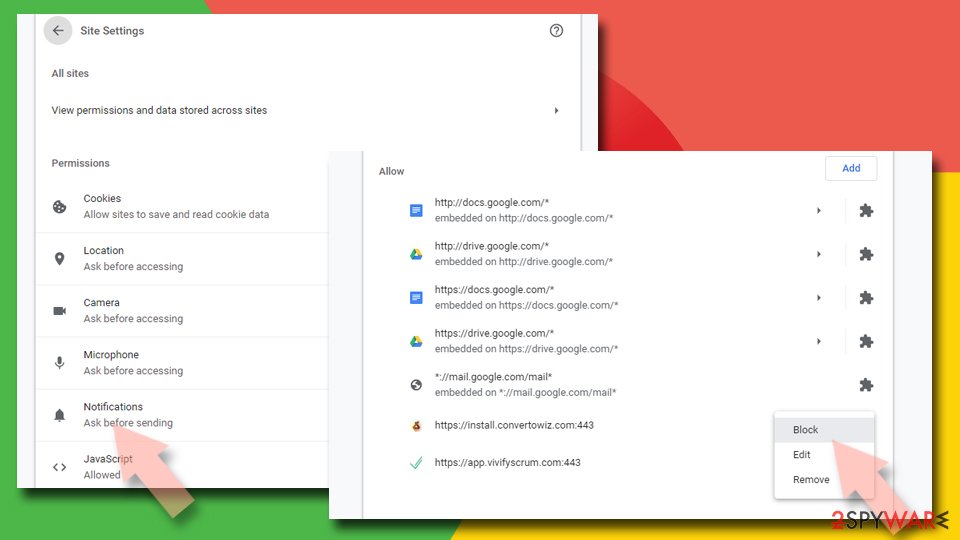
- Open the Google Chrome browser and go to Menu > Settings.
- Scroll down and click on Advanced.
- Locate the Privacy and security section and pick Site Settings > Notifications.
- Look at the Allow section and look for a suspicious URL.
- Click the three vertical dots next to it and pick Block. This should remove unwanted notifications from Google Chrome.

Google Chrome (Android)
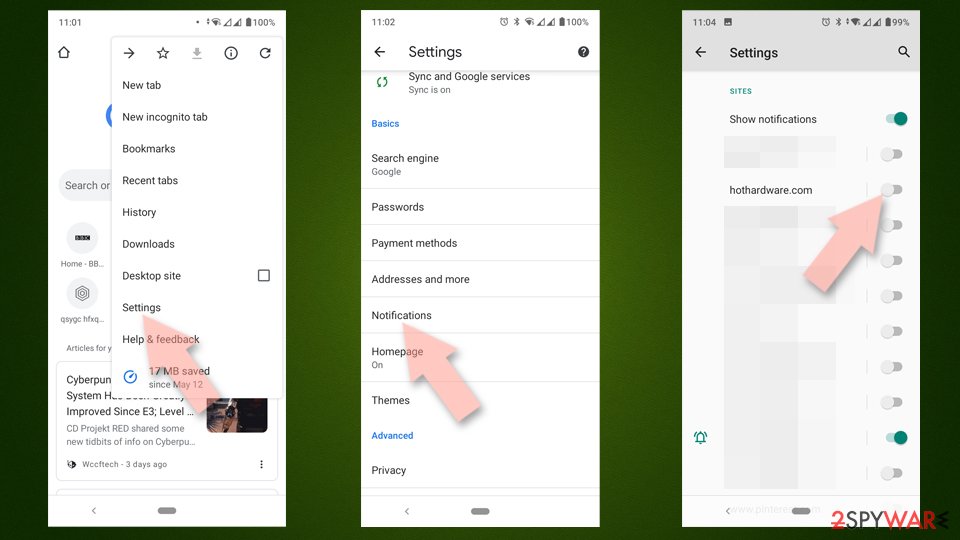
- Open Google Chrome and tap on Settings (three vertical dots).
- Select Notifications.
- Scroll down to the Sites section.
- Locate the unwanted URL and toggle the button to the left (Off position).

Mozilla Firefox
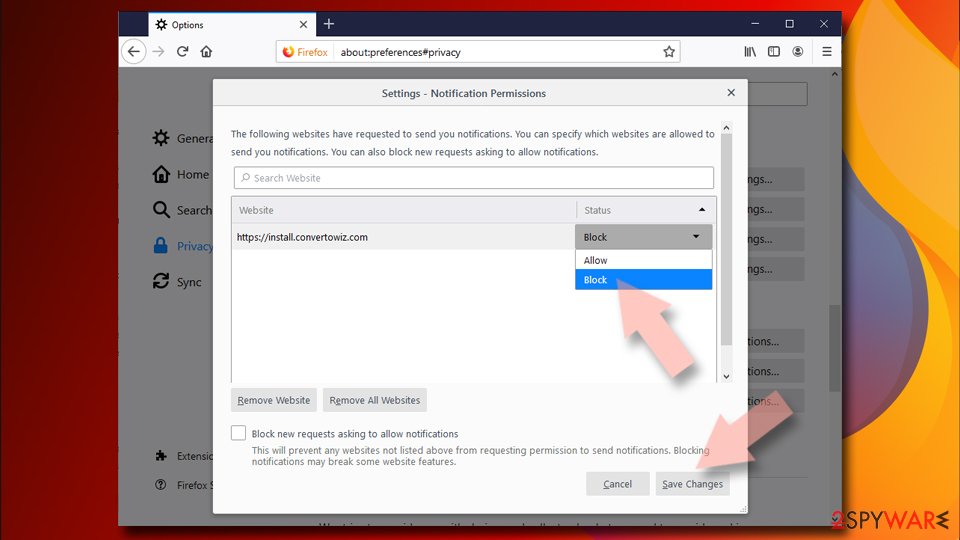
- Open Mozilla Firefox and go to Menu > Options.
- Click on Privacy & Security section.
- Under Permissions, you should be able to see Notifications. Click the Settings button next to it.
- In the Settings – Notification Permissions window, click on the drop-down menu by the URL in question.
- Select Block and then click on Save Changes. This should remove unwanted notifications from Mozilla Firefox.

Safari
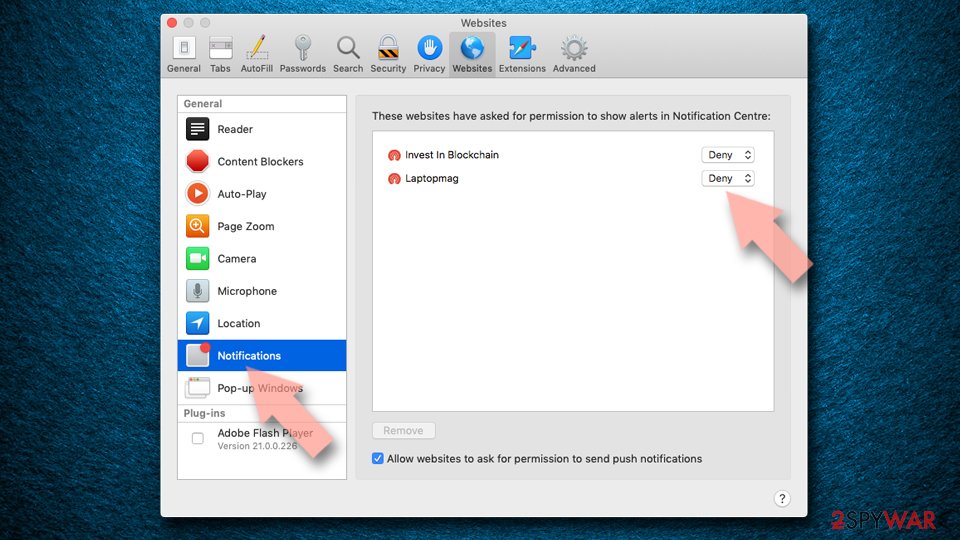
- Click on Safari > Preferences…
- Go to the Websites tab and, under General, select Notifications.
- Select the web address in question, click the drop-down menu and select Deny.

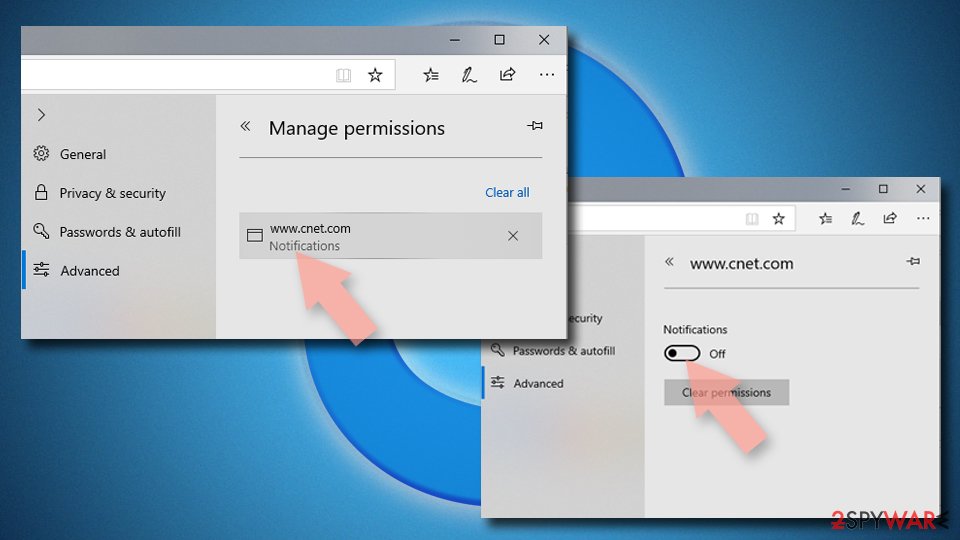
MS Edge
- Open Microsoft Edge, and click the Settings and more button (three horizontal dots) at the top-right of the window.
- Select Settings and then go to Advanced.
- Under Website permissions, pick Manage permissions and select the URL in question.
- Toggle the switch to the left to turn notifications off on Microsoft Edge.

MS Edge (Chromium)
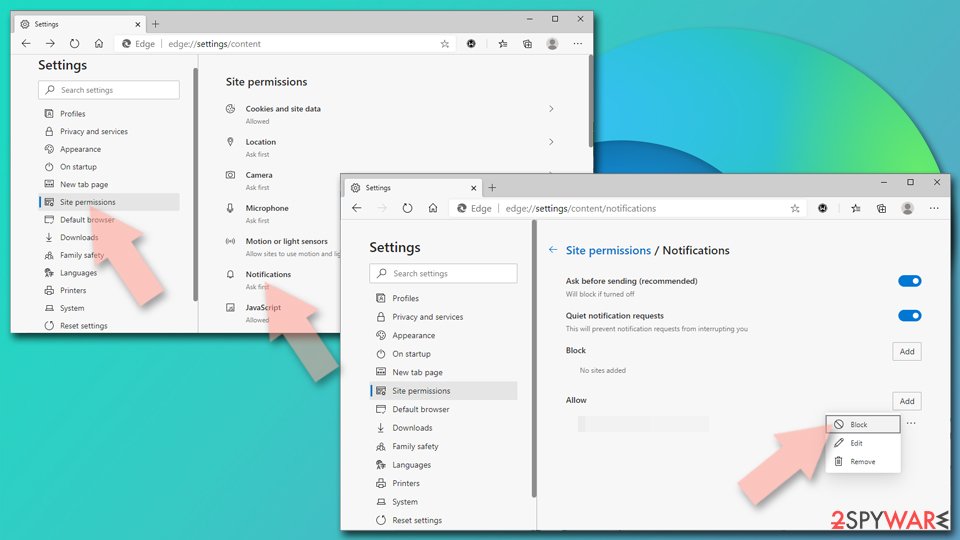
- Open Microsoft Edge, and go to Settings.
- Select Site permissions.
- Go to Notifications on the right.
- Under Allow, you will find the unwanted entry.
- Click on More actions and select Block.

Internet Explorer
- Open Internet Explorer, and click on the Gear icon at the top-right of the window.
- Select Internet options and go to the Privacy tab.
- In the Pop-up Blocker section, click on Settings.
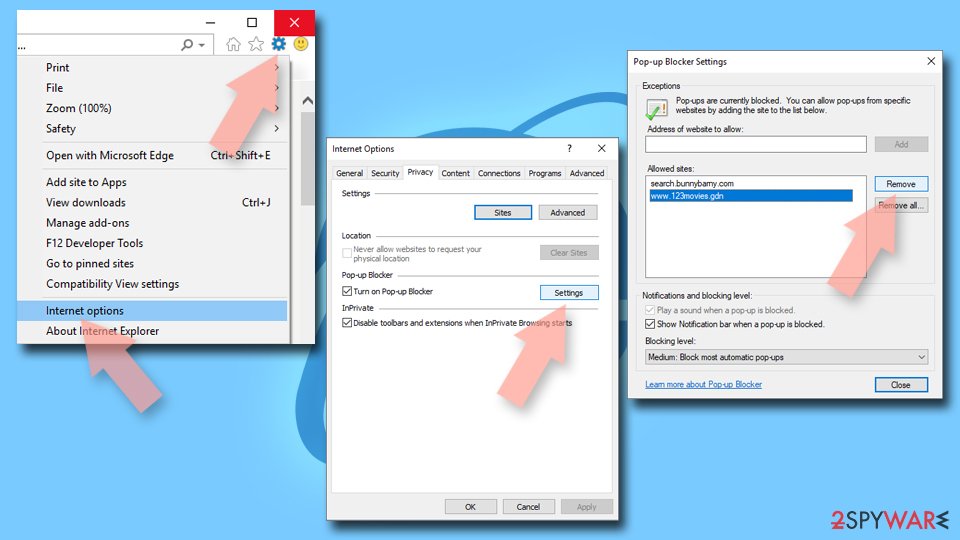
- Locate the web address in question under Allowed sites and pick Remove.

Adware checks to make
Those who see persistent ads and encounter phishing[2] or other malicious websites often might be infected with adware[3] or even malware. Users might install potentially unwanted or malicious software inadvertently, hence they wouldn't even know that such is running in the background.
Therefore we strongly recommend you check your system with powerful anti-malware software, such as SpyHunterCombo Cleaner or MalwarebytesMalwarebytes. This will ensure that no malicious processes are running in the background and that all the most aggressive adware programs are deleted automatically.
If malware is found on your system, security software will quickly eliminate it. In this case, we also recommend cleaning browser cookies, cache, history, and other web data to ensure that some of the malicious ads do not return. For that, we recommend you use FortectIntego or employ the manual guide below.
Remove from Microsoft Edge
Delete unwanted extensions from MS Edge:
- Select Menu (three horizontal dots at the top-right of the browser window) and pick Extensions.
- From the list, pick the extension and click on the Gear icon.
- Click Remove.


Clear cookies and other browser data:
- Click on the Menu (three horizontal dots at the top-right of the browser window) and select Settings > Privacy, search, and services..
- Under Clear browsing data, pick Choose what to clear.
- Select Cookies and other site data and Cached images and files. (apart from passwords, although you might want to include Media licenses as well, if applicable) and click on Clear.


Restore new tab and homepage settings:
- Click the menu icon and choose Settings.
- Then find On startup section.
- Click Remove next to any suspicious startup page.
Reset MS Edge if the above steps did not work:
- Press on Ctrl + Shift + Esc to open Task Manager.
- Click on More details arrow at the bottom of the window.
- Select Details tab.
- Now scroll down and locate every entry with Microsoft Edge name in it. Right-click on each of them and select End Task to stop MS Edge from running.


Instructions for Chromium-based Edge
Delete extensions from MS Edge (Chromium):
- Open Edge and click select Settings > Extensions.
- Delete unwanted extensions by clicking Remove.


Clear cache and site data:
- Click on Menu and go to Settings.
- Select Privacy, search and services.
- Under Clear browsing data, pick Choose what to clear.
- Under Time range, pick All time.
- Select Clear now.


Reset Chromium-based MS Edge:
- Click on Menu and select Settings.
- On the left side, pick Reset settings.
- Select Restore settings to their default values.
- Confirm with Reset.
- This will disable extensions and reset startup pages but will not delete bookmarks, saved passwords, or browsing history.


Remove from Mozilla Firefox (FF)
Remove dangerous extensions:
- Open Mozilla Firefox browser and click on the Menu (three horizontal lines at the top-right of the window).
- Select Add-ons.
- In here, select the unwanted extension and click Remove.


Reset the homepage:
- Click three horizontal lines at the top right corner to open the menu.
- Choose Settings.
- Under Home, set your preferred homepage and new tab settings.
Clear cookies and site data:
- Click Menu and pick Settings.
- Go to Privacy & Security section.
- Scroll down to locate Cookies and Site Data.
- Click on Clear Data...
- Select Cookies and Site Data and Temporary cached files and pages, then click Clear.


Reset Mozilla Firefox
If clearing the browser as explained above did not help, reset Mozilla Firefox:
- Open Mozilla Firefox browser and click the Menu.
- Go to Help and then choose Troubleshooting Information.

- Under Give Firefox a tune up section, click on Refresh Firefox...
- Once the pop-up shows up, confirm the action by pressing on Refresh Firefox.



Remove from Google Chrome
Delete malicious extensions from Google Chrome:
- Open Google Chrome, click on the Menu (three vertical dots at the top-right corner) and select More tools > Extensions.
- In the newly opened window, you will see all the installed extensions. Uninstall all suspicious extensions related to the unwanted program by clicking Remove.


Clear cache and web data from Chrome:
- Click on Menu and pick Settings.
- Under Privacy and security, select Clear browsing data.
- Select Browsing history, Cookies and other site data, as well as Cached images and files.
- Click Clear data.


Change your homepage:
- Click menu and choose Settings.
- Look for a suspicious site in the On startup section.
- Click on Open a specific or set of pages and click on three dots to find the Remove option.
Reset Google Chrome:
If the previous methods did not help you, reset Google Chrome to eliminate all the unwanted components:
- Click on Menu and select Settings.
- In the Settings, scroll down and click Advanced.
- Scroll down and locate Reset and clean up section.
- Now click Restore settings to their original defaults.
- Confirm with Reset settings.


Delete from Safari
Remove dangerous extensions:
- Open Safari, click Safari in the menu at the top-left of the screen, and select Preferences.
- Go to the Extensions tab, look for any suspicious entries, and click Uninstall to remove them.


Clear history and website data:
- Click Safari in the menu and pick Clear History.
- Set Clear to all history and confirm with Clear History.


Reset Safari:
- Click Safari in the menu and select Preferences > Advanced.
- Enable Show Develop menu in menu bar.
- From the menu bar, click Develop and select Empty Caches.


Did this guide help?
Be the first to comment