

PC Smart Cleanup alarms users with fake alerts
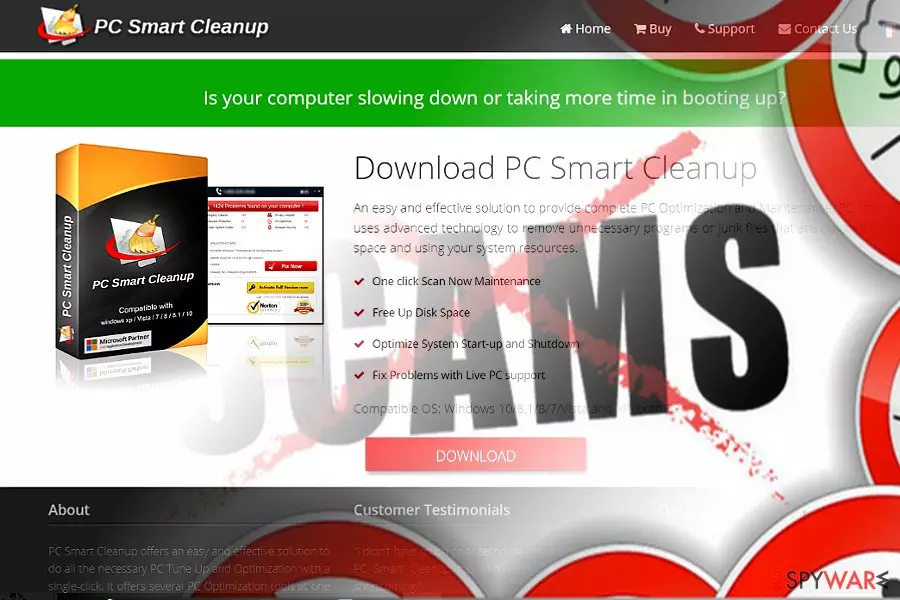
PC Smart Cleanup operates as the supposed PC optimization tool which helps users maintain the sufficient performance of the device. Microsoft[1] has voiced clear criticism about these tools as they often happen to fail to fulfill their mission, and in fact, might even make the system even more vulnerable to virtual assaults. They especially condemn the tools which meddle with the registry keys. .
This software is labeled as the PUP as it identifies dozens if not hundreds of issues but does not specify them. Gullible users alarmed with the high number of detected problems might dash to purchase the full edition.
However, it does nothing except eliminates fake messages. Furthermore, there is a viable reason why you might want to remove PC Smart Cleanup. This tool is promoted via browser-based tech support scams[2]. Here is an extract from the message:
Your system is heavily damaged by (4) virus!
19 September 2017
We have detected that your Windows 10 is 28.1% DAMAGED because of (4) harmful viruses from recent adult sites.
If you do not remove the virus now, it will cause permanent damage to your system, corrupt your photos, data, applications, etc.
Here's what you NEED to do (step by step):
Step 1: Tap the button and install PCSmartCleanup for free now!
Step 2: Open the app to fix your system now!
This is the typical scam designed to fool credulous users to call a specific number, in this case, download the software. Needless to say that no legitimate apps engage in such advertising campaign. You can uninstall the tool manually or perform automatic PC Smart Cleanup removal. FortectIntego or MalwarebytesMalwarebytes does it for you faster.
Distribution methods diversify
Observing the case of PC Smart Cleanup virus which is spread with the assistance of “Your system is heavily damaged by (4) virus!” scam, crooks seem to shift to more vivid transmission strategies.
Usually, such questionable PUPs are promoted on the official websites. You can find this Pc optimization on its official site as well. Alternatively, they try to settle on the system by disguising as optional add-ons when users install free file-converters or media players.
In order to avoid trouble removing PC Smart Cleanup or similar optimization tools, pay attention to the installation process and choose “Custom” mode to spot irrelevant add-ons on time.
Get rid of PC Smart Cleanup
You can uninstall the program via the Control panel. You might also make use of anti-spyware software to speed up PC Smart Cleanup removal. Update and run the scan.
It would be useful to scan the system in Safe Mode and check whether it did not leave any of its files.
- Click on Windows key+R and type regedit.
- Once the Registry Editor launches, click on the Edit and then Find Next function.
- Type PC Smart Cleanup and look for its files among the registry files.
Finally, reset the settings to eliminate PC Smart Cleanup cookies and Your system is heavily damaged by (4) virus! scam web scripts. Despite whether you live in Italy[3] or the UK, be wary of the scam.
Uninstall from Windows
Uninstall from Windows 10/8:
- Type Control Panel into the Windows search box and open the result.
- Under Programs, select Uninstall a program.


Uninstall from Windows 7/XP:
- Click on Windows Start > Control Panel (Windows XP users should click on Add/Remove Programs).
- In Control Panel, select Programs > Uninstall a program.


Remove the unwanted program:
- In the Programs and Features window, look for any recently installed suspicious entries, select them, and click Uninstall.
- If User Account Control appears, click Yes to confirm, then complete the removal.


Delete from macOS
Remove the unwanted application:
- From the menu bar, select Go > Applications.
- In the Applications folder, look for any suspicious entries, then drag them to Trash (or right-click and pick Move to Trash).


Delete leftover files and folders:
- Select Go > Go to Folder.
- Enter /Library/Application Support and remove any suspicious folders related to the unwanted program.
- Repeat the same check in the /Library/LaunchAgents and /Library/LaunchDaemons folders, deleting any suspicious entries.

- Finally, empty the Trash to permanently remove the leftovers.

Reset Internet Explorer
Remove dangerous add-ons:
- Open Internet Explorer, click on the Gear icon (IE menu) on the top-right corner of the browser
- Pick Manage Add-ons.
- You will see a Manage Add-ons window. Here, look for suspicious plugins. Click on these entries and select Disable.


Change your homepage if it was altered:
- Open IE and click on the Gear icon.
- Select Internet Options.
- In the General tab, delete the Home page address and replace it by your preferred one (for example, Google.com).
- Click Apply and then select OK.


Delete temporary files:
- Press on the Gear icon and select Internet Options.
- Under Browsing history, click Delete...
- Select relevant fields and press Delete.


Reset Internet Explorer:
- Click on Gear icon > Internet options and select Advanced tab.
- Select Reset.
- In the new window, check Delete personal settings and select Reset.


Remove from Microsoft Edge
Delete unwanted extensions from MS Edge:
- Select Menu (three horizontal dots at the top-right of the browser window) and pick Extensions.
- From the list, pick the extension and click on the Gear icon.
- Click Remove.


Clear cookies and other browser data:
- Click on the Menu (three horizontal dots at the top-right of the browser window) and select Settings > Privacy, search, and services..
- Under Clear browsing data, pick Choose what to clear.
- Select Cookies and other site data and Cached images and files. (apart from passwords, although you might want to include Media licenses as well, if applicable) and click on Clear.


Restore new tab and homepage settings:
- Click the menu icon and choose Settings.
- Then find On startup section.
- Click Remove next to any suspicious startup page.
Reset MS Edge if the above steps did not work:
- Press on Ctrl + Shift + Esc to open Task Manager.
- Click on More details arrow at the bottom of the window.
- Select Details tab.
- Now scroll down and locate every entry with Microsoft Edge name in it. Right-click on each of them and select End Task to stop MS Edge from running.


Instructions for Chromium-based Edge
Delete extensions from MS Edge (Chromium):
- Open Edge and click select Settings > Extensions.
- Delete unwanted extensions by clicking Remove.


Clear cache and site data:
- Click on Menu and go to Settings.
- Select Privacy, search and services.
- Under Clear browsing data, pick Choose what to clear.
- Under Time range, pick All time.
- Select Clear now.


Reset Chromium-based MS Edge:
- Click on Menu and select Settings.
- On the left side, pick Reset settings.
- Select Restore settings to their default values.
- Confirm with Reset.
- This will disable extensions and reset startup pages but will not delete bookmarks, saved passwords, or browsing history.


Remove from Mozilla Firefox (FF)
Remove dangerous extensions:
- Open Mozilla Firefox browser and click on the Menu (three horizontal lines at the top-right of the window).
- Select Add-ons.
- In here, select the unwanted extension and click Remove.


Reset the homepage:
- Click three horizontal lines at the top right corner to open the menu.
- Choose Settings.
- Under Home, set your preferred homepage and new tab settings.
Clear cookies and site data:
- Click Menu and pick Settings.
- Go to Privacy & Security section.
- Scroll down to locate Cookies and Site Data.
- Click on Clear Data...
- Select Cookies and Site Data and Temporary cached files and pages, then click Clear.


Reset Mozilla Firefox
If clearing the browser as explained above did not help, reset Mozilla Firefox:
- Open Mozilla Firefox browser and click the Menu.
- Go to Help and then choose Troubleshooting Information.

- Under Give Firefox a tune up section, click on Refresh Firefox...
- Once the pop-up shows up, confirm the action by pressing on Refresh Firefox.



Remove from Google Chrome
Delete malicious extensions from Google Chrome:
- Open Google Chrome, click on the Menu (three vertical dots at the top-right corner) and select More tools > Extensions.
- In the newly opened window, you will see all the installed extensions. Uninstall all suspicious extensions related to the unwanted program by clicking Remove.


Clear cache and web data from Chrome:
- Click on Menu and pick Settings.
- Under Privacy and security, select Clear browsing data.
- Select Browsing history, Cookies and other site data, as well as Cached images and files.
- Click Clear data.


Change your homepage:
- Click menu and choose Settings.
- Look for a suspicious site in the On startup section.
- Click on Open a specific or set of pages and click on three dots to find the Remove option.
Reset Google Chrome:
If the previous methods did not help you, reset Google Chrome to eliminate all the unwanted components:
- Click on Menu and select Settings.
- In the Settings, scroll down and click Advanced.
- Scroll down and locate Reset and clean up section.
- Now click Restore settings to their original defaults.
- Confirm with Reset settings.


Delete from Safari
Remove dangerous extensions:
- Open Safari, click Safari in the menu at the top-left of the screen, and select Preferences.
- Go to the Extensions tab, look for any suspicious entries, and click Uninstall to remove them.


Clear history and website data:
- Click Safari in the menu and pick Clear History.
- Set Clear to all history and confirm with Clear History.


Reset Safari:
- Click Safari in the menu and select Preferences > Advanced.
- Enable Show Develop menu in menu bar.
- From the menu bar, click Develop and select Empty Caches.


Did this guide help?
Be the first to comment