

Radiospick is a scam website that aims to get users personal details by misleading them
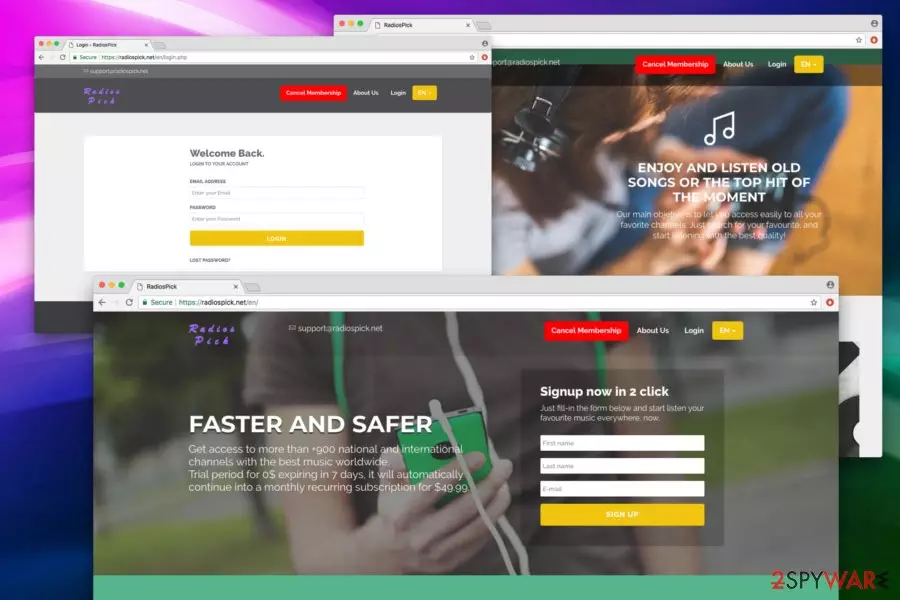
Radiospick is an untrustworthy website with offers a subscription-based service for music. However, it has also been added to an adware program that causes fake ads on users' machines right after infiltrating them. Adware programs are created to deliver traffic[1] to affiliate websites and in such a way generate profit for its developers.
Typically, intrusive ads deliver a fake message which offers users to obtain The new iPhone X for $1 or other expensive gifts. It might deliver other types of ads, such as pop-ups, deals, offers, banners, discounts, and other unwanted content, which is typically irrelevant to the user, and promote bogus software, fake updates, and other highly suspicious content.
Developers of adware are putting a lot of effort to promote products and services of affiliated parties. Do not let crooks monetize at the expense of your compromised Google Chrome or other browser and remove Radiospick virus immediately!
| Name | Radiospick.net |
|---|---|
| Type | Adware, scam |
| Issues | The site is focusing on redirects and misleading content to trick people |
| Damage | Exposure to dangerous online content can lead to malware installations and damaged machine files or functions |
| Distribution | Freeware bundling and deceiving online pages, ads |
| Elimination | You should get a proper anti-malware tool and remove the infection automatically |
| Repair | Run a tool like FortectIntego to find and fix any affected parts of the system |
Individuals who get rerouted directly to the shady website might be tempted by the offer to start a trial of the service. The trial is offered for only $1 (this is done to obtain credit card details) and lasts three days. Afterward, the victims’ bank account is charged €49 monthly.
The information about service cancellation is quite obscure, and there are many unclear statements about it. Thus, users might just not understand how it works, and the subscription will continue automatically. Unfortunately, returning the money which was already charged is impossible.
If you want to use a music streaming service, you should pick a safe and legitimate one. Not only is it cheaper, but you can be sure that personal details such as bank account information will remain private and will not be abused. Using questionable services like the one offered by Radiospick is never a good idea, especially if they are using deceptive tactics to lure users into subscribing.
The most threatening trait of the virus is its redirecting trends. Adware is a typically harmless piece of software that does not damage computer files directly. However, rerouting to questionable domains might compromise a computer’s safety and infect it with nasty malware.
Therefore, if you got redirected to a suspicious website or accidentally clicked on an ad, close down your browser immediately. Remember that adware might install additional components on your PC without asking; hence you should perform a full Radiospick removal using anti-spyware software, such as SpyHunterCombo Cleaner or MalwarebytesMalwarebytes.

Opt for Advanced software installation mode to avoid adware
Security experts from viruset.no[2] noted that users are typically unaware of how adware and other PUPs invade their machines. Developers of unwanted apps are definitely aware of that and take advantage of software bundling to install undesired applications on unsuspecting users’ computers. However, you can avoid infiltration of PUPs by following these tips:
- Before installing an unknown program, make sure you read up on it online. Information provided will help you to decide whether you can trust the application or not;
- If possible, always pick legitimate download sources. Third-party domains might hide malicious installers;[3]
- When installing freeware, always opt for Advance/Custom settings instead of Recommended/Default ones;
- Opt-out of any additional components by de-clicking pre-checked tick boxes;
- Never rush the installation and read through EULA/Privacy Policy carefully;
- Avoid visiting websites of dubious content (adult, free online gaming, online dating, and similar).
Eliminate Radiospick.net adware for good
To remove the threat and its redirects or pop-ups, you will have to either employ robust security software or delete the virus manually. Automatic Radiospick.net removal is recommended to users who are not that acquainted with computers and their processes. To proceed, simply download and install the anti-malware program and bring it up to date. Then, perform a full system scan.
If you want to complete a manual potentially unwanted program removal, please follow our step-by-step guide beneath this article. However, the unwanted app might reappear if you perform this procedure incorrectly. Thus, be observant while going through steps.
Uninstall from Windows
Uninstall from Windows 10/8:
- Type Control Panel into the Windows search box and open the result.
- Under Programs, select Uninstall a program.


Uninstall from Windows 7/XP:
- Click on Windows Start > Control Panel (Windows XP users should click on Add/Remove Programs).
- In Control Panel, select Programs > Uninstall a program.


Remove the unwanted program:
- In the Programs and Features window, look for any recently installed suspicious entries, select them, and click Uninstall.
- If User Account Control appears, click Yes to confirm, then complete the removal.


Delete from macOS
Remove the unwanted application:
- From the menu bar, select Go > Applications.
- In the Applications folder, look for any suspicious entries, then drag them to Trash (or right-click and pick Move to Trash).


Delete leftover files and folders:
- Select Go > Go to Folder.
- Enter /Library/Application Support and remove any suspicious folders related to the unwanted program.
- Repeat the same check in the /Library/LaunchAgents and /Library/LaunchDaemons folders, deleting any suspicious entries.

- Finally, empty the Trash to permanently remove the leftovers.

Remove from Microsoft Edge
Delete unwanted extensions from MS Edge:
- Select Menu (three horizontal dots at the top-right of the browser window) and pick Extensions.
- From the list, pick the extension and click on the Gear icon.
- Click Remove.


Clear cookies and other browser data:
- Click on the Menu (three horizontal dots at the top-right of the browser window) and select Settings > Privacy, search, and services..
- Under Clear browsing data, pick Choose what to clear.
- Select Cookies and other site data and Cached images and files. (apart from passwords, although you might want to include Media licenses as well, if applicable) and click on Clear.


Restore new tab and homepage settings:
- Click the menu icon and choose Settings.
- Then find On startup section.
- Click Remove next to any suspicious startup page.
Reset MS Edge if the above steps did not work:
- Press on Ctrl + Shift + Esc to open Task Manager.
- Click on More details arrow at the bottom of the window.
- Select Details tab.
- Now scroll down and locate every entry with Microsoft Edge name in it. Right-click on each of them and select End Task to stop MS Edge from running.


Instructions for Chromium-based Edge
Delete extensions from MS Edge (Chromium):
- Open Edge and click select Settings > Extensions.
- Delete unwanted extensions by clicking Remove.


Clear cache and site data:
- Click on Menu and go to Settings.
- Select Privacy, search and services.
- Under Clear browsing data, pick Choose what to clear.
- Under Time range, pick All time.
- Select Clear now.


Reset Chromium-based MS Edge:
- Click on Menu and select Settings.
- On the left side, pick Reset settings.
- Select Restore settings to their default values.
- Confirm with Reset.
- This will disable extensions and reset startup pages but will not delete bookmarks, saved passwords, or browsing history.


Remove from Mozilla Firefox (FF)
Remove dangerous extensions:
- Open Mozilla Firefox browser and click on the Menu (three horizontal lines at the top-right of the window).
- Select Add-ons.
- In here, select the unwanted extension and click Remove.


Reset the homepage:
- Click three horizontal lines at the top right corner to open the menu.
- Choose Settings.
- Under Home, set your preferred homepage and new tab settings.
Clear cookies and site data:
- Click Menu and pick Settings.
- Go to Privacy & Security section.
- Scroll down to locate Cookies and Site Data.
- Click on Clear Data...
- Select Cookies and Site Data and Temporary cached files and pages, then click Clear.


Reset Mozilla Firefox
If clearing the browser as explained above did not help, reset Mozilla Firefox:
- Open Mozilla Firefox browser and click the Menu.
- Go to Help and then choose Troubleshooting Information.

- Under Give Firefox a tune up section, click on Refresh Firefox...
- Once the pop-up shows up, confirm the action by pressing on Refresh Firefox.



Remove from Google Chrome
Delete malicious extensions from Google Chrome:
- Open Google Chrome, click on the Menu (three vertical dots at the top-right corner) and select More tools > Extensions.
- In the newly opened window, you will see all the installed extensions. Uninstall all suspicious extensions related to the unwanted program by clicking Remove.


Clear cache and web data from Chrome:
- Click on Menu and pick Settings.
- Under Privacy and security, select Clear browsing data.
- Select Browsing history, Cookies and other site data, as well as Cached images and files.
- Click Clear data.


Change your homepage:
- Click menu and choose Settings.
- Look for a suspicious site in the On startup section.
- Click on Open a specific or set of pages and click on three dots to find the Remove option.
Reset Google Chrome:
If the previous methods did not help you, reset Google Chrome to eliminate all the unwanted components:
- Click on Menu and select Settings.
- In the Settings, scroll down and click Advanced.
- Scroll down and locate Reset and clean up section.
- Now click Restore settings to their original defaults.
- Confirm with Reset settings.


Delete from Safari
Remove dangerous extensions:
- Open Safari, click Safari in the menu at the top-left of the screen, and select Preferences.
- Go to the Extensions tab, look for any suspicious entries, and click Uninstall to remove them.


Clear history and website data:
- Click Safari in the menu and pick Clear History.
- Set Clear to all history and confirm with Clear History.


Reset Safari:
- Click Safari in the menu and select Preferences > Advanced.
- Enable Show Develop menu in menu bar.
- From the menu bar, click Develop and select Empty Caches.


Did this guide help?
Be the first to comment