

Everything you need to know about Search.emailfaster.co
We all use computers on a daily basis and Search.emailfaster.co virus is a program that can ruin that experience quickly. This potentially unwanted program (PUP) is advertised as a free and convenient tool, which helps to access email accounts faster by clicking on shortcuts on the browser’s homepage. However, the user has to agree to some terms before installing this shady piece of software – he has to agree to change home and new tab page, as well as the search engine to Search.emailfaster.co. At first, it seems that it is just a regular search engine, but it functions quite suspiciously. Beware of so-called Search.emailfaster.co redirect issue; users complain that this search engine serves results that can randomly open suspicious third-party websites. If you do not want to visit them, stay away from results marked as “ads.” However, redirects might also occur after clicking on regular search results, so be careful.
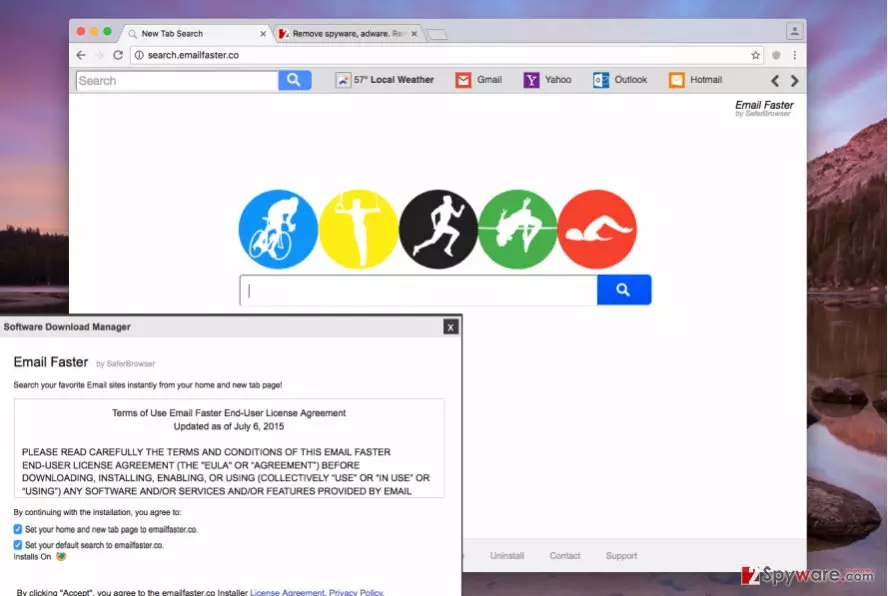
We want to inform you that third-party websites that you can access via this search engine have their own terms and policies, and it might be unsafe to visit them. Try to stay away from sites that try to push you into downloading some suspicious programs, updates, or any files in general. Also, we do not recommend clicking on ads that falsely inform you that your computer is at risk and that you need to install some software to fix it. Most likely, such ads advertise rogue security programs. However, that is not the end of risks that you might encounter while using this suspicious search engine. Another thing in consideration is data collection. It appears that this browser hijacker installs tracking cookies and spies on user’s activity online. Although it is not capable of collecting personally-identifiable data, it can gather your search queries, the list of visited websites, clicks on links and ads, and similar data and analyze it for marketing purposes. Later on, it might share such information with third-parties to serve you targeted ads. If you do not want it to integrate sponsored links here and there, remove Search.emailfaster.co hijacker without a doubt. Search.emailfaster.co removal should be completed using a system scanner, for example, FortectIntego.
How did this program hijack your computer?
Did this application, which has been developed by Safer Browser company, manage to enter your computer without your knowledge? If so, you are probably keen to know how did Search.emailfaster.co hijack your computer system. It is easy to explain that. PUPs typically spread along free applications, so when you download a new program from the Internet, it is essential to check certain settings during its installation. We recommend choosing Advanced or Custom settings. This way, you can see what additional programs have been added to your download, and deselect the ones that you do not want to install. It would be the best if you deselected all additional components, including apps, toolbars, and so on. Then you can finish the installation in the usual manner.
How to remove Search.emailfaster.co?
That is the main question that users ask a lot. To remove Search.emailfaster.co virus, you have to check your computer system and see if there are any suspicious programs installed; besides, you need to clean each of your web browsers separately. It appears that this browser hijacker is compatible with Google Chrome, Mozilla Firefox, Safari, and possibly other Internet browsers. To implement Search.emailfaster.co removal, look through instructions provided below and carry them out. Of course, you can just go the easier way and delete this hijacker using malware removal tools.
Uninstall from Windows
Uninstall from Windows 10/8:
- Type Control Panel into the Windows search box and open the result.
- Under Programs, select Uninstall a program.


Uninstall from Windows 7/XP:
- Click on Windows Start > Control Panel (Windows XP users should click on Add/Remove Programs).
- In Control Panel, select Programs > Uninstall a program.


Remove the unwanted program:
- In the Programs and Features window, look for any recently installed suspicious entries, select them, and click Uninstall.
- If User Account Control appears, click Yes to confirm, then complete the removal.


Delete from macOS
Remove the unwanted application:
- From the menu bar, select Go > Applications.
- In the Applications folder, look for any suspicious entries, then drag them to Trash (or right-click and pick Move to Trash).


Delete leftover files and folders:
- Select Go > Go to Folder.
- Enter /Library/Application Support and remove any suspicious folders related to the unwanted program.
- Repeat the same check in the /Library/LaunchAgents and /Library/LaunchDaemons folders, deleting any suspicious entries.

- Finally, empty the Trash to permanently remove the leftovers.

Reset Internet Explorer
Remove dangerous add-ons:
- Open Internet Explorer, click on the Gear icon (IE menu) on the top-right corner of the browser
- Pick Manage Add-ons.
- You will see a Manage Add-ons window. Here, look for suspicious plugins. Click on these entries and select Disable.


Change your homepage if it was altered:
- Open IE and click on the Gear icon.
- Select Internet Options.
- In the General tab, delete the Home page address and replace it by your preferred one (for example, Google.com).
- Click Apply and then select OK.


Delete temporary files:
- Press on the Gear icon and select Internet Options.
- Under Browsing history, click Delete...
- Select relevant fields and press Delete.


Reset Internet Explorer:
- Click on Gear icon > Internet options and select Advanced tab.
- Select Reset.
- In the new window, check Delete personal settings and select Reset.


Remove from Mozilla Firefox (FF)
Remove dangerous extensions:
- Open Mozilla Firefox browser and click on the Menu (three horizontal lines at the top-right of the window).
- Select Add-ons.
- In here, select the unwanted extension and click Remove.


Reset the homepage:
- Click three horizontal lines at the top right corner to open the menu.
- Choose Settings.
- Under Home, set your preferred homepage and new tab settings.
Clear cookies and site data:
- Click Menu and pick Settings.
- Go to Privacy & Security section.
- Scroll down to locate Cookies and Site Data.
- Click on Clear Data...
- Select Cookies and Site Data and Temporary cached files and pages, then click Clear.


Reset Mozilla Firefox
If clearing the browser as explained above did not help, reset Mozilla Firefox:
- Open Mozilla Firefox browser and click the Menu.
- Go to Help and then choose Troubleshooting Information.

- Under Give Firefox a tune up section, click on Refresh Firefox...
- Once the pop-up shows up, confirm the action by pressing on Refresh Firefox.



Remove from Google Chrome
Delete malicious extensions from Google Chrome:
- Open Google Chrome, click on the Menu (three vertical dots at the top-right corner) and select More tools > Extensions.
- In the newly opened window, you will see all the installed extensions. Uninstall all suspicious extensions related to the unwanted program by clicking Remove.


Clear cache and web data from Chrome:
- Click on Menu and pick Settings.
- Under Privacy and security, select Clear browsing data.
- Select Browsing history, Cookies and other site data, as well as Cached images and files.
- Click Clear data.


Change your homepage:
- Click menu and choose Settings.
- Look for a suspicious site in the On startup section.
- Click on Open a specific or set of pages and click on three dots to find the Remove option.
Reset Google Chrome:
If the previous methods did not help you, reset Google Chrome to eliminate all the unwanted components:
- Click on Menu and select Settings.
- In the Settings, scroll down and click Advanced.
- Scroll down and locate Reset and clean up section.
- Now click Restore settings to their original defaults.
- Confirm with Reset settings.


Delete from Safari
Remove dangerous extensions:
- Open Safari, click Safari in the menu at the top-left of the screen, and select Preferences.
- Go to the Extensions tab, look for any suspicious entries, and click Uninstall to remove them.


Clear history and website data:
- Click Safari in the menu and pick Clear History.
- Set Clear to all history and confirm with Clear History.


Reset Safari:
- Click Safari in the menu and select Preferences > Advanced.
- Enable Show Develop menu in menu bar.
- From the menu bar, click Develop and select Empty Caches.


Did this guide help?
4 comments
Argella
Thank you! The fact that you provide individual instructions for each virus is praisable!
como
This has infiltrated into my computer system in less than one minute. Luckily, I have managed to delete it quickly enough. However, had to use anti-malware program for that.
Hailey
how to delete thisss useless virus from my computer!
Megan
Calm down; it is really easy. Have you even looked at removal instructions?... I have just cleaned my browser from this and I think that it was a pretty easy thing to do. You should try to delete it manually, too ! :)