

Search.hlocalweatherradar.co links to the notorious SaferBrowser hijacker
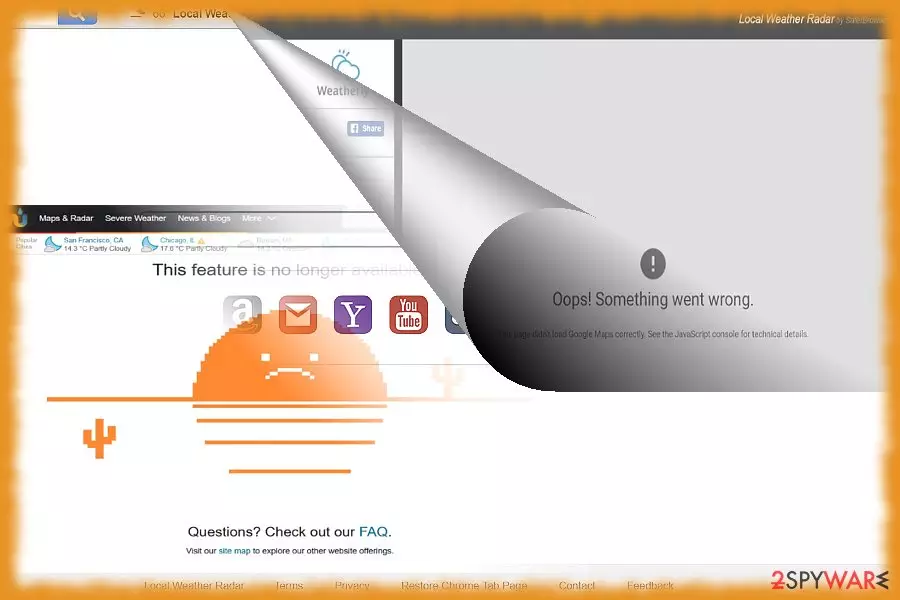
Search.hlocalweatherradar.co virus happens to be another search tool designed by Polarity Technologies Ltd. We have already discussed it in numerous articles. It seems that it has grown into a wide network. As a result, you are likely to encounter one or another search tool of theirs.
Contrary to its veneer, the website has also certain drawbacks which may outweigh all pros. The PUP has long since adopted a similar method to the former SaferBrowser group of hijackers as it offers a variety of quick-access links to shopping, gaming, or news. Each search tool of Polarity Technologies also focuses on a certain aspect: movies, shopping, sports, games, etc.
| name | Search.hlocalweatherradar.co virus |
|---|---|
| Type | Browser hijacker |
| Symptoms | Redirects to dubious affiliated pages; deceptive ads in search search results; diminished PC performance |
| Distribution | Software bundles, file-sharing platfoms |
| Elimination | Remove the hijacker with anti-malware software |
| System fix |
The “specialty” of search.hlocalweatherradar.co is the weather. Once you click on Local Weather, in the top right corner you see a clear reference to SaferBrowser hijackers – Local Weather Radar by Safer Browser.
The latter has gained notorious fame by aggressively promoting its services and “hijacking” users’ default search engines. In addition, Polarity Technologies collects non-personal information indicating your search queries and transmits the data to partner companies. As a result, you may get crammed with bothersome apps.
Therefore, you should think it over whether constant pop-ups will not bother you. Otherwise, you may proceed to search.hlocalweatherradar.co removal. In this situation, SpyHunterCombo Cleaner or MalwarebytesMalwarebytes comes in handy, as these reliable security tools can remove any threats immediately.
You could also remove the threat with our detailed guidelines posted at the bottom of the article. Afterward, we highly recommend using the FortectIntego system diagnostics tool to perform a full system scan and repair all system-related irregularities.
Using legitimate apps as baits
Besides the mentioned links to Safer Browser, Local Weather Radar also uses links to legitimate applications, such as Weather Underground[1] or National Weather Service. However, the website does not grant you proper access to the application.
It is praiseworthy that the tool employs Yahoo as the database and supports security browser add-ons. On the other hand, you may soon get bothered by Search.hlocalweatherradar.co redirect tendency. Due to cooperation with third parties, you may get directed to their websites. Unfortunately, rarely they use sufficient SSL certificates and may contain serious flaws which make them vulnerable to external virtual attacks.[2]
In addition, you should consider the fact that the tool literally spies what websites you visit or what search entries you type. Consequently, you may notice that more relevant ads begin to surface. If you accidentally disclose your email address, commercial offers may start flooding the Spam folder. Note that this PUP targets all residents despite whether you live in Portugal[3] or Germany. Make haste to remove Search.hlocalweatherradar.co.
Multiple techniques to expand the distribution network
One of the key reasons why this PUP might pop up here and lies in cooperation with multiple third parties. Thus, if you are wandering in a movie streaming site, or looking for a new browser app, you may get redirected to this domain.
Since the PUP has its own website, Search.hlocalweatherradar.co hijack is unlikely to happen.
On the other hand, you may spot it as an additional program attached to a recently downloaded file converter or media player. In order to spot such PUPs, opt for “Advanced” settings. Remove the checkmarks from shady optional tools, and proceed with the installation process.
Ways to get rid of Search.hlocalweatherradar.co permanently
In order to delete this browser infection from Chrome, Safari, or Firefox, you opt for a manual elimination method or eliminate it with the assistance of a malware removal tool. It also comes in handy in terminating more elaborate malware threats.
As for Search.hlocalweatherradar.co removal, delete the associated extensions and toolbars. In order to clear the browser from its web scripts, you may opt for a full browser reset. All required instructions are posted below. Please follow them, and you'll be able to browse the web safely again.
Uninstall from Windows
Uninstall from Windows 10/8:
- Type Control Panel into the Windows search box and open the result.
- Under Programs, select Uninstall a program.


Uninstall from Windows 7/XP:
- Click on Windows Start > Control Panel (Windows XP users should click on Add/Remove Programs).
- In Control Panel, select Programs > Uninstall a program.


Remove the unwanted program:
- In the Programs and Features window, look for any recently installed suspicious entries, select them, and click Uninstall.
- If User Account Control appears, click Yes to confirm, then complete the removal.


Delete from macOS
Remove the unwanted application:
- From the menu bar, select Go > Applications.
- In the Applications folder, look for any suspicious entries, then drag them to Trash (or right-click and pick Move to Trash).


Delete leftover files and folders:
- Select Go > Go to Folder.
- Enter /Library/Application Support and remove any suspicious folders related to the unwanted program.
- Repeat the same check in the /Library/LaunchAgents and /Library/LaunchDaemons folders, deleting any suspicious entries.

- Finally, empty the Trash to permanently remove the leftovers.

Remove from Microsoft Edge
Delete unwanted extensions from MS Edge:
- Select Menu (three horizontal dots at the top-right of the browser window) and pick Extensions.
- From the list, pick the extension and click on the Gear icon.
- Click Remove.


Clear cookies and other browser data:
- Click on the Menu (three horizontal dots at the top-right of the browser window) and select Settings > Privacy, search, and services..
- Under Clear browsing data, pick Choose what to clear.
- Select Cookies and other site data and Cached images and files. (apart from passwords, although you might want to include Media licenses as well, if applicable) and click on Clear.


Restore new tab and homepage settings:
- Click the menu icon and choose Settings.
- Then find On startup section.
- Click Remove next to any suspicious startup page.
Reset MS Edge if the above steps did not work:
- Press on Ctrl + Shift + Esc to open Task Manager.
- Click on More details arrow at the bottom of the window.
- Select Details tab.
- Now scroll down and locate every entry with Microsoft Edge name in it. Right-click on each of them and select End Task to stop MS Edge from running.


Instructions for Chromium-based Edge
Delete extensions from MS Edge (Chromium):
- Open Edge and click select Settings > Extensions.
- Delete unwanted extensions by clicking Remove.


Clear cache and site data:
- Click on Menu and go to Settings.
- Select Privacy, search and services.
- Under Clear browsing data, pick Choose what to clear.
- Under Time range, pick All time.
- Select Clear now.


Reset Chromium-based MS Edge:
- Click on Menu and select Settings.
- On the left side, pick Reset settings.
- Select Restore settings to their default values.
- Confirm with Reset.
- This will disable extensions and reset startup pages but will not delete bookmarks, saved passwords, or browsing history.


Remove from Mozilla Firefox (FF)
Remove dangerous extensions:
- Open Mozilla Firefox browser and click on the Menu (three horizontal lines at the top-right of the window).
- Select Add-ons.
- In here, select the unwanted extension and click Remove.


Reset the homepage:
- Click three horizontal lines at the top right corner to open the menu.
- Choose Settings.
- Under Home, set your preferred homepage and new tab settings.
Clear cookies and site data:
- Click Menu and pick Settings.
- Go to Privacy & Security section.
- Scroll down to locate Cookies and Site Data.
- Click on Clear Data...
- Select Cookies and Site Data and Temporary cached files and pages, then click Clear.


Reset Mozilla Firefox
If clearing the browser as explained above did not help, reset Mozilla Firefox:
- Open Mozilla Firefox browser and click the Menu.
- Go to Help and then choose Troubleshooting Information.

- Under Give Firefox a tune up section, click on Refresh Firefox...
- Once the pop-up shows up, confirm the action by pressing on Refresh Firefox.



Remove from Google Chrome
Delete malicious extensions from Google Chrome:
- Open Google Chrome, click on the Menu (three vertical dots at the top-right corner) and select More tools > Extensions.
- In the newly opened window, you will see all the installed extensions. Uninstall all suspicious extensions related to the unwanted program by clicking Remove.


Clear cache and web data from Chrome:
- Click on Menu and pick Settings.
- Under Privacy and security, select Clear browsing data.
- Select Browsing history, Cookies and other site data, as well as Cached images and files.
- Click Clear data.


Change your homepage:
- Click menu and choose Settings.
- Look for a suspicious site in the On startup section.
- Click on Open a specific or set of pages and click on three dots to find the Remove option.
Reset Google Chrome:
If the previous methods did not help you, reset Google Chrome to eliminate all the unwanted components:
- Click on Menu and select Settings.
- In the Settings, scroll down and click Advanced.
- Scroll down and locate Reset and clean up section.
- Now click Restore settings to their original defaults.
- Confirm with Reset settings.


Delete from Safari
Remove dangerous extensions:
- Open Safari, click Safari in the menu at the top-left of the screen, and select Preferences.
- Go to the Extensions tab, look for any suspicious entries, and click Uninstall to remove them.


Clear history and website data:
- Click Safari in the menu and pick Clear History.
- Set Clear to all history and confirm with Clear History.


Reset Safari:
- Click Safari in the menu and select Preferences > Advanced.
- Enable Show Develop menu in menu bar.
- From the menu bar, click Develop and select Empty Caches.


Did this guide help?
Be the first to comment