

What are the drawbacks of using Search.sh-cmf.com?
Search.sh-cmf.com virus is another malicious domain from the SaferBrowser which uses deceptive ways to advertise sponsored content. There are numerous almost identical search engines that SaferBrowser generates to promote a particular product and generate revenue from other ads. Of course, none of them can be trusted because the virus creators do not bother verifying every single promoted product or website, so there might be some malicious ones among them. Besides, apart from the multiple ads and sponsored links it displays in the search results, Search.sh-cmf.com is also known as a redirect virus. This means that users may be sent to unfamiliar domains without permission and be unintentionally exposed to a variety of cyber threats if the sites are insecure. Luckily, there is no need being constantly under threat. Following some easy steps, you can remove Search.sh-cmf.com from your computer in no time. Or simply scan your device with antivirus, such as FortectIntego and eliminate the infection automatically.
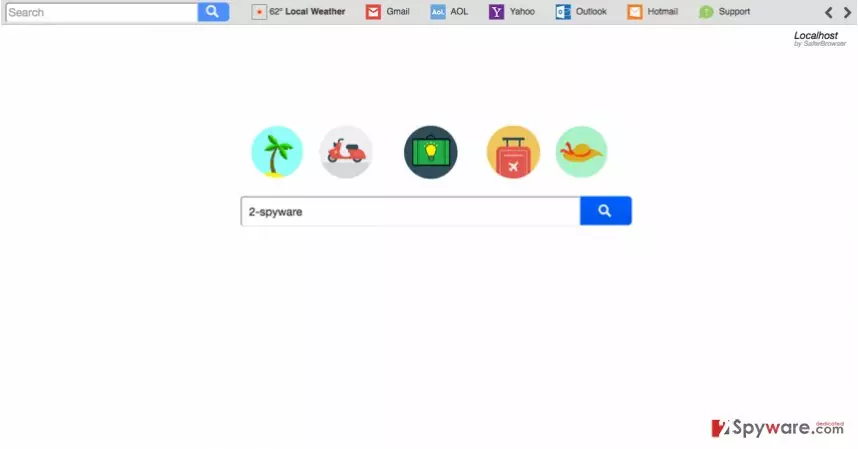
Typically to browser hijackers, this virus may drain your computer’s resources which will most likely result in a slowdown of the system. Various system errors may start to emerge, and your browser may crash more frequently. In case you notice similar signs on your computer, react quickly and scan it with some anti-malware utility to prevent potential damage. Another reason to hurry up with the Search.sh-cmf.com removal is related to data tracking. Once the virus enters your computer, it will start collecting information about your IP address, most visited sites, viewed pages and other data it finds necessary. Undoubtedly, the hijacker creators will try to justify this information tracking by claiming the collected data to be of non-personal origin. Even if this data is really non-personal, it may provide some useful information which can later be used for more appealing advertising. And since the virus developers have full power over this data, they can sell or share it with some unknown third parties whenever they please.
How can you stop the browser hijacker before it infects your system:
Browser hijackers are not malicious themselves. But what they can do is draw some other malware on your computer. It may try offering you to obtain some obscure software which is bundled with adware, worms or other viruses. In fact, Search.sh-cmf.com itself spread in exactly the same way. It travels attached to legitimate programs, hidden in the advanced setup setting and hope to enter computers undetected. Luckily, the virus can quickly be spotted while installing new software using the mentioned “Advanced” or “Custom” modes. One of the installation windows may offer you to make Search.sh-cmf.com your default search engine and homepage. This option will be pre-marked for you, so all you have to do to stop its installation is to unmark it.
Recommendations on the Search.sh-cmf.com removal:
When users get infected with browser hijackers, they often become impatient because the virus tends to reappear over and over again, if the uninstall is not carried out properly. In fact, there is a simple solution to a successful Search.sh-cmf.com removal. You have to obtain a trustworthy antivirus removal tool and run a full system scan. The full system analysis will ensure that your computer is virus-free and protected from the future infections as well. Some users might prefer uninstalling viruses manually. We have taken this demand into account and offer you professional guidelines which you can freely use to remove Search.sh-cmf.com from your computer. The instructions are provided below the article.
Uninstall from Windows
Uninstall from Windows 10/8:
- Type Control Panel into the Windows search box and open the result.
- Under Programs, select Uninstall a program.


Uninstall from Windows 7/XP:
- Click on Windows Start > Control Panel (Windows XP users should click on Add/Remove Programs).
- In Control Panel, select Programs > Uninstall a program.


Remove the unwanted program:
- In the Programs and Features window, look for any recently installed suspicious entries, select them, and click Uninstall.
- If User Account Control appears, click Yes to confirm, then complete the removal.


Delete from macOS
Remove the unwanted application:
- From the menu bar, select Go > Applications.
- In the Applications folder, look for any suspicious entries, then drag them to Trash (or right-click and pick Move to Trash).


Delete leftover files and folders:
- Select Go > Go to Folder.
- Enter /Library/Application Support and remove any suspicious folders related to the unwanted program.
- Repeat the same check in the /Library/LaunchAgents and /Library/LaunchDaemons folders, deleting any suspicious entries.

- Finally, empty the Trash to permanently remove the leftovers.

Remove from Microsoft Edge
Delete unwanted extensions from MS Edge:
- Select Menu (three horizontal dots at the top-right of the browser window) and pick Extensions.
- From the list, pick the extension and click on the Gear icon.
- Click Remove.


Clear cookies and other browser data:
- Click on the Menu (three horizontal dots at the top-right of the browser window) and select Settings > Privacy, search, and services..
- Under Clear browsing data, pick Choose what to clear.
- Select Cookies and other site data and Cached images and files. (apart from passwords, although you might want to include Media licenses as well, if applicable) and click on Clear.


Restore new tab and homepage settings:
- Click the menu icon and choose Settings.
- Then find On startup section.
- Click Remove next to any suspicious startup page.
Reset MS Edge if the above steps did not work:
- Press on Ctrl + Shift + Esc to open Task Manager.
- Click on More details arrow at the bottom of the window.
- Select Details tab.
- Now scroll down and locate every entry with Microsoft Edge name in it. Right-click on each of them and select End Task to stop MS Edge from running.


Instructions for Chromium-based Edge
Delete extensions from MS Edge (Chromium):
- Open Edge and click select Settings > Extensions.
- Delete unwanted extensions by clicking Remove.


Clear cache and site data:
- Click on Menu and go to Settings.
- Select Privacy, search and services.
- Under Clear browsing data, pick Choose what to clear.
- Under Time range, pick All time.
- Select Clear now.


Reset Chromium-based MS Edge:
- Click on Menu and select Settings.
- On the left side, pick Reset settings.
- Select Restore settings to their default values.
- Confirm with Reset.
- This will disable extensions and reset startup pages but will not delete bookmarks, saved passwords, or browsing history.


Remove from Mozilla Firefox (FF)
Remove dangerous extensions:
- Open Mozilla Firefox browser and click on the Menu (three horizontal lines at the top-right of the window).
- Select Add-ons.
- In here, select the unwanted extension and click Remove.


Reset the homepage:
- Click three horizontal lines at the top right corner to open the menu.
- Choose Settings.
- Under Home, set your preferred homepage and new tab settings.
Clear cookies and site data:
- Click Menu and pick Settings.
- Go to Privacy & Security section.
- Scroll down to locate Cookies and Site Data.
- Click on Clear Data...
- Select Cookies and Site Data and Temporary cached files and pages, then click Clear.


Reset Mozilla Firefox
If clearing the browser as explained above did not help, reset Mozilla Firefox:
- Open Mozilla Firefox browser and click the Menu.
- Go to Help and then choose Troubleshooting Information.

- Under Give Firefox a tune up section, click on Refresh Firefox...
- Once the pop-up shows up, confirm the action by pressing on Refresh Firefox.



Remove from Google Chrome
Delete malicious extensions from Google Chrome:
- Open Google Chrome, click on the Menu (three vertical dots at the top-right corner) and select More tools > Extensions.
- In the newly opened window, you will see all the installed extensions. Uninstall all suspicious extensions related to the unwanted program by clicking Remove.


Clear cache and web data from Chrome:
- Click on Menu and pick Settings.
- Under Privacy and security, select Clear browsing data.
- Select Browsing history, Cookies and other site data, as well as Cached images and files.
- Click Clear data.


Change your homepage:
- Click menu and choose Settings.
- Look for a suspicious site in the On startup section.
- Click on Open a specific or set of pages and click on three dots to find the Remove option.
Reset Google Chrome:
If the previous methods did not help you, reset Google Chrome to eliminate all the unwanted components:
- Click on Menu and select Settings.
- In the Settings, scroll down and click Advanced.
- Scroll down and locate Reset and clean up section.
- Now click Restore settings to their original defaults.
- Confirm with Reset settings.


Delete from Safari
Remove dangerous extensions:
- Open Safari, click Safari in the menu at the top-left of the screen, and select Preferences.
- Go to the Extensions tab, look for any suspicious entries, and click Uninstall to remove them.


Clear history and website data:
- Click Safari in the menu and pick Clear History.
- Set Clear to all history and confirm with Clear History.


Reset Safari:
- Click Safari in the menu and select Preferences > Advanced.
- Enable Show Develop menu in menu bar.
- From the menu bar, click Develop and select Empty Caches.


Did this guide help?
3 comments
Wernon
These localhost viruses are so common these days.. And they are on many different domains too!
Enthremo34
We had this infection on our home computer.. Good thing Ive read about Reimage and downloaded it :)
Trumpinna
Annoying as heck! The removal did not work