

The essential facts about search-shield.com virus
While choosing a new search engine, you need to be careful not to run into search-shield.com virus. This search provider is classified as a browser hijacker. Thus, you should not expect much from this browsing tool. It might not deliver the most relevant search results as you expect. What is more, continuously popping up ads might make you blow a fuse. The redirect tendency might become a great disturbance since it prevents you from reaching preferred websites in time. These are only a few suggestions why you should not keep this hijacker on the computer. If you are not convinced to start search-shield.com removal, then keep reading further.
One of the main things which help you distinguish between an ordinary search engine and a browser hijacker is the domain name. Note that questionable browsing tools bear random names or too commercial ones. Usually, you might see such search providers as search.mysafetab.com, gosearchonlinenow.com, or stabx.xyz. Such domain titles should restrain you from using or installing similar browsing tools. Speaking about this particular PUP, you might get deceived by its feature to use Bing as the main database. However, the browser hijacker still employs its certain layer, through which it delivers different search results.
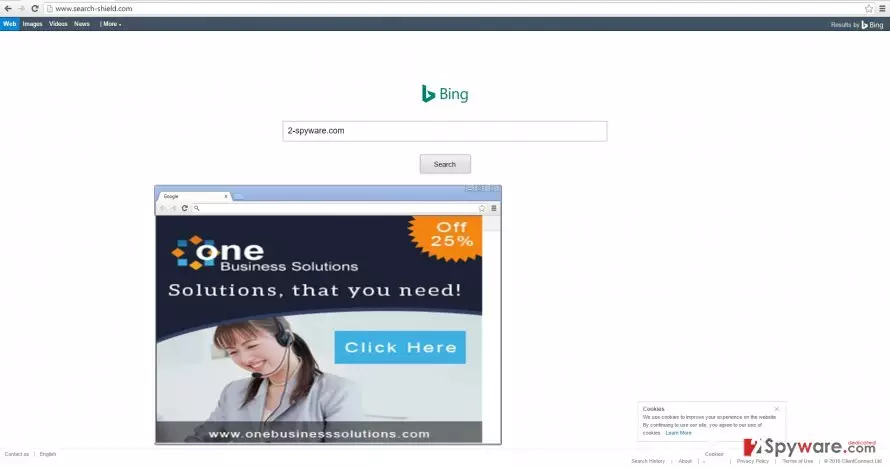
This PUP, created by ClientConnect Ltd, cooperates with third-parties. In exchange for their support, they promote their products or certain web pages to you. You may be redirected to their domains after clicking ads and commercial websites. In addition, you might get bothered by search-shield.com redirect problem. Due to this peculiarity, you get misled to other domains other than your primary choice. It is common for the majority of browser hijackers since they are obliged to advertise their partner’s services and websites. However, the main problem is that those domains are not always secure. Crooks use them to disguise various malware in there. It would be wise to remove search-shield.com as soon as possible. FortectIntego is one of the programs which would help you speed up the process.
How does the hijacker invade the PC?
The hijack might have taken place when you were installing a new application. You might admit to committing the same mistake of not properly reviewing the installation guide as the majority of users did. As a result of this vice, the PUP easily settled on the computer. If you are interested in how you can spot Search Shield, opt for the “Custom” settings before initiating the installation process. Another significant step is to unmark all optional add-ons. If you leave them pre-marked, do not surprised when your homepage is replaced with a suspicious search engine or a couple of questionable programs are wandering across the operating system.
Remove search-shield.com quickly
It is not difficult to exterminate browser hijacker if you employ an anti-spyware application. Make sure it is updated. It is crucial to locate all files related to this hijacker so newest virus definitions should be obtained. In addition, the software will save your time as it is programmed to track potential threats significantly faster than human eye. Moreover, some users might struggle to identify which files are of malicious origin. Nonetheless, the users who are confident in performing the elimination independently might try deleting the hijacker with the help of manual instructions. In that case, find the uninstallation guidelines provided below.
Uninstall from Windows
Uninstall from Windows 10/8:
- Type Control Panel into the Windows search box and open the result.
- Under Programs, select Uninstall a program.


Uninstall from Windows 7/XP:
- Click on Windows Start > Control Panel (Windows XP users should click on Add/Remove Programs).
- In Control Panel, select Programs > Uninstall a program.


Remove the unwanted program:
- In the Programs and Features window, look for any recently installed suspicious entries, select them, and click Uninstall.
- If User Account Control appears, click Yes to confirm, then complete the removal.


Delete from macOS
Remove the unwanted application:
- From the menu bar, select Go > Applications.
- In the Applications folder, look for any suspicious entries, then drag them to Trash (or right-click and pick Move to Trash).


Delete leftover files and folders:
- Select Go > Go to Folder.
- Enter /Library/Application Support and remove any suspicious folders related to the unwanted program.
- Repeat the same check in the /Library/LaunchAgents and /Library/LaunchDaemons folders, deleting any suspicious entries.

- Finally, empty the Trash to permanently remove the leftovers.

Remove from Microsoft Edge
Delete unwanted extensions from MS Edge:
- Select Menu (three horizontal dots at the top-right of the browser window) and pick Extensions.
- From the list, pick the extension and click on the Gear icon.
- Click Remove.


Clear cookies and other browser data:
- Click on the Menu (three horizontal dots at the top-right of the browser window) and select Settings > Privacy, search, and services..
- Under Clear browsing data, pick Choose what to clear.
- Select Cookies and other site data and Cached images and files. (apart from passwords, although you might want to include Media licenses as well, if applicable) and click on Clear.


Restore new tab and homepage settings:
- Click the menu icon and choose Settings.
- Then find On startup section.
- Click Remove next to any suspicious startup page.
Reset MS Edge if the above steps did not work:
- Press on Ctrl + Shift + Esc to open Task Manager.
- Click on More details arrow at the bottom of the window.
- Select Details tab.
- Now scroll down and locate every entry with Microsoft Edge name in it. Right-click on each of them and select End Task to stop MS Edge from running.


Instructions for Chromium-based Edge
Delete extensions from MS Edge (Chromium):
- Open Edge and click select Settings > Extensions.
- Delete unwanted extensions by clicking Remove.


Clear cache and site data:
- Click on Menu and go to Settings.
- Select Privacy, search and services.
- Under Clear browsing data, pick Choose what to clear.
- Under Time range, pick All time.
- Select Clear now.


Reset Chromium-based MS Edge:
- Click on Menu and select Settings.
- On the left side, pick Reset settings.
- Select Restore settings to their default values.
- Confirm with Reset.
- This will disable extensions and reset startup pages but will not delete bookmarks, saved passwords, or browsing history.


Remove from Mozilla Firefox (FF)
Remove dangerous extensions:
- Open Mozilla Firefox browser and click on the Menu (three horizontal lines at the top-right of the window).
- Select Add-ons.
- In here, select the unwanted extension and click Remove.


Reset the homepage:
- Click three horizontal lines at the top right corner to open the menu.
- Choose Settings.
- Under Home, set your preferred homepage and new tab settings.
Clear cookies and site data:
- Click Menu and pick Settings.
- Go to Privacy & Security section.
- Scroll down to locate Cookies and Site Data.
- Click on Clear Data...
- Select Cookies and Site Data and Temporary cached files and pages, then click Clear.


Reset Mozilla Firefox
If clearing the browser as explained above did not help, reset Mozilla Firefox:
- Open Mozilla Firefox browser and click the Menu.
- Go to Help and then choose Troubleshooting Information.

- Under Give Firefox a tune up section, click on Refresh Firefox...
- Once the pop-up shows up, confirm the action by pressing on Refresh Firefox.



Remove from Google Chrome
Delete malicious extensions from Google Chrome:
- Open Google Chrome, click on the Menu (three vertical dots at the top-right corner) and select More tools > Extensions.
- In the newly opened window, you will see all the installed extensions. Uninstall all suspicious extensions related to the unwanted program by clicking Remove.


Clear cache and web data from Chrome:
- Click on Menu and pick Settings.
- Under Privacy and security, select Clear browsing data.
- Select Browsing history, Cookies and other site data, as well as Cached images and files.
- Click Clear data.


Change your homepage:
- Click menu and choose Settings.
- Look for a suspicious site in the On startup section.
- Click on Open a specific or set of pages and click on three dots to find the Remove option.
Reset Google Chrome:
If the previous methods did not help you, reset Google Chrome to eliminate all the unwanted components:
- Click on Menu and select Settings.
- In the Settings, scroll down and click Advanced.
- Scroll down and locate Reset and clean up section.
- Now click Restore settings to their original defaults.
- Confirm with Reset settings.


Delete from Safari
Remove dangerous extensions:
- Open Safari, click Safari in the menu at the top-left of the screen, and select Preferences.
- Go to the Extensions tab, look for any suspicious entries, and click Uninstall to remove them.


Clear history and website data:
- Click Safari in the menu and pick Clear History.
- Set Clear to all history and confirm with Clear History.


Reset Safari:
- Click Safari in the menu and select Preferences > Advanced.
- Enable Show Develop menu in menu bar.
- From the menu bar, click Develop and select Empty Caches.


Did this guide help?
3 comments
wayne
Who does this search engine protect from?
MaggieSm77
The removal took 6 minutes.
Deborah
One company changes another..and we still manage to install these browser hijackers.