

The description of Search.theweathercenter.co hijacker
Search.theweathercenter.co virus is a typical Internet browser hijacker that spreads through software bundles and integrates sponsored content within search results. It adds The Weather Center New Tab (by Safer Browser) to the browser and implements some adjustments in its settings then. First of all, it replaces homepage address with Search.theweathercenter.co and also sets this URL as a default new tab page, and also as the main search engine. At the first sight, the activity of this browser hijacker does not seem infectious or severe at all, but all dangers are hiding behind the search engine that is provided on that website. Although it pretends to be an advantageous search tool, experts say that it is better to stay away from it.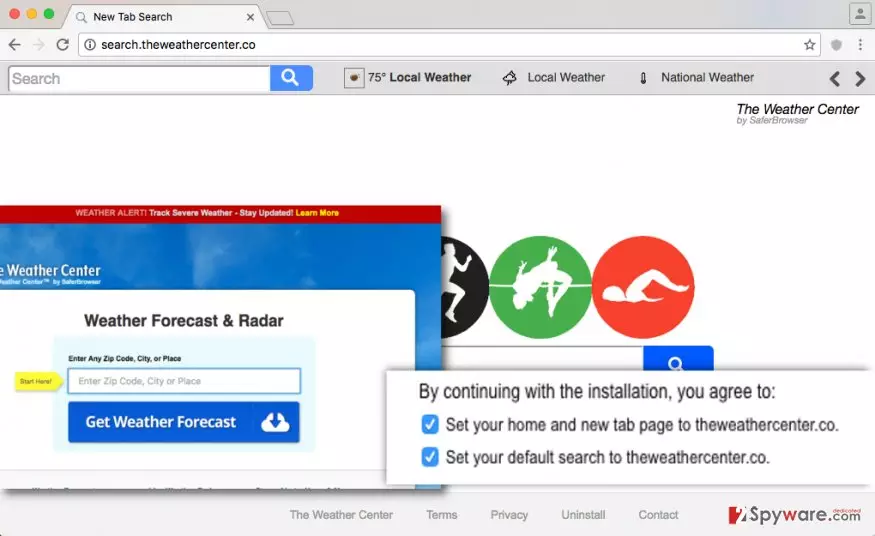
Some of its search results can be modified and contain links leading to external third-party websites, which might be insecure. Please bear in mind that this browser hijacker is not malicious itself, but links that it injects into Query.theweathercenter.co search results can be dangerous. If you decide to visit them, please, stay away from suggestions to install files, programs, software updates, and other suspicious components to your computer system. Otherwise, you might end up cluttering the PC with useless ad-supported apps or severe computer parasites. To avoid visiting insecure web pages, we suggest using another search engine, ideally, a one that has a better reputation than the discussed one. Sadly, you will quickly find out that it is not that easy to remove Search.theweathercenter.co from your browser. It refuses to leave homepage and new tab page position that easily; to complete Search.theweathercenter.co removal, you will need to scan your computer system with malware removal tool, for instance, FortectIntego.
Methods of distribution
Search.theweathercenter.co hijack could happen recently. Try to remember when was the last time you installed a free computer program? Most likely, this browser hijacker came into your computer system alongside it. It is so because such potentially unwanted programs are distributed next to other free programs most of the time. They can arrive at the computer system along download managers, media players, and other free programs that can be downloaded from the Internet charge-free. When you download such free program to your PC, make sure you get rid of all additional components added to it. For that, open its installer and go to installation settings. Configure additional components via Advanced or Custom settings by deselecting unwanted ones, and proceed with the installation then. As you can see, it is way easier to avoid PUPs than you thought!
Search.theweathercenter.co removal
Search.theweathercenter.co redirect issue is one of the most annoying things in the world, and if you do not like to experience system slowdowns, crashes, redirects, receive pop-up ads, and encounter other issues, it is better to remove Search.theweathercenter.co virus. Please be very attentive and remove all of its components to keep your computer system clean. We also suggest scanning your computer system with anti-malware software afterward just to be sure that there are no other spyware or malware threats on the whole computer system. Such malware removal software also can be used for Search.theweathercenter.co removal, of course.
Uninstall from Windows
Uninstall from Windows 10/8:
- Type Control Panel into the Windows search box and open the result.
- Under Programs, select Uninstall a program.


Uninstall from Windows 7/XP:
- Click on Windows Start > Control Panel (Windows XP users should click on Add/Remove Programs).
- In Control Panel, select Programs > Uninstall a program.


Remove the unwanted program:
- In the Programs and Features window, look for any recently installed suspicious entries, select them, and click Uninstall.
- If User Account Control appears, click Yes to confirm, then complete the removal.


Delete from macOS
Remove the unwanted application:
- From the menu bar, select Go > Applications.
- In the Applications folder, look for any suspicious entries, then drag them to Trash (or right-click and pick Move to Trash).


Delete leftover files and folders:
- Select Go > Go to Folder.
- Enter /Library/Application Support and remove any suspicious folders related to the unwanted program.
- Repeat the same check in the /Library/LaunchAgents and /Library/LaunchDaemons folders, deleting any suspicious entries.

- Finally, empty the Trash to permanently remove the leftovers.

Reset Internet Explorer
Remove dangerous add-ons:
- Open Internet Explorer, click on the Gear icon (IE menu) on the top-right corner of the browser
- Pick Manage Add-ons.
- You will see a Manage Add-ons window. Here, look for suspicious plugins. Click on these entries and select Disable.


Change your homepage if it was altered:
- Open IE and click on the Gear icon.
- Select Internet Options.
- In the General tab, delete the Home page address and replace it by your preferred one (for example, Google.com).
- Click Apply and then select OK.


Delete temporary files:
- Press on the Gear icon and select Internet Options.
- Under Browsing history, click Delete...
- Select relevant fields and press Delete.


Reset Internet Explorer:
- Click on Gear icon > Internet options and select Advanced tab.
- Select Reset.
- In the new window, check Delete personal settings and select Reset.


Remove from Mozilla Firefox (FF)
Remove dangerous extensions:
- Open Mozilla Firefox browser and click on the Menu (three horizontal lines at the top-right of the window).
- Select Add-ons.
- In here, select the unwanted extension and click Remove.


Reset the homepage:
- Click three horizontal lines at the top right corner to open the menu.
- Choose Settings.
- Under Home, set your preferred homepage and new tab settings.
Clear cookies and site data:
- Click Menu and pick Settings.
- Go to Privacy & Security section.
- Scroll down to locate Cookies and Site Data.
- Click on Clear Data...
- Select Cookies and Site Data and Temporary cached files and pages, then click Clear.


Reset Mozilla Firefox
If clearing the browser as explained above did not help, reset Mozilla Firefox:
- Open Mozilla Firefox browser and click the Menu.
- Go to Help and then choose Troubleshooting Information.

- Under Give Firefox a tune up section, click on Refresh Firefox...
- Once the pop-up shows up, confirm the action by pressing on Refresh Firefox.



Remove from Google Chrome
Delete malicious extensions from Google Chrome:
- Open Google Chrome, click on the Menu (three vertical dots at the top-right corner) and select More tools > Extensions.
- In the newly opened window, you will see all the installed extensions. Uninstall all suspicious extensions related to the unwanted program by clicking Remove.


Clear cache and web data from Chrome:
- Click on Menu and pick Settings.
- Under Privacy and security, select Clear browsing data.
- Select Browsing history, Cookies and other site data, as well as Cached images and files.
- Click Clear data.


Change your homepage:
- Click menu and choose Settings.
- Look for a suspicious site in the On startup section.
- Click on Open a specific or set of pages and click on three dots to find the Remove option.
Reset Google Chrome:
If the previous methods did not help you, reset Google Chrome to eliminate all the unwanted components:
- Click on Menu and select Settings.
- In the Settings, scroll down and click Advanced.
- Scroll down and locate Reset and clean up section.
- Now click Restore settings to their original defaults.
- Confirm with Reset settings.


Delete from Safari
Remove dangerous extensions:
- Open Safari, click Safari in the menu at the top-left of the screen, and select Preferences.
- Go to the Extensions tab, look for any suspicious entries, and click Uninstall to remove them.


Clear history and website data:
- Click Safari in the menu and pick Clear History.
- Set Clear to all history and confirm with Clear History.


Reset Safari:
- Click Safari in the menu and select Preferences > Advanced.
- Enable Show Develop menu in menu bar.
- From the menu bar, click Develop and select Empty Caches.


Did this guide help?
4 comments
Asya
Honestly, dont install theweathercenter if you do not want to be bothered by redirects and ads every day!
Julia
i am so glad I have already killed this virus. Had to reset my browsers but it was so worth it.
Gina
still cant find it on my pc...
Lecter
So I finally found what the problem was! No more redirects now. Good article, thanks for providing such detailed report.