
Trojan.Downloader: what it is and how to remove it
Trojan.Downloader is a general term for trojans designed to download and install other malware on your computer without your knowledge. This infection operates in the background, creating damage and stealing data while remaining undetected until serious compromise occurs.
Facts checked October 5, 2026. Removal steps tested on Windows 11 (26H2) and checked against Microsoft's and the browser makers' current documentation. Sections marked as our earlier report are the original text: they describe the threat as it was then and have not been reviewed since. The 2026 status, the removal steps and the questions are current.
Automatic
Get a free scan and check if your PC is infected.
Fortect finds malware, unwanted programs and the Windows damage they leave behind, and repairs it in one pass.
An automatic scan checks installed programs, startup items and browser extensions for anything that came with Trojan.Downloader.
Do it yourself · free Remove Trojan.Downloader yourself 5 steps, about 15 minutes, no software needed.
Start the steps
Trojan.Downloader: summary
| Distribution | The particular malware spreads using malicious files, phishing links. Trojan can infiltrate the machine silently and undetected, so the infiltration is not noticed |
|---|---|
| Name | Trojan.Downloader |
| Type | Trojan horse[2] |
| Purpose | Malware is created to spread other threats, inject payload files, drop malicious data, applications, and launch other operations that a malicious actor wants to trigger |
| Danger | Trojans can infect machines with other threats and steal data directly from the system using other tools. There are many layers this malware might have to achieve creators' goals |
| Detection names | No Microsoft detection name is known |
| Removal | Scan the PC with security software to find and remove the malware and anything installed with it. Fortect scans Windows for malware and repairs the system files and settings it damaged. Remove it nowTo use the full-featured product, you have to purchase a license for Fortect. The scan is free. |
Show 5 more facts
| Damage | Not recorded in the old report |
|---|---|
| Symptoms | An unknown program in Installed apps |
| Evidence | 4 write-ups by security sites; details still limited |
| First seen | 23 July 2020 |
| Facts checked | 5 October 2026 |
What Trojan.Downloader does on an infected PC
From our report of Jul 2020 · not reviewed since
Trojan.Downloader is the general term used to describe trojans designed to download other malware on the machine
Trojan.Downloader is the type of trojan horse that installs files, malware, and malicious applications.
It may look like a legitimate program or file, but it is malicious in nature. In most cases, these threats get downloaded without users' knowledge or consent, so this virus has the main purpose of creating damage, stealing, and disrupting data.
The intruder gets downloaded on the computer, so it can run in the background freely. Trojan can even download and install new versions of itself, drop the payload of ransomware-type threats, and trigger other more noticeable symptoms.
However, the purpose of Trojan.Downloader virus is to remain undetected until the confidential, personal, sensitive information is stolen, obtained, or the machine gets compromised. It is focusing on secret downloads and operations involving remote server that helps with malicious executions and file downloads.
It may only work when there is an internet connection, so it can connect to a remote server, but once malware gets injected, the system gets affected regardless of the internet. There are many similar threats that fall under this term like JSDownloader or Ymacco Trojan.
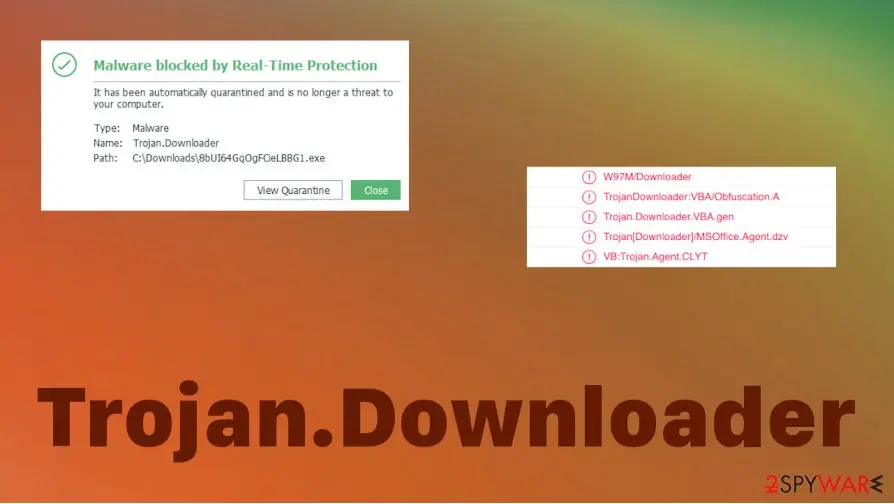
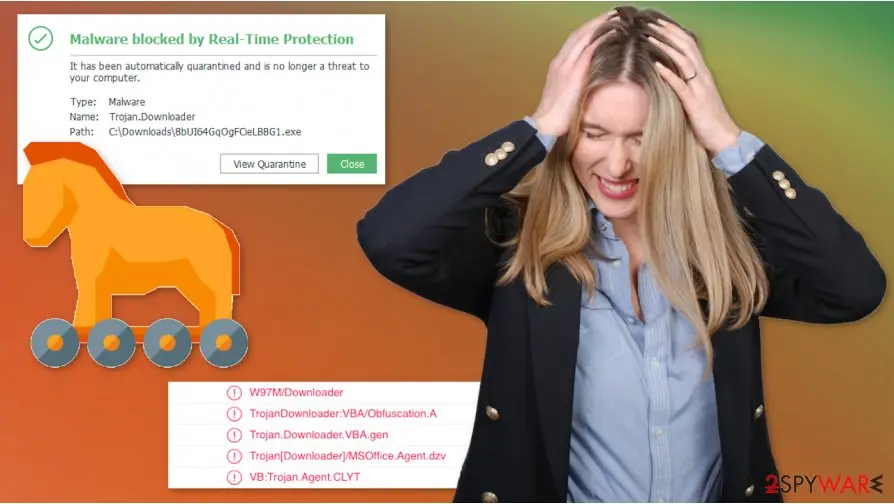
Generally, Trojan.Downloader is the detection that appears on the AV program windows after a system check. A trojan horse can be distributed when it is downloaded from the email as an attachment or delivered from a malicious link. Exploit kits and malicious sites can often be used in such campaigns.
No matter what method is used to spread the particular version of Trojan.Downloader. Since this is the more general term, you may have a particular infection on the machine. There are tons of them, and researchers have described many of them. Unfortunately, there are ransomware and cryptojacking threats that get detected with this result.
Try to remove Trojan.Downloader once the AV engine shows you the detection name on the screen. Do not wait for long since there are dangerous trojans and other types of malware associated with such detection result:
Trojan.Downloader cannot cipher information on the machine, nor trigger particular issues on the targeted computer. You cannot tell when the initial infiltration happened, so you need to react as soon as anything suspicious occurs on the device. The best way to tackle such infection is the proper anti-malware tool selection that can find and delete traces of the virus properly.
You should pay attention to the fact that there are many threats like this Trojan.Downloader virus, so you can encounter the threat one way or another. It many spread ransomware, so when you try to remove any cryptovirus, and you see the result with this detection it is pretty much known how the extortion-based virus cam to your PC.
Trojan.Downloader removal is a very important process because when the malware is added on the system it starts to run in the background to achieve the needed goals. It can:
- Trojan-Downloader:FraudLoad
- Trojan-Downloader:W32/JQCN
- Trojan-Downloader:OSX/Jahlev.A
- Trojan-Downloader:W32/Bredolab
- Trojan-Downloader.JPUY
- install and run programs;
- steal data from the machine;
- inject direct malware payload;
- open backdoors for remote hackers;
- record direct keystrokes.
From our report of Jul 2020 · not reviewed since
More from our earlier report on Trojan.Downloader
- You need to remove Trojan.Downloader as soon as you encounter any suspicious symptoms, so you can clear any associated malware at the same time
- Since the trojan is running in the background for a while possibly, your device can get damaged.
- Find corrupted or affected parts with the help of
How Trojan.Downloader got on your PC
From our report of Jul 2020 · not reviewed since
There are tons of email campaigns that can spread this or any other malware around.
Those emails mainly include file attachments, links in the notification itself, and redirects to more malicious sites, hacked copies of legitimate platforms. You may encounter some fake alerts with notices about software licenses and declarations about illegal activities.
If you click on any malicious content or allow processes to run, you may trigger the infiltration of malware like this or even other programs that cause further damage. Phishing email campaigns can be noticed, if you find suspicious material and delete the notification, avoid clicking on anything. You need to pay attention to various materials, especially the ones that you encounter online.
Avoid pirating and torrent sites, rely on proper software sources, do not get scared by scammy messages, read into everything, so you cannot become a victim of an online scam. Run the AV tool more often, so malicious content gets blocked before trojan infiltration happens.
How to remove Trojan.Downloader
A loader's job is to install other malware, so treat the PC as infected with more than one program until the scans are clean.
Step 1: Delete scheduled tasks that bring it back
Open Task Scheduler from the Start menu and click Task Scheduler Library. Select each task you do not recognise and read the Actions tab:
- a task that starts a file in
%AppData%or%Temp% - runs
powershellwith a long encoded line - opens a web address belongs to Trojan.Downloader or a similar program
Right-click such a task and choose Delete, and check the subfolders too. Leave tasks from Microsoft, your PC's maker and programs you use. Task Scheduler is the same in Windows 11 and Windows 10.

Windows 11: Task Scheduler Library, the task selected, the Actions tab shows the file it runs. Full procedure with screenshots: Remove what malware leaves behind in Windows
- a task that starts a file in
Step 2: Remove it from startup
Whatever Trojan.Downloader installed usually starts with Windows. Open Task Manager with Ctrl + Shift + Esc, go to Startup apps in Windows 11 or the Startup tab in Windows 10, and disable what you do not know, starting with entries that have an empty Publisher column.
Open file location on the right-click menu shows the file, which helps you decide and tells you what to delete later. Disabling is safe: if something you need stops working, switch it back on.
Full procedure with screenshots: Stop apps from opening at startup On uGetFix
Step 3: Delete the folders left behind
What the uninstaller leaves behind is usually in the user folders. Open File Explorer, switch on View > Show > Hidden items (in Windows 10 View > Hidden items), and go through
%LocalAppData%,%AppData%, %ProgramData% and the two Program Files folders.Sort by Date modified and delete folders that appeared together with the problem and belong to no program you use. Folders with random names that hold
.exe,.dll, .js or .ps1 files are the strongest sign.Full procedure with screenshots: Remove what malware leaves behind in Windows
Step 4: Scan the PC, then run the offline scan
Open Windows Security > Virus & threat protection > Scan options, run a Full scan and remove everything it finds. Then select Microsoft Defender Antivirus (offline scan) and click Scan now: the PC restarts and scans before Windows loads, which finds files that hide while Windows runs.
Save your work first, because the offline scan takes about 15 minutes. Both scans are built into Windows 11 and Windows 10, and a second scanner from another vendor is a useful extra opinion.

Windows 11: Windows Security > Virus & threat protection > Scan options. Full procedure with screenshots: Run a Microsoft Defender Offline scan
Step 5: Change passwords from another device and sign out other sessions
Assume that the passwords saved in this PC's browsers, and the accounts that were open in them, are known to the attacker. From a phone or a clean computer, change the e-mail password first, then banking, shopping, social and gaming accounts.
Use each service's option to sign out of all other sessions, because stolen cookies keep a session open even after a password change. Turn on two-step verification on each account. Wait with the infected Windows 11 or Windows 10 PC until the scans are clean.
Full procedure with screenshots: Turn on two-step verification / secure a hacked account
Instructions for each browser and system
The detailed steps for every browser and system this guide covers. Open the one you use.
Manual removal using Safe Mode
Important! →
Manual removal guide might be too complicated for regular computer users. It requires advanced IT knowledge to be performed correctly (if vital system files are removed or damaged, it might result in full Windows compromise), and it also might take hours to complete. Therefore, we highly advise using the automatic method provided above instead.
Step 1. Access Safe Mode with Networking
Manual malware removal should be best performed in the Safe Mode environment.
Windows 7 / Vista / XP
- Click Start > Shutdown > Restart > OK.
- When your computer becomes active, start pressing F8 button (if that does not work, try F2, F12, Del, etc. - it all depends on your motherboard model) multiple times until you see the Advanced Boot Options window.
- Select Safe Mode with Networking from the list.

Windows 10 / Windows 8
- Right-click on Start button and select Settings.

- Scroll down to pick Update & Security.

- On the left side of the window, pick Recovery.
- Now scroll down to find Advanced Startup section.
- Click Restart now.

- Select Troubleshoot.

- Go to Advanced options.

- Select Startup Settings.

- Press Restart.
- Now press 5 or click 5) Enable Safe Mode with Networking.

Step 2. Shut down suspicious processes
Windows Task Manager is a useful tool that shows all the processes running in the background. If malware is running a process, you need to shut it down:
- Press Ctrl + Shift + Esc on your keyboard to open Windows Task Manager.
- Click on More details.

- Scroll down to Background processes section, and look for anything suspicious.
- Right-click and select Open file location.

- Go back to the process, right-click and pick End Task.

- Delete the contents of the malicious folder.
Step 3. Check program Startup
- Press Ctrl + Shift + Esc on your keyboard to open Windows Task Manager.
- Go to Startup tab.
- Right-click on the suspicious program and pick Disable.

Step 4. Delete virus files
Malware-related files can be found in various places within your computer. Here are instructions that could help you find them:
- Type in Disk Cleanup in Windows search and press Enter.

- Select the drive you want to clean (C: is your main drive by default and is likely to be the one that has malicious files in).
- Scroll through the Files to delete list and select the following:
Temporary Internet Files
Downloads
Recycle Bin
Temporary files - Pick Clean up system files.

- You can also look for other malicious files hidden in the following folders (type these entries in Windows Search and press Enter):
%AppData%
%LocalAppData%
%ProgramData%
%WinDir%
After you are finished, reboot the PC in normal mode.
From our report of Jul 2020 · not reviewed since
Perform the full virus elimination process, so you get rid of the Trojan.Downloader virus
You may encounter issues with the system when a threat like Trojan.Downloader virus is installed, but you cannot know what causes these problems with the machine.
This is why we always recommend having a powerful anti-malware tool on hand that can check the system for various threats and intruders.
You should remove Trojan.Downloader as soon as your AV engine indicates the threat. Or you can check the system with or if you find anything suspicious with the device and performance of the computer. Try to use at least a few tools if you cannot find anything malicious. There are many databases that AV tools can rely on.
When you successfully achieve the wanted results of Trojan.Downloader removal, you should also think about the things that Trojan may have done to your device. There are features that get disabled and various functions that trojan triggers to run or stops operating. Try to check for affected files using and repair those issues.
[GI=method-1]Reboot the machine in Safe Mode with Networking and clear the Trojan.Downloader virus with AV tool
[GI=method-2]Make the system virus-free by using the System Restore function
After removal: passwords, accounts and prevention
Secure your accounts after the clean-up
Assume that whatever was saved in the browsers on this PC while the PC showed trojan.Downloader in the list of installed apps has been copied:
- passwords
- cookies
- autofill data
Work from a clean device, or from this PC once the offline scan finds nothing.
Start with your main e-mail account, because it can reset everything else, then banking and payment, then social and gaming accounts. Change each password, sign out of all sessions and turn on two-step verification: Turn on two-step verification / secure a hacked account.
The full order, including crypto wallets and card replacement, is in securing your accounts after malware.
Choose a proper web browser and improve your safety with a VPN tool
Online spying has got momentum in recent years and people are getting more and more interested in how to protect their privacy online.
One of the basic means to add a layer of security - choose the most private and secure web browser. Although web browsers can't grant full privacy protection and security, some of them are much better at sandboxing, HTTPS upgrading, active content blocking, tracking blocking, phishing protection, and similar privacy-oriented features.
However, if you want true anonymity, we suggest you employ a powerful VPN - it can encrypt all the traffic that comes and goes out of your computer, preventing tracking completely.
Lost your files? Use data recovery software
While some files located on any computer are replaceable or useless, others can be extremely valuable.
Family photos, work documents, school projects - these are types of files that we don't want to lose. Unfortunately, there are many ways how unexpected data loss can occur:
- power cuts
- Blue Screen of Death errors
- hardware failures
- crypto-malware attack
- even accidental deletion
To ensure that all the files remain intact, you should prepare regular data backups. You can choose cloud-based or physical copies you could restore from later in case of a disaster. If your backups were lost as well or you never bothered to prepare any, can be your only hope to retrieve your invaluable files.
Questions about Trojan.Downloader
What is Trojan.Downloader?
Trojan.Downloader is the general term describing trojans engineered specifically to download other malware and malicious applications onto your machine. It may appear as a legitimate program or file, but it operates with purely malicious intent. These threats get downloaded without users' knowledge or consent, focusing on creating damage, stealing data, and disrupting your computer's normal operation.
The intruder runs in the background freely, and can even download new versions of itself to ensure persistence. Trojan.Downloader may drop ransomware payloads, trigger other noticeable symptoms, but its primary goal is remaining undetected while confidential and personal information is stolen or your machine gets compromised.
How does Trojan.Downloader get on my computer?
Trojan.Downloader spreads using malicious files and phishing links, often arriving as email attachments or through exploit kits and malicious websites. Users typically encounter it when downloading files from compromised sources or clicking malicious links. Exploit kits automate the infection process by identifying vulnerabilities in your system and silently installing the trojan without user interaction.
The infection may occur through drive-by-download methods where malware automatically downloads just from visiting a compromised website. Phishing campaigns frequently distribute trojans through deceptive email messages that appear legitimate. Trojan.Downloader can infiltrate your machine silently and undetected, making the infiltration go completely unnoticed until significant damage has occurred.
What malware can Trojan.Downloader install?
Trojan.Downloader serves as a delivery mechanism for various dangerous threats, including other trojans, ransomware, cryptojacking malware, spyware, and keyloggers. The specific payload depends on what the malicious actor programmed it to download. Once installed, Trojan.Downloader connects to remote servers to execute commands and download additional malicious payloads.
It may remain dormant initially, only requiring internet connectivity to communicate with remote servers and receive instructions. Even without internet, once the initial malware downloads and injects into your system, damage continues regardless of connectivity status. The trojan may have multiple layers designed to achieve the creators' goals through various infection stages.
What are the dangers of Trojan.Downloader?
Trojan.Downloader poses severe dangers through multiple infection mechanisms. The malware runs in the background for extended periods, allowing time for serious system damage. It can install ransomware that encrypts all your files and demands payment for decryption keys.
It may deploy cryptojacking malware that mines cryptocurrency using your hardware. The trojan enables hackers to open backdoors for remote access to your machine, giving them complete control.
It can steal sensitive data directly from your system using additional tools. After the virus has been on your system for some time, your device can accumulate significant damage from these various threats working in parallel.
How do I detect Trojan.Downloader?
Trojan.Downloader typically appears as a detection name on your antivirus program's scan results after system checking. You cannot determine when the initial infiltration happened, making immediate reaction essential as soon as anything suspicious occurs. The infection often displays no obvious symptoms because it operates silently in the background.
However, you might notice suspicious files running in the background through Task Manager, application crashes, performance slowdowns, or unexplained system behavior changes. Running regular antivirus scans is the most reliable detection method. Without security software, you may never know Trojan.Downloader has infected your system until serious consequences become apparent.
Why do I see Trojan.Downloader if I haven't noticed problems?
Trojan.Downloader operates specifically to avoid triggering obvious symptoms, making detection difficult without security software. The malware is designed to remain undetected until confidential information is stolen or your machine gets compromised in ways that may take time to become apparent.
You cannot tell when the initial infiltration happened just by observing your system. The trojan may be quietly downloading additional malware that hasn't activated yet, or it may be stealing data in the background without causing performance issues.
Your antivirus engine detects it based on known signatures or suspicious behavior patterns, not on symptoms you would notice. This is why regular security scans are essential—they catch these silent threats before they cause noticeable damage.
Can Trojan.Downloader lead to ransomware?
Yes, Trojan.Downloader frequently serves as the delivery mechanism for ransomware infections. When you try to remove any cryptovirus and see this detection result in your antivirus scan, it's a pretty clear indication of how the extortion-based virus came to your PC. The trojan first compromises your system, then downloads and installs ransomware that encrypts your files and demands ransom payment.
This two-stage infection process makes ransomware deployments more successful because the downloader establishes persistence and disables security measures before the ransomware activates. Understanding this connection is important because it shows why immediate Trojan.Downloader removal is critical—every day you delay risks having ransomware downloaded onto your system.
How do I remove Trojan.Downloader completely?
Trojan.Downloader removal requires proper antivirus tool selection that can find and delete all traces of the virus thoroughly. Begin by rebooting your machine into Safe Mode with Networking to reduce the malware's ability to protect itself or interfere with removal.
Run your security software's full system scan using the latest virus definitions. If your current antivirus cannot remove it completely, try alternative security tools that may have different detection signatures. After removal, check for any damaged or corrupted files using system repair utilities and fix any issues.
Perform repeated scans to ensure all malicious components are completely eliminated. Since this trojan often installs multiple payloads, verify that no additional malware remains on your system after initial removal is complete.
Will Fortect remove Trojan.Downloader?
Fortect scans Windows for malware and unwanted programs and repairs the system files and settings they change, and its free scan shows what it finds on your PC before you decide anything.
For Trojan.Downloader, follow the plan above as well: the browser steps take back permissions and settings that no scanner treats as a threat, and uninstalling the program that brought it removes the source.
Run Microsoft Defender's full scan and, if anything was found, its offline scan as a second opinion. If the symptoms are gone after the plan and both scans are clean, there is nothing more to do.
Sources
- Wikipedia: Ransomware (read October 5, 2026)
- Webroot: What is a Trojan Virus? (read October 5, 2026)
- VirsuTotal: Detection name list (read October 5, 2026)
- FTC: How to recognize, remove and avoid malware (read October 5, 2026)
- Microsoft Learn: Microsoft Defender Offline (read October 5, 2026)