“Google is Tracking Your Searches” pop-ups hide dishonest marketing tricks
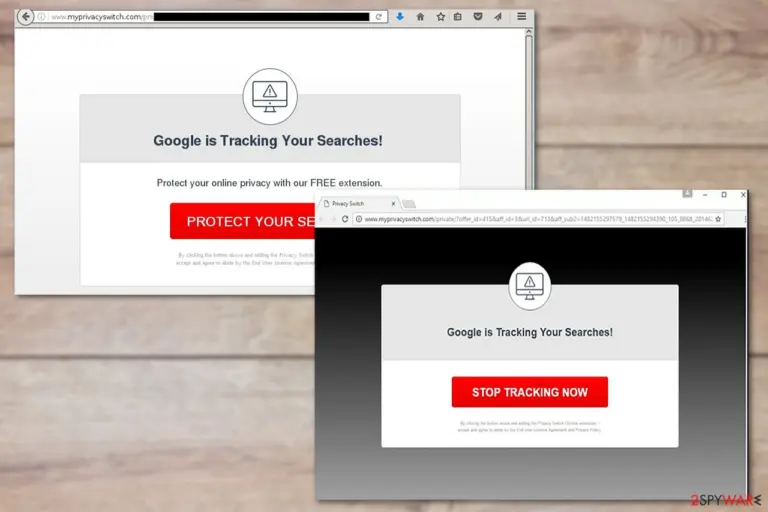
“Google is Tracking Your Searches” virus is a term that users tend to use when describing the unwanted pop-ups that start showing up on their web browser. The users are right about one thing – these pop-ups are not trustworthy and most likely signal that your PC has been infected by a sneaky adware [1] virus.
Naturally, adware victims are unaware of that. They do not give consent to the adware entering their computers. People may have downloaded freeware carrying a malicious file unknowingly when visiting shady websites. We’ll expand more on that later. But first, let us look closer at how this adware infiltrates computers and why it does it.
Name
“Turn Off Search Tracking” ads
Type
Adware, a rogue application
Category
Potentially unwanted programs
Issues
Continuous advertisements and other intrusive symptoms create frustration for people. Also, such material can expose users to malicious pages
Distribution
Other programs can install such browser-based apps freeware installations are the ones that often end up with the silent intruder drop
Elimination
Anti-malware tools are the ones that should be employed in the termination process
Repair
When the program is deleted, make sure to run FortectIntego and check for possible damage too
If you are here for “Google is Tracking Your Searches” removal instructions, you can simply skip to the end of the article where you will find all the necessary information. Browser settings can get changed by the program that controls these processes, so you need to reset those preferences yourself.
The main reason why this virus infiltrates computers is advertising. While the notification supposedly tries to protect you from Google tracking[2], its real intention is to make you install Privacy Switch software on your computer.
The “STOP TRACKING LINK” will redirect you to the Privacy Switch download page and ask you to replace your Google search engine with the Privacy Switch one. You should not do that, of course, as it may put your PC in danger. You should remove the program without much consideration.
We recommend using SpyHunterCombo Cleaner, MalwarebytesMalwarebytes, or similar software for this purpose. Anti-malware applications or security tools can run a full system scan and find various PUPs, including the redirect virus or tracker software and remove them from the machine.
According to the statistics, the Privacy Switch site is most popular in the USA, Brazil, and France [3], so we can presume the advertising of this site is more intensive in these countries as well. Keep that in mind and stay protected!
Ways adware and other PUPs get distributed
As mentioned previously in the article, hijacks the system without the user’s consent. There are a few typical ways the malware can end up on your PC:
Questionable freeware and shareware may be bundled with it and bring the adware on your computer;
You may click on a malicious ad when browsing online;
A malicious payload may be installed on your PC after accidentally visiting infectious websites or interacting with infected download buttons.
The mentioned techniques are the primary ways adware spread around. You should keep in mind that without proper protection and careful behavior online, you become much more vulnerable to all sorts of cyber infections.
“Google is Tracking Your Searches” removal instructions
Adware may tempt you with an anonymous and untracked web browsing experience, but you should remember that it is only an attempt to draw you into the circle of online advertising.
If you ignore it or, worse, agree to install the promoted software, you will not only have to remove the “Google is Tracking Your Searches” virus but possibly deal with a bunch of other problems.
Quick “Google is Tracking Your Searches” removal will help solve these issues. Just act quickly, obtain a reliable PC scanning utility and scan your entire system with it. Tools like this can find PUPs and other intruders that control those intrusive activities and can still run in the background.
Uninstall from Windows
Uninstall from Windows 10/8:
Type Control Panel into the Windows search box and open the result.
Under Programs, select Uninstall a program.
Uninstall from Windows 7/XP:
Click on Windows Start > Control Panel (Windows XP users should click on Add/Remove Programs).
In Control Panel, select Programs > Uninstall a program.
Remove the unwanted program:
In the Programs and Features window, look for any recently installed suspicious entries, select them, and click Uninstall.
If User Account Control appears, click Yes to confirm, then complete the removal.
Delete from macOS
Remove the unwanted application:
From the menu bar, select Go > Applications.
In the Applications folder, look for any suspicious entries, then drag them to Trash (or right-click and pick Move to Trash).
Delete leftover files and folders:
Select Go > Go to Folder.
Enter /Library/Application Support and remove any suspicious folders related to the unwanted program.
Repeat the same check in the /Library/LaunchAgents and /Library/LaunchDaemons folders, deleting any suspicious entries.
Finally, empty the Trash to permanently remove the leftovers.
Remove from Microsoft Edge
Delete unwanted extensions from MS Edge:
Select Menu (three horizontal dots at the top-right of the browser window) and pick Extensions.
From the list, pick the extension and click on the Gear icon.
Click Remove.
Clear cookies and other browser data:
Click on the Menu (three horizontal dots at the top-right of the browser window) and select Settings > Privacy, search, and services..
Under Clear browsing data, pick Choose what to clear.
Select Cookies and other site data and Cached images and files. (apart from passwords, although you might want to include Media licenses as well, if applicable) and click on Clear.
Restore new tab and homepage settings:
Click the menu icon and choose Settings.
Then find On startup section.
Click Remove next to any suspicious startup page.
Reset MS Edge if the above steps did not work:
Press on Ctrl + Shift + Esc to open Task Manager.
Click on More details arrow at the bottom of the window.
Select Details tab.
Now scroll down and locate every entry with Microsoft Edge name in it. Right-click on each of them and select End Task to stop MS Edge from running.
Instructions for Chromium-based Edge
Delete extensions from MS Edge (Chromium):
Open Edge and click select Settings > Extensions.
Delete unwanted extensions by clicking Remove.
Clear cache and site data:
Click on Menu and go to Settings.
Select Privacy, search and services.
Under Clear browsing data, pick Choose what to clear.
Under Time range, pick All time.
Select Clear now.
Reset Chromium-based MS Edge:
Click on Menu and select Settings.
On the left side, pick Reset settings.
Select Restore settings to their default values.
Confirm with Reset.
This will disable extensions and reset startup pages but will not delete bookmarks, saved passwords, or browsing history.
Remove from Mozilla Firefox (FF)
Remove dangerous extensions:
Open Mozilla Firefox browser and click on the Menu (three horizontal lines at the top-right of the window).
Select Add-ons.
In here, select the unwanted extension and click Remove.
Reset the homepage:
Click three horizontal lines at the top right corner to open the menu.
Choose Settings.
Under Home, set your preferred homepage and new tab settings.
Clear cookies and site data:
Click Menu and pick Settings.
Go to Privacy & Security section.
Scroll down to locate Cookies and Site Data.
Click on Clear Data...
Select Cookies and Site Data and Temporary cached files and pages, then click Clear.
Reset Mozilla Firefox
If clearing the browser as explained above did not help, reset Mozilla Firefox:
Open Mozilla Firefox browser and click the Menu.
Go to Help and then choose Troubleshooting Information.
Under Give Firefox a tune up section, click on Refresh Firefox...
Once the pop-up shows up, confirm the action by pressing on Refresh Firefox.
Remove from Google Chrome
Delete malicious extensions from Google Chrome:
Open Google Chrome, click on the Menu (three vertical dots at the top-right corner) and select More tools > Extensions.
In the newly opened window, you will see all the installed extensions. Uninstall all suspicious extensions related to the unwanted program by clicking Remove.
Clear cache and web data from Chrome:
Click on Menu and pick Settings.
Under Privacy and security, select Clear browsing data.
Select Browsing history, Cookies and other site data, as well as Cached images and files.
Click Clear data.
Change your homepage:
Click menu and choose Settings.
Look for a suspicious site in the On startup section.
Click on Open a specific or set of pages and click on three dots to find the Remove option.
Reset Google Chrome:
If the previous methods did not help you, reset Google Chrome to eliminate all the unwanted components:
Click on Menu and select Settings.
In the Settings, scroll down and click Advanced.
Scroll down and locate Reset and clean up section.
Now click Restore settings to their original defaults.
Confirm with Reset settings.
Delete from Safari
Remove dangerous extensions:
Open Safari, click Safari in the menu at the top-left of the screen, and select Preferences.
Go to the Extensions tab, look for any suspicious entries, and click Uninstall to remove them.
Clear history and website data:
Click Safari in the menu and pick Clear History.
Set Clear to all history and confirm with Clear History.
Reset Safari:
Click Safari in the menu and select Preferences > Advanced.
Enable Show Develop menu in menu bar.
From the menu bar, click Develop and select Empty Caches.














































Be the first to comment