

WinPcap is a legitimate software involved in doubtful activities that lead to PUP allegations
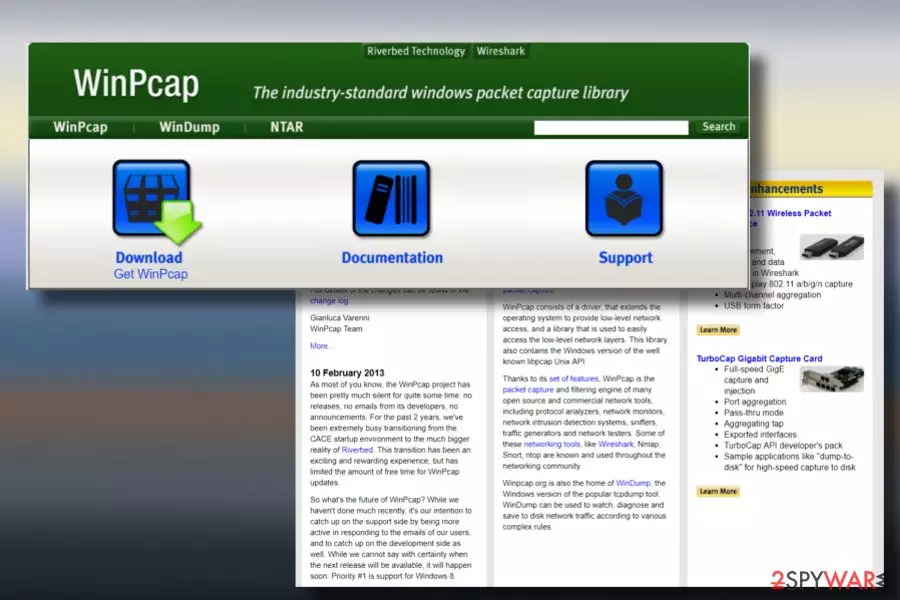
WinPcap is legitimate software that can be used for helping the network interface card to operate in hybrid mode. While its legitimacy is not questionable, cybersecurity experts[1] warn the online community that this software belongs to adware and potentially unwanted program (PUP) categories.
The main reason why cybersecurity researchers drew their attention to the WinPcap app is related to doubtful distribution techniques that its developers employ. Lots of people reported this tool for installing on PCs without asking their permission. Stealthy installation happens with the help of free software packages and if you were tricked into installing this tool accidentally, we recommend people uninstall the tool and related components from the system. Otherwise, they may run into various annoying and really unwanted activities, such as slowdowns, redirects, annoying pop-up ads, and similar issues.
| Name | WinPcap |
|---|---|
| Type | Potentially unwanted program |
| Issues | The program gets pre-packed with other freeware and causes slowdowns of the machine with all the redirects and pop-up ads |
| Danger | The application can lead to infiltration of different tools and questionable PUPs that track and collect information about your habits online |
| Elimination | Running the proper anti-malware tool can help remove the suspicious programs and determine if the piece you are concerned about is really malicious |
| Repair | Do not forget about those alterations that PUPs can make and run FortectIntego to fix virus damage |
In fact, that's the main reason why the adware has been involved in various discussions and why its name has been mentioned in various security forums. Many people call it a virus and an in-depth analysis of this tool explains why. As we have already pointed out, the WinPcap virus is closely related to various freeware and can get into PCs without being noticed.
In more technical terms, the distribution of unwanted apps along with freeware is called “bundling.” This method has become really popular among the developers of such programs as browser add-ons, extensions, and plugins, so the only precautionary measure to block their installation is a careful installation of each freeware.

Besides, another reason why WinPcap removal is a recommended action to initiate is related to the system's changes that it performs. It injects suspicious components to Google Chrome or Mozilla Firefox and can start generating irritating advertisements, such as pop-ups, banners, or hyperlinks. Note that those ads are not managed by the developer of this tool, but created and managed by unknown third parties who may seek to increase traffic to shady web domains.
Besides, this program may install tracking cookies[2] and may collect personally non-identifiable information. It does not target personal information like credit card details or logins and is hardly capable of collecting it. Nevertheless, it exposes information, such as browsing history,[3] search queries, email address, IP address, etc. at the risk of being leaked and violated.
Finally, it may initiate problems when trying to remove the application from the system. If you also can't do that, you should try using a reputable anti-spyware, such as SpyHunterCombo Cleaner or MalwarebytesMalwarebytes. Of course, you can also try eliminating it manually, but you should be very careful when performing the steps that are given down below.
Adware developers prefer the “bundling” distribution method
This misleading application can be downloaded from its official website or in a bundle with other free programs. In most cases, it spreads along with WireShark and similar tools. To prevent its infiltration, you have to keep your eye on every installation window of the software.
To avoid PUPs in general, you should stick to Advanced or Custom installation all the time. Besides, read the End User License Agreement and other terms carefully. Also, don't miss additional offers that are marked by default. You have to uncheck all ticks saying that you agree to install extensions, add-ons, or toolbars before clicking “Next.” Finally, if you suffer from continuous redirects on your browser, scan your PC with updated anti-spyware.
Removing the WinPcap virus from the system
The process of PUP elimination is difficult since “remove virus” is probably the most common search query related to this application. Due to the fact that it spreads via freeware bundles and hijacks web browsers silently such search queries are no longer surprising.
If you think that your PC is infected because you noticed WinPcap ads or started experiencing browser redirects to unusual websites, you should perform a thorough system scan with a professional anti-malware tool. Nonetheless, since this app is not a severe computer infection, it can be deleted manually. The instructions below will show you how to do that.
Uninstall from Windows
Uninstall from Windows 10/8:
- Type Control Panel into the Windows search box and open the result.
- Under Programs, select Uninstall a program.


Uninstall from Windows 7/XP:
- Click on Windows Start > Control Panel (Windows XP users should click on Add/Remove Programs).
- In Control Panel, select Programs > Uninstall a program.


Remove the unwanted program:
- In the Programs and Features window, look for any recently installed suspicious entries, select them, and click Uninstall.
- If User Account Control appears, click Yes to confirm, then complete the removal.


Delete from macOS
Remove the unwanted application:
- From the menu bar, select Go > Applications.
- In the Applications folder, look for any suspicious entries, then drag them to Trash (or right-click and pick Move to Trash).


Delete leftover files and folders:
- Select Go > Go to Folder.
- Enter /Library/Application Support and remove any suspicious folders related to the unwanted program.
- Repeat the same check in the /Library/LaunchAgents and /Library/LaunchDaemons folders, deleting any suspicious entries.

- Finally, empty the Trash to permanently remove the leftovers.

Remove from Microsoft Edge
Delete unwanted extensions from MS Edge:
- Select Menu (three horizontal dots at the top-right of the browser window) and pick Extensions.
- From the list, pick the extension and click on the Gear icon.
- Click Remove.


Clear cookies and other browser data:
- Click on the Menu (three horizontal dots at the top-right of the browser window) and select Settings > Privacy, search, and services..
- Under Clear browsing data, pick Choose what to clear.
- Select Cookies and other site data and Cached images and files. (apart from passwords, although you might want to include Media licenses as well, if applicable) and click on Clear.


Restore new tab and homepage settings:
- Click the menu icon and choose Settings.
- Then find On startup section.
- Click Remove next to any suspicious startup page.
Reset MS Edge if the above steps did not work:
- Press on Ctrl + Shift + Esc to open Task Manager.
- Click on More details arrow at the bottom of the window.
- Select Details tab.
- Now scroll down and locate every entry with Microsoft Edge name in it. Right-click on each of them and select End Task to stop MS Edge from running.


Instructions for Chromium-based Edge
Delete extensions from MS Edge (Chromium):
- Open Edge and click select Settings > Extensions.
- Delete unwanted extensions by clicking Remove.


Clear cache and site data:
- Click on Menu and go to Settings.
- Select Privacy, search and services.
- Under Clear browsing data, pick Choose what to clear.
- Under Time range, pick All time.
- Select Clear now.


Reset Chromium-based MS Edge:
- Click on Menu and select Settings.
- On the left side, pick Reset settings.
- Select Restore settings to their default values.
- Confirm with Reset.
- This will disable extensions and reset startup pages but will not delete bookmarks, saved passwords, or browsing history.


Remove from Mozilla Firefox (FF)
Remove dangerous extensions:
- Open Mozilla Firefox browser and click on the Menu (three horizontal lines at the top-right of the window).
- Select Add-ons.
- In here, select the unwanted extension and click Remove.


Reset the homepage:
- Click three horizontal lines at the top right corner to open the menu.
- Choose Settings.
- Under Home, set your preferred homepage and new tab settings.
Clear cookies and site data:
- Click Menu and pick Settings.
- Go to Privacy & Security section.
- Scroll down to locate Cookies and Site Data.
- Click on Clear Data...
- Select Cookies and Site Data and Temporary cached files and pages, then click Clear.


Reset Mozilla Firefox
If clearing the browser as explained above did not help, reset Mozilla Firefox:
- Open Mozilla Firefox browser and click the Menu.
- Go to Help and then choose Troubleshooting Information.

- Under Give Firefox a tune up section, click on Refresh Firefox...
- Once the pop-up shows up, confirm the action by pressing on Refresh Firefox.



Remove from Google Chrome
Delete malicious extensions from Google Chrome:
- Open Google Chrome, click on the Menu (three vertical dots at the top-right corner) and select More tools > Extensions.
- In the newly opened window, you will see all the installed extensions. Uninstall all suspicious extensions related to the unwanted program by clicking Remove.


Clear cache and web data from Chrome:
- Click on Menu and pick Settings.
- Under Privacy and security, select Clear browsing data.
- Select Browsing history, Cookies and other site data, as well as Cached images and files.
- Click Clear data.


Change your homepage:
- Click menu and choose Settings.
- Look for a suspicious site in the On startup section.
- Click on Open a specific or set of pages and click on three dots to find the Remove option.
Reset Google Chrome:
If the previous methods did not help you, reset Google Chrome to eliminate all the unwanted components:
- Click on Menu and select Settings.
- In the Settings, scroll down and click Advanced.
- Scroll down and locate Reset and clean up section.
- Now click Restore settings to their original defaults.
- Confirm with Reset settings.


Delete from Safari
Remove dangerous extensions:
- Open Safari, click Safari in the menu at the top-left of the screen, and select Preferences.
- Go to the Extensions tab, look for any suspicious entries, and click Uninstall to remove them.


Clear history and website data:
- Click Safari in the menu and pick Clear History.
- Set Clear to all history and confirm with Clear History.


Reset Safari:
- Click Safari in the menu and select Preferences > Advanced.
- Enable Show Develop menu in menu bar.
- From the menu bar, click Develop and select Empty Caches.


Did this guide help?
1 comment
Mayank Sharma
Earlier i uninstalled the older version of winpcap. But when i again installed the new version of winpcap, it gives a message which is shown below.
"A previous version of WinPcap has been detected on this system and cannot be
removed because in use by another application. Please close all the
WinPcap-based applications and run the installer again."
Plz help me in order to completely remove the older version of winpcap.
my e-mail :myk121093@gmail.com