

WinRepair Pro is a potentially unwanted program that may show fake errors messages
WinRepair Pro is a potentially unwanted program that can cause some problems for your computer. Although it seems like a legitimate tool that is supposed to find PC's errors, terminate virus/malware, and increase overall PC's performance, we would like to encourage you to look for a more reliable system tool.
As we have pointed out, WinRepair Pro is classified as PUP, which means that this program has some downsides about which you should be aware of. Therefore, carefully read the rest of this post and decide whether you need this questionable application or not.
WinRepair Pro by IMALI – N.I. MEDIA TDis a system optimization tool that may be considered to be a Microsoft partner, at least, that's what is stated on the official website. This type of software supports all Windows versions, including 7, 8, 8.1, 10, XP, and Vista.
As we have already pointed out, WinRepair Pro PUP is supposed to check the system for errors and fix all issues that burden the system. However, there is one problem here. The application is programmed to fix a very small amount of errors (approximately 15) for free, which is NOT enough for increasing the system's performance. For that, you may have to delete hundreds or even thousands of registry and user errors.
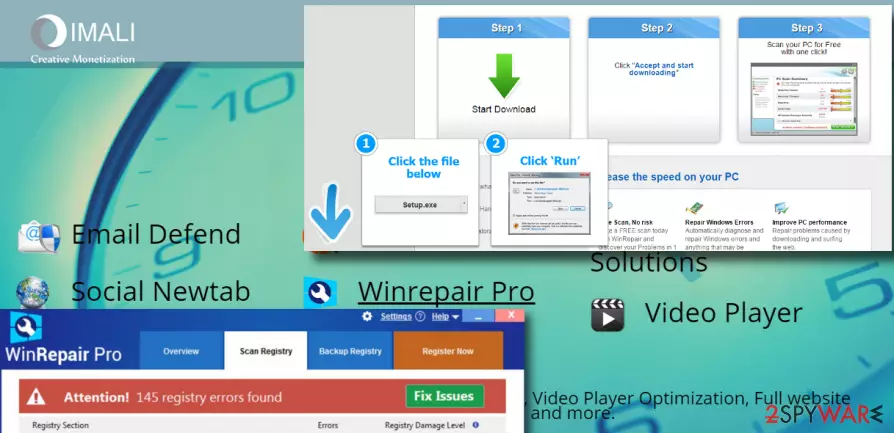
Unfortunately, to do so, you will be asked to buy a license key for this tool, which may cost up to 100euro for one year. Before you do so, we would like to warn you that some of the errors that WinRepair Pro malware may represent you with might be invented, which is why after upgrading this program, performing the scan, and deleting the errors may NOT increase your PC's speed. That's why you should better find a more reliable application for optimizing your Windows OS, for example, install FortectIntego.
The majority of the users install the WinRepair Pro virus accidentally because it tends to spread via software packages. However, we will speak about marketing methods that are used to promote this rogue optimizer a bit later. Here we would like to list the main symptoms indicating the fact that this PUP has settled down on the system.
- You may notice that your Windows OS runs a bit slower than it used to before;
- Once the OS is booted, a strange scanner may load automatically and check your PC's system entirely. To make sure that the scanner is brought by this doubtful PC Optimizer, check if it is marked as WinRepair Pro on the top left corner.
- You may start receiving pop-up messages generated by this tool saying:
ATTENTION! 145 Registry Errors Found!Attention! Your PC is infected with malware and might be under attack of scammers!
- If on the C:\Program Files (x86) or C:\Program Files you find a directory named WinRepair Pro, there is no doubt that this PUP is on your PC;
- Finally, to make it clear, open Task Manager and check if it's running RegList.wrp, WinRepairPro.exe, and WRPUns.exe processes.
If you have checked all these issues and each of them was confirmed, there is no doubt that this dubious PC optimizer has infected your PC's system. In this case, we would recommend you remove WinRepair Pro virus to prevent all possible damage. To do so, SpyHunterCombo Cleaner, MalwarebytesMalwarebytes, or another professional malware removal tool can be helpful.
Carefully install new programs
This particular potentially unwanted program has an official website where its free trial version (for one month) can be downloaded for free or a full version bought for a certain amount of money. However, direct downloading rarely happens.
Usually, people install it along with other free programs, which is why we highly encourage people to start checking freeware's installation setup more carefully. It's a must to check Advanced/Custom settings and reject the installation of 'optional downloads,' such as this one.
If it has already landed on the system, find its removal guide at the bottom of this article. You can remove the potentially unwanted program manually or automatically.
How to perform the WinRepair Pro removal
You can easily remove WinRepair Pro virus manually. For this purpose, you need to:
- Click 'Start' and select 'Control Panel'.
- Click 'Uninstall a Program' under 'Programs'.
- Choose 'WinRepair Pro ' and select the 'Uninstall/Change' option.
- Click 'Yes' and 'OK' to save the changes.
Nevertheless, after doing so, you are strongly advised to check the system with SpyHunterCombo Cleaner or MalwarebytesMalwarebytes to remove its components and other suspicious/malicious files that can be lurking in the system.
In addition, after successful WinRepair Pro removal, you need to be careful if you do not want to download suspicious programs again. Always use advanced/custom installation method and download programs only from reliable sources.
Uninstall from Windows
Uninstall from Windows 10/8:
- Type Control Panel into the Windows search box and open the result.
- Under Programs, select Uninstall a program.


Uninstall from Windows 7/XP:
- Click on Windows Start > Control Panel (Windows XP users should click on Add/Remove Programs).
- In Control Panel, select Programs > Uninstall a program.


Remove the unwanted program:
- In the Programs and Features window, look for any recently installed suspicious entries, select them, and click Uninstall.
- If User Account Control appears, click Yes to confirm, then complete the removal.


Delete from macOS
Remove the unwanted application:
- From the menu bar, select Go > Applications.
- In the Applications folder, look for any suspicious entries, then drag them to Trash (or right-click and pick Move to Trash).


Delete leftover files and folders:
- Select Go > Go to Folder.
- Enter /Library/Application Support and remove any suspicious folders related to the unwanted program.
- Repeat the same check in the /Library/LaunchAgents and /Library/LaunchDaemons folders, deleting any suspicious entries.

- Finally, empty the Trash to permanently remove the leftovers.

Reset Internet Explorer
Remove dangerous add-ons:
- Open Internet Explorer, click on the Gear icon (IE menu) on the top-right corner of the browser
- Pick Manage Add-ons.
- You will see a Manage Add-ons window. Here, look for suspicious plugins. Click on these entries and select Disable.


Change your homepage if it was altered:
- Open IE and click on the Gear icon.
- Select Internet Options.
- In the General tab, delete the Home page address and replace it by your preferred one (for example, Google.com).
- Click Apply and then select OK.


Delete temporary files:
- Press on the Gear icon and select Internet Options.
- Under Browsing history, click Delete...
- Select relevant fields and press Delete.


Reset Internet Explorer:
- Click on Gear icon > Internet options and select Advanced tab.
- Select Reset.
- In the new window, check Delete personal settings and select Reset.


Remove from Microsoft Edge
Delete unwanted extensions from MS Edge:
- Select Menu (three horizontal dots at the top-right of the browser window) and pick Extensions.
- From the list, pick the extension and click on the Gear icon.
- Click Remove.


Clear cookies and other browser data:
- Click on the Menu (three horizontal dots at the top-right of the browser window) and select Settings > Privacy, search, and services..
- Under Clear browsing data, pick Choose what to clear.
- Select Cookies and other site data and Cached images and files. (apart from passwords, although you might want to include Media licenses as well, if applicable) and click on Clear.


Restore new tab and homepage settings:
- Click the menu icon and choose Settings.
- Then find On startup section.
- Click Remove next to any suspicious startup page.
Reset MS Edge if the above steps did not work:
- Press on Ctrl + Shift + Esc to open Task Manager.
- Click on More details arrow at the bottom of the window.
- Select Details tab.
- Now scroll down and locate every entry with Microsoft Edge name in it. Right-click on each of them and select End Task to stop MS Edge from running.


Instructions for Chromium-based Edge
Delete extensions from MS Edge (Chromium):
- Open Edge and click select Settings > Extensions.
- Delete unwanted extensions by clicking Remove.


Clear cache and site data:
- Click on Menu and go to Settings.
- Select Privacy, search and services.
- Under Clear browsing data, pick Choose what to clear.
- Under Time range, pick All time.
- Select Clear now.


Reset Chromium-based MS Edge:
- Click on Menu and select Settings.
- On the left side, pick Reset settings.
- Select Restore settings to their default values.
- Confirm with Reset.
- This will disable extensions and reset startup pages but will not delete bookmarks, saved passwords, or browsing history.


Remove from Mozilla Firefox (FF)
Remove dangerous extensions:
- Open Mozilla Firefox browser and click on the Menu (three horizontal lines at the top-right of the window).
- Select Add-ons.
- In here, select the unwanted extension and click Remove.


Reset the homepage:
- Click three horizontal lines at the top right corner to open the menu.
- Choose Settings.
- Under Home, set your preferred homepage and new tab settings.
Clear cookies and site data:
- Click Menu and pick Settings.
- Go to Privacy & Security section.
- Scroll down to locate Cookies and Site Data.
- Click on Clear Data...
- Select Cookies and Site Data and Temporary cached files and pages, then click Clear.


Reset Mozilla Firefox
If clearing the browser as explained above did not help, reset Mozilla Firefox:
- Open Mozilla Firefox browser and click the Menu.
- Go to Help and then choose Troubleshooting Information.

- Under Give Firefox a tune up section, click on Refresh Firefox...
- Once the pop-up shows up, confirm the action by pressing on Refresh Firefox.



Remove from Google Chrome
Delete malicious extensions from Google Chrome:
- Open Google Chrome, click on the Menu (three vertical dots at the top-right corner) and select More tools > Extensions.
- In the newly opened window, you will see all the installed extensions. Uninstall all suspicious extensions related to the unwanted program by clicking Remove.


Clear cache and web data from Chrome:
- Click on Menu and pick Settings.
- Under Privacy and security, select Clear browsing data.
- Select Browsing history, Cookies and other site data, as well as Cached images and files.
- Click Clear data.


Change your homepage:
- Click menu and choose Settings.
- Look for a suspicious site in the On startup section.
- Click on Open a specific or set of pages and click on three dots to find the Remove option.
Reset Google Chrome:
If the previous methods did not help you, reset Google Chrome to eliminate all the unwanted components:
- Click on Menu and select Settings.
- In the Settings, scroll down and click Advanced.
- Scroll down and locate Reset and clean up section.
- Now click Restore settings to their original defaults.
- Confirm with Reset settings.


Delete from Safari
Remove dangerous extensions:
- Open Safari, click Safari in the menu at the top-left of the screen, and select Preferences.
- Go to the Extensions tab, look for any suspicious entries, and click Uninstall to remove them.


Clear history and website data:
- Click Safari in the menu and pick Clear History.
- Set Clear to all history and confirm with Clear History.


Reset Safari:
- Click Safari in the menu and select Preferences > Advanced.
- Enable Show Develop menu in menu bar.
- From the menu bar, click Develop and select Empty Caches.


Did this guide help?
2 comments
Mariann M
WinRepair Pro is not a genuine optimization tool, is it?
Jglencarr
Whenever I load the system, WinRepair Pro virus starts scanning the machine. What should I do to stop that? Its strange that I cant find the installer of this app in control panel