

WiseConvert is a PUP that travels around together with another hijacker called search.conduit.com
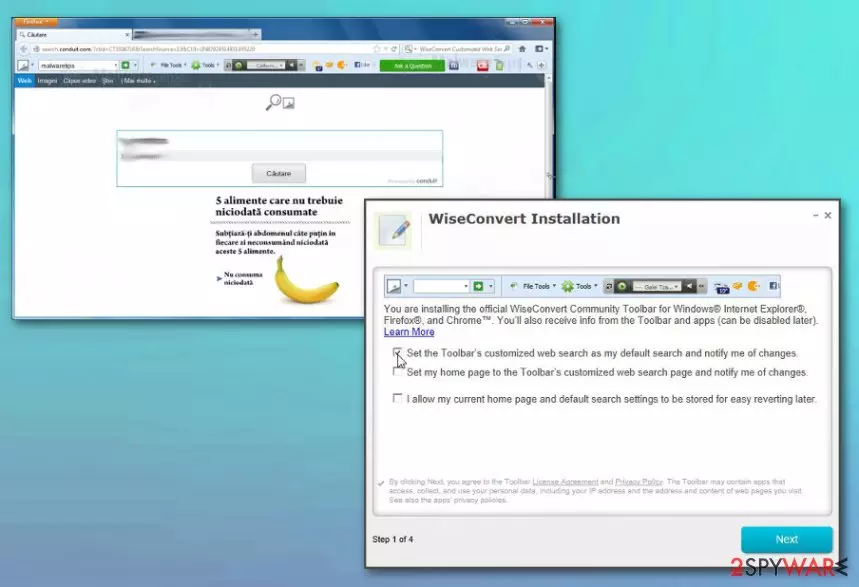
WiseConvert is a browser hijacker traveling around in a form of the toolbar. Once inside the system, it starts redirecting users' search sessions to Search.conduit.com, Wiseconvert.com or random sponsored pages. Intrusive advertisements, constant redirects to unfamiliar domains, and changes in your browsers' settings indicate that you are dealing with the potentially unwanted program[1] seeking to earn the money from advertising. However, clicking on such links is not recommended since they can make you reach domains that can be filled with malware. If your device got infected by WiseConvert, don't hesitate and check your recently-installed programs for this app. Additionally, you should reset your web browsers.
| Name | WiseConvert |
|---|---|
| Type | Toolbar |
| Category | Browser hijacker/ Potentially unwanted program |
| Affects | Chrome, Safari, Firefox and other browsers |
| Distribution | Software bundles, deceptive sites, and advertisements |
| Removal | Use FortectIntego and clean your device |
According to its official page, this toolbar was created using the Conduit platform which upholds the highest privacy and security standards, and it gives people the ability to stay connected to the news when they need that. However, we should warn you that WiseConvert is designed only to trick users into thinking that it can help them improve their searches online. After entering the system and making specific changes in your internet browsers, the PUP affects the performance of your device negatively.
First of all, WiseConvert virus starts collecting browsing-related data[2] to get more knowledge about what attracts users and what could make them click on specific ads. Additionally, its developers tend to set up numerous ads that are typically added to users' search results. Once clicked, these links redirect victims to sponsored ads and generate pay-per-click income to PUP's hijackers. The biggest issue is that these sites can be anything from completely legit and useful domains to fraudulent websites.
To avoid redirects to unsafe sites seeking to swindle your personal data, you should remove WiseConvert Toolbar from the system. Besides, keep in mind that the app continues collecting such details as your IP address, location, even social media activity. No matter that this data isn't considered personally identifiable, its loss can lead you to constant spam emails found in your inbox, suspicious questionnaires appearing on sites that you perfectly know and similar issues.
According to researchers[3], you should perform WiseConvert Toolbar removal by using our detailed removal guide presented below this article. To eliminate virus damage, run FortectIntego. This program will help you see all issues caused by hijack, including system vulnerabilities, corrupted files, and potentially unwanted programs.

Rogue tools and programs come in software bundles. Tips to avoid them
Various tools and programs can be installed manually from an insecure website or deceptive advertisement. However, it has also been reported that PUP developers hide their products inside shareware and freeware bundles. Of course, you can avoid letting it in after checking the components list and unchecking additional programs from it.
You can see the full list of programs when you choose Advanced or Custom settings during freeware installation. This step allows controlling which programs or applications you are getting on the device. Opting for Default or Quick installations automatically installs all programs including those PUPs and useless tools.
Uninstall WiseConvert Toolbar and other related programs from your computer
To get rid of the unwanted activity on your web browsers, you need to remove WiseConvert Toolbar from your computer. The best solution, in this case, is running a full system scan with an anti-malware software. These programs are designed to check the device thoroughly and detect every issue related to the security of the device. After the proper scan, the program suggests removing these errors and malicious programs.
WiseConvert removal should be initiated without delay. Having in mind that the virus is not as active as it was several years ago, you should also don't forget to reset your web browsers to their primary state to prevent redirects on your web browsers in the future. Keep in mind that the virus travels together with other PUPs that should also be eliminated in no time.
Uninstall from Windows
Uninstall from Windows 10/8:
- Type Control Panel into the Windows search box and open the result.
- Under Programs, select Uninstall a program.


Uninstall from Windows 7/XP:
- Click on Windows Start > Control Panel (Windows XP users should click on Add/Remove Programs).
- In Control Panel, select Programs > Uninstall a program.


Remove the unwanted program:
- In the Programs and Features window, look for any recently installed suspicious entries, select them, and click Uninstall.
- If User Account Control appears, click Yes to confirm, then complete the removal.


Delete from macOS
Remove the unwanted application:
- From the menu bar, select Go > Applications.
- In the Applications folder, look for any suspicious entries, then drag them to Trash (or right-click and pick Move to Trash).


Delete leftover files and folders:
- Select Go > Go to Folder.
- Enter /Library/Application Support and remove any suspicious folders related to the unwanted program.
- Repeat the same check in the /Library/LaunchAgents and /Library/LaunchDaemons folders, deleting any suspicious entries.

- Finally, empty the Trash to permanently remove the leftovers.

Reset Internet Explorer
Remove dangerous add-ons:
- Open Internet Explorer, click on the Gear icon (IE menu) on the top-right corner of the browser
- Pick Manage Add-ons.
- You will see a Manage Add-ons window. Here, look for suspicious plugins. Click on these entries and select Disable.


Change your homepage if it was altered:
- Open IE and click on the Gear icon.
- Select Internet Options.
- In the General tab, delete the Home page address and replace it by your preferred one (for example, Google.com).
- Click Apply and then select OK.


Delete temporary files:
- Press on the Gear icon and select Internet Options.
- Under Browsing history, click Delete...
- Select relevant fields and press Delete.


Reset Internet Explorer:
- Click on Gear icon > Internet options and select Advanced tab.
- Select Reset.
- In the new window, check Delete personal settings and select Reset.


Remove from Microsoft Edge
Delete unwanted extensions from MS Edge:
- Select Menu (three horizontal dots at the top-right of the browser window) and pick Extensions.
- From the list, pick the extension and click on the Gear icon.
- Click Remove.


Clear cookies and other browser data:
- Click on the Menu (three horizontal dots at the top-right of the browser window) and select Settings > Privacy, search, and services..
- Under Clear browsing data, pick Choose what to clear.
- Select Cookies and other site data and Cached images and files. (apart from passwords, although you might want to include Media licenses as well, if applicable) and click on Clear.


Restore new tab and homepage settings:
- Click the menu icon and choose Settings.
- Then find On startup section.
- Click Remove next to any suspicious startup page.
Reset MS Edge if the above steps did not work:
- Press on Ctrl + Shift + Esc to open Task Manager.
- Click on More details arrow at the bottom of the window.
- Select Details tab.
- Now scroll down and locate every entry with Microsoft Edge name in it. Right-click on each of them and select End Task to stop MS Edge from running.


Instructions for Chromium-based Edge
Delete extensions from MS Edge (Chromium):
- Open Edge and click select Settings > Extensions.
- Delete unwanted extensions by clicking Remove.


Clear cache and site data:
- Click on Menu and go to Settings.
- Select Privacy, search and services.
- Under Clear browsing data, pick Choose what to clear.
- Under Time range, pick All time.
- Select Clear now.


Reset Chromium-based MS Edge:
- Click on Menu and select Settings.
- On the left side, pick Reset settings.
- Select Restore settings to their default values.
- Confirm with Reset.
- This will disable extensions and reset startup pages but will not delete bookmarks, saved passwords, or browsing history.


Remove from Mozilla Firefox (FF)
Remove dangerous extensions:
- Open Mozilla Firefox browser and click on the Menu (three horizontal lines at the top-right of the window).
- Select Add-ons.
- In here, select the unwanted extension and click Remove.


Reset the homepage:
- Click three horizontal lines at the top right corner to open the menu.
- Choose Settings.
- Under Home, set your preferred homepage and new tab settings.
Clear cookies and site data:
- Click Menu and pick Settings.
- Go to Privacy & Security section.
- Scroll down to locate Cookies and Site Data.
- Click on Clear Data...
- Select Cookies and Site Data and Temporary cached files and pages, then click Clear.


Reset Mozilla Firefox
If clearing the browser as explained above did not help, reset Mozilla Firefox:
- Open Mozilla Firefox browser and click the Menu.
- Go to Help and then choose Troubleshooting Information.

- Under Give Firefox a tune up section, click on Refresh Firefox...
- Once the pop-up shows up, confirm the action by pressing on Refresh Firefox.



Remove from Google Chrome
Delete malicious extensions from Google Chrome:
- Open Google Chrome, click on the Menu (three vertical dots at the top-right corner) and select More tools > Extensions.
- In the newly opened window, you will see all the installed extensions. Uninstall all suspicious extensions related to the unwanted program by clicking Remove.


Clear cache and web data from Chrome:
- Click on Menu and pick Settings.
- Under Privacy and security, select Clear browsing data.
- Select Browsing history, Cookies and other site data, as well as Cached images and files.
- Click Clear data.


Change your homepage:
- Click menu and choose Settings.
- Look for a suspicious site in the On startup section.
- Click on Open a specific or set of pages and click on three dots to find the Remove option.
Reset Google Chrome:
If the previous methods did not help you, reset Google Chrome to eliminate all the unwanted components:
- Click on Menu and select Settings.
- In the Settings, scroll down and click Advanced.
- Scroll down and locate Reset and clean up section.
- Now click Restore settings to their original defaults.
- Confirm with Reset settings.


Delete from Safari
Remove dangerous extensions:
- Open Safari, click Safari in the menu at the top-left of the screen, and select Preferences.
- Go to the Extensions tab, look for any suspicious entries, and click Uninstall to remove them.


Clear history and website data:
- Click Safari in the menu and pick Clear History.
- Set Clear to all history and confirm with Clear History.


Reset Safari:
- Click Safari in the menu and select Preferences > Advanced.
- Enable Show Develop menu in menu bar.
- From the menu bar, click Develop and select Empty Caches.


Did this guide help?
5 comments
julia m
this toolbar has been the bane of my life, thank you so much i have now disabled it. however it is still only disabled not deleted. im just glad its not putting up pop up ads every time i go on e bay. cheers :)
Patricia
Got rid of Wiseconvert toolbars, but still have "Produtools" toolbars which I cant get rid of. Any suggestions? BTW-do you know what I might have done to get them in the first place? My computer has slowed down so much I can hardly use it since these two toolbars showed up. Thanks for your help.
Erick DAUER
Hi,
The probem is I cannot find the program in the list of programs to uninstall-delete
Where is it¿
thanks
james vallely
Dear Sir
Initially found wise in control panel clicked delete ,thought was sucessfully deleted ,unfortunatly wasnt . Have just redownloaded spy hunter lets hope this program is effective
thanks j vallely
Cam
I have a Mac. I have nothing...nothing showing in the tools menu. I did find the wiseconvert in the plug-ins but I cant get it off my computer.
I thank you for any help you can give.