

Zzz3.club – a browser hijacker which has been created and released by QxSearch Inc.
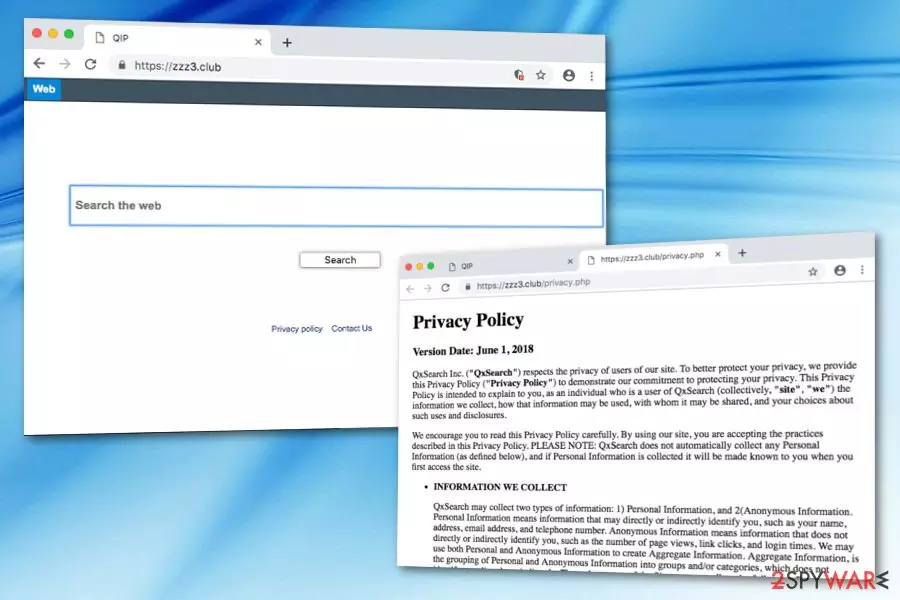
Zzz3.club is a browser hijacker which has been developed by an organization named QxSearch Inc. This questionable application can perform changes and unpleasant actions on popular web browser applications, for example, Google Chrome, Mozilla Firefox, Internet Explorer, Safari, etc. Browser-hijacking programs such as Zzz3.club virus are capable of injecting questionable extensions which allow them to modify some settings. If you are infected with this potentially unwanted program, you will definitely notice it instantly. Your default search engine will be set to https://zzz3.club/ and you might also overcome some differences in the main page and new tab URL zones. Nevertheless, you might be taken to other third-party pages[1] and redirecting is also a sign of a browser hijacker infection.
Once infected and hijacked by Zzz3.club, search results will be delivered from a different network, known as Searchgg Custom Search. Due to this reason, search query information might appear to be misleading or evidence-lacking. Using the new search engine is not a good decision if you are searching for reliable information sources on the Internet.
| Name | Zzz3.club |
|---|---|
| Type | Browser hijacker |
| Category | Potentially unwanted program |
| Creator/developer | QxSearch Inc. |
| Search engine | https://zzz3.club/ |
| Appearance | You can overcome this app in other software or on unprotected web pages |
| Detection tools | Scan your system with FortectIntego to find all questionable components |
Additionally, Zzz3.club might also collect informative details about you and your browsing activities/habits. This is even stated by browser hijacker's developers in its privacy policy:
QxSearch may collect two types of information: 1) Personal Information, and 2(Anonymous Information. Personal Information means information that may directly or indirectly identify you, such as your name, address, email address, and telephone number. Anonymous Information means information that does not directly or indirectly identify you, such as the number of page views, link clicks, and login times. We may use both Personal and Anonymous Information to create Aggregate Information. Aggregate Information, is the grouping of Personal and Anonymous Information into groups and/or categories, which does not identify you directly or indirectly. Through you use of the Site we may collect the following Personal Information: you name; email address; information you provided in public forums and/or social networks; information you provided us including your device identifier or IP address when you use the Site.
As you might have already noticed, Zzz3.club developers are even capable of viewing some personal information such as your name and email address. If you find this triggering, you should consider is it worth having this questionable application installed. However, it is very doubtful in any case as its search engine does not even provide worthy results.
Additionally, Zzz3.club may be capable of redirecting you to other rogue pages. Some of these websites might turn out to be even malware-laden. Do not risk your computer's safety and your own privacy by keeping this browser hijacker for a long time. Redirects might cause your system infection with a Trojan horse or ransomware virus if you are taken to a malicious network.[2]
You need to remove Zzz3.club due to all the beforementioned reasons. Nevertheless, this questionable application might also be capable of displaying advertising posts on your computer screen while using the infected web browser. These adverts might also cause redirects or promote useless products/services/software.
To fully succeed in the Zzz3.club removal, you should scan your computer with a trustworthy program such as FortectIntego. The system scan results will show if the browser hijacker has planted suspicious content somewhere else, not only in your web browser applications. After the scan, you will be able to get rid of the cyber threat effectively.

Browser-hijacking apps often hide in bundles of software
Technology specialists from LesVirus.fr[3] claim that potentially unwanted programs such as browser hijackers or adware are often hidden in software bundles. Questionable content comes attached to an original product that the user downloads and installs together on the computer system to launch its doubtful activities.
Gladly, this stealth installation can be easily avoided if cautiousness is brought out while searching throughout the web sphere. Keeping a distance from questionable downloading sources, not using indirect software downloading hyperlinks, and opting for the Custom installation mode will slightly decrease the risk of a PUP[4] infection.
Another way to level up your machine's security system is by using automatical software. Antimalware/antivirus/antispyware tools are created for threat protection and removal. Furthermore, they will block suspicious-looking websites or at least provide you with a warning if you are trying to access something questionable on the Internet.
Removal guidelines for Zzz3.club browser hijacker
Once Zzz3.club hijacks your web browsers such as Google Chrome, Mozilla Firefox, Internet Explorer, Microsoft Edge, or Safari, you know that is time to act quickly and remove the cyber threat before it causes you indirect damage through browser redirects or its ads start overloading your computer screen during browsing.
There are two ways in which you can complete the Zzz3.club removal process. The first one is by downloading and installing a trustworthy computer tool and launching it to deal with the browser hijacker. This way is much easier and might be even more effective as the program itself will look for all directories on your machine that might be infected.
You can remove Zzz3.club virus by using our step-by-step guide also. However, check web browser applications just in case if the browser hijacker planted rogue extensions in them. Also, this will help you to reverse your search engine to its default state and you will be able to browse the web as effectively as before the infection occurred.
Uninstall from Windows
Uninstall from Windows 10/8:
- Type Control Panel into the Windows search box and open the result.
- Under Programs, select Uninstall a program.


Uninstall from Windows 7/XP:
- Click on Windows Start > Control Panel (Windows XP users should click on Add/Remove Programs).
- In Control Panel, select Programs > Uninstall a program.


Remove the unwanted program:
- In the Programs and Features window, look for any recently installed suspicious entries, select them, and click Uninstall.
- If User Account Control appears, click Yes to confirm, then complete the removal.


Delete from macOS
Remove the unwanted application:
- From the menu bar, select Go > Applications.
- In the Applications folder, look for any suspicious entries, then drag them to Trash (or right-click and pick Move to Trash).


Delete leftover files and folders:
- Select Go > Go to Folder.
- Enter /Library/Application Support and remove any suspicious folders related to the unwanted program.
- Repeat the same check in the /Library/LaunchAgents and /Library/LaunchDaemons folders, deleting any suspicious entries.

- Finally, empty the Trash to permanently remove the leftovers.

Reset Internet Explorer
Remove dangerous add-ons:
- Open Internet Explorer, click on the Gear icon (IE menu) on the top-right corner of the browser
- Pick Manage Add-ons.
- You will see a Manage Add-ons window. Here, look for suspicious plugins. Click on these entries and select Disable.


Change your homepage if it was altered:
- Open IE and click on the Gear icon.
- Select Internet Options.
- In the General tab, delete the Home page address and replace it by your preferred one (for example, Google.com).
- Click Apply and then select OK.


Delete temporary files:
- Press on the Gear icon and select Internet Options.
- Under Browsing history, click Delete...
- Select relevant fields and press Delete.


Reset Internet Explorer:
- Click on Gear icon > Internet options and select Advanced tab.
- Select Reset.
- In the new window, check Delete personal settings and select Reset.


Remove from Microsoft Edge
Delete unwanted extensions from MS Edge:
- Select Menu (three horizontal dots at the top-right of the browser window) and pick Extensions.
- From the list, pick the extension and click on the Gear icon.
- Click Remove.


Clear cookies and other browser data:
- Click on the Menu (three horizontal dots at the top-right of the browser window) and select Settings > Privacy, search, and services..
- Under Clear browsing data, pick Choose what to clear.
- Select Cookies and other site data and Cached images and files. (apart from passwords, although you might want to include Media licenses as well, if applicable) and click on Clear.


Restore new tab and homepage settings:
- Click the menu icon and choose Settings.
- Then find On startup section.
- Click Remove next to any suspicious startup page.
Reset MS Edge if the above steps did not work:
- Press on Ctrl + Shift + Esc to open Task Manager.
- Click on More details arrow at the bottom of the window.
- Select Details tab.
- Now scroll down and locate every entry with Microsoft Edge name in it. Right-click on each of them and select End Task to stop MS Edge from running.


Instructions for Chromium-based Edge
Delete extensions from MS Edge (Chromium):
- Open Edge and click select Settings > Extensions.
- Delete unwanted extensions by clicking Remove.


Clear cache and site data:
- Click on Menu and go to Settings.
- Select Privacy, search and services.
- Under Clear browsing data, pick Choose what to clear.
- Under Time range, pick All time.
- Select Clear now.


Reset Chromium-based MS Edge:
- Click on Menu and select Settings.
- On the left side, pick Reset settings.
- Select Restore settings to their default values.
- Confirm with Reset.
- This will disable extensions and reset startup pages but will not delete bookmarks, saved passwords, or browsing history.


Remove from Mozilla Firefox (FF)
Remove dangerous extensions:
- Open Mozilla Firefox browser and click on the Menu (three horizontal lines at the top-right of the window).
- Select Add-ons.
- In here, select the unwanted extension and click Remove.


Reset the homepage:
- Click three horizontal lines at the top right corner to open the menu.
- Choose Settings.
- Under Home, set your preferred homepage and new tab settings.
Clear cookies and site data:
- Click Menu and pick Settings.
- Go to Privacy & Security section.
- Scroll down to locate Cookies and Site Data.
- Click on Clear Data...
- Select Cookies and Site Data and Temporary cached files and pages, then click Clear.


Reset Mozilla Firefox
If clearing the browser as explained above did not help, reset Mozilla Firefox:
- Open Mozilla Firefox browser and click the Menu.
- Go to Help and then choose Troubleshooting Information.

- Under Give Firefox a tune up section, click on Refresh Firefox...
- Once the pop-up shows up, confirm the action by pressing on Refresh Firefox.



Remove from Google Chrome
Delete malicious extensions from Google Chrome:
- Open Google Chrome, click on the Menu (three vertical dots at the top-right corner) and select More tools > Extensions.
- In the newly opened window, you will see all the installed extensions. Uninstall all suspicious extensions related to the unwanted program by clicking Remove.


Clear cache and web data from Chrome:
- Click on Menu and pick Settings.
- Under Privacy and security, select Clear browsing data.
- Select Browsing history, Cookies and other site data, as well as Cached images and files.
- Click Clear data.


Change your homepage:
- Click menu and choose Settings.
- Look for a suspicious site in the On startup section.
- Click on Open a specific or set of pages and click on three dots to find the Remove option.
Reset Google Chrome:
If the previous methods did not help you, reset Google Chrome to eliminate all the unwanted components:
- Click on Menu and select Settings.
- In the Settings, scroll down and click Advanced.
- Scroll down and locate Reset and clean up section.
- Now click Restore settings to their original defaults.
- Confirm with Reset settings.


Delete from Safari
Remove dangerous extensions:
- Open Safari, click Safari in the menu at the top-left of the screen, and select Preferences.
- Go to the Extensions tab, look for any suspicious entries, and click Uninstall to remove them.


Clear history and website data:
- Click Safari in the menu and pick Clear History.
- Set Clear to all history and confirm with Clear History.


Reset Safari:
- Click Safari in the menu and select Preferences > Advanced.
- Enable Show Develop menu in menu bar.
- From the menu bar, click Develop and select Empty Caches.


Did this guide help?
Be the first to comment