

Chromodo is a web browser that tries to promote third parties by showing various ads
Chromodo is an Internet web browser that is based on the Chromium engine. Like any other legitimate application, it presents itself in an appealing way. As stated, it is going to increase download/upload speed, improve online security, open pages more quickly, and so on. Therefore, for users who want to try something alternative to Chrome, IE, and Mozilla Firefox, the Chromodo browser may appear a great deal.
Unfortunately, but most of the Chromium-based web browsers, including Kometa, Torch, Olcinium, eFast, etc. are not reliable because they are involved in the promotion of third parties, their websites, and software. Chromodo is not an exception.
If this web browser has been set by default without your permission, it should not be ignored because this web browser is blamed for allowing adware-type programs to display advertisements via it easily. You should remove Chromodo browser from the computer if you do not want to have a suspicious program in the system.

According to security experts, it belongs to the PUP category. That's because its developers rely on the 'bundling' distribution method and spread it along with freeware/shareware. It can be attached to:
- freebies like software updates (Java, Flash Player, Media Player, etc.),
- torrent files,
- media streaming software,
- download managers, and so on.
If your default web browser has been replaced by the Chromodo virus out of nowhere, you must have agreed to install it as an optional download. Unfortunately, but this dubious web browser might have installed other PUPs (adware, browser hijacker) on the system.
Therefore, to remove Chromodo virus along with all its components and counterparts, we would recommend using reliable anti-spyware software. SpyHunterCombo Cleaner, MalwarebytesMalwarebytes or another official malware removal tool will be perfect for this task.
Many users install this browser accidentally
This PUP hijacks the system as soon as the user agrees to install it. Since it spreads bundled with freeware, the majority of users install it accidentally. After that, it injects itself as a default web browser and does not allow it to switch to the previous one.
As we have already mentioned, this browser is advertising-supported, so you may also notice various types of advertisements (pop-up ads, textual links, banner ads, etc.) on each page that you try to read. According to recent studies, most of them are tagless. However, some of them may be labeled as “Ads by Chromodo” or “Chromodo Ads.”
The purpose of displaying those pop-ups – to make Internet users visit sponsored websites, increase their page rank, and collect clicks. However, some instances have already been recorded when Chromodo redirects exposed people to irrelevant pages full of questionable content. Not to mention, this questionable web browser can also work as a data tracker. It may install cookies and collect browsing-related information that you may not be keen on disclosing. Security experts warn that it can analyze the following details:
- Search queries;
- Most frequently accessed web pages;
- Data that the user types or ads that he/she encounters in the visited pages;
- PC's IP address;
- PC's location;
- Bookmark list;
- Download/upload information, etc.
Last, but certainly not least, such PUP may also try to download other potentially unwanted programs to the system. Thus, even though it's not malicious on its own, collaboration with third parties makes it potentially dangerous and leaking to critical security issues. Thus, delete Chromodo adware without any consideration. The explanation of how to do that is given below.
Remove Chromodo browser from your computer
Security-minded people should never use Chromodo browser because it's ad-supported, cookies filled, and third-party related. It is spreading via software packages, so there's nothing surprising that it has slithered onto your PC without being noticed. If you wish to remove Chromodo browser for good, the best solution is a full system scan with a reputable anti-spyware.
Nevertheless, you can find the manual Chromodo browser removal guide indicated below. To avoid PUP installation in the future, make sure that you always check the Advanced or Custom installation option while installing freeware.
Uninstall from Windows
Uninstall from Windows 10/8:
- Type Control Panel into the Windows search box and open the result.
- Under Programs, select Uninstall a program.


Uninstall from Windows 7/XP:
- Click on Windows Start > Control Panel (Windows XP users should click on Add/Remove Programs).
- In Control Panel, select Programs > Uninstall a program.


Remove the unwanted program:
- In the Programs and Features window, look for any recently installed suspicious entries, select them, and click Uninstall.
- If User Account Control appears, click Yes to confirm, then complete the removal.


Delete from macOS
Remove the unwanted application:
- From the menu bar, select Go > Applications.
- In the Applications folder, look for any suspicious entries, then drag them to Trash (or right-click and pick Move to Trash).


Delete leftover files and folders:
- Select Go > Go to Folder.
- Enter /Library/Application Support and remove any suspicious folders related to the unwanted program.
- Repeat the same check in the /Library/LaunchAgents and /Library/LaunchDaemons folders, deleting any suspicious entries.

- Finally, empty the Trash to permanently remove the leftovers.

Reset Internet Explorer
Remove dangerous add-ons:
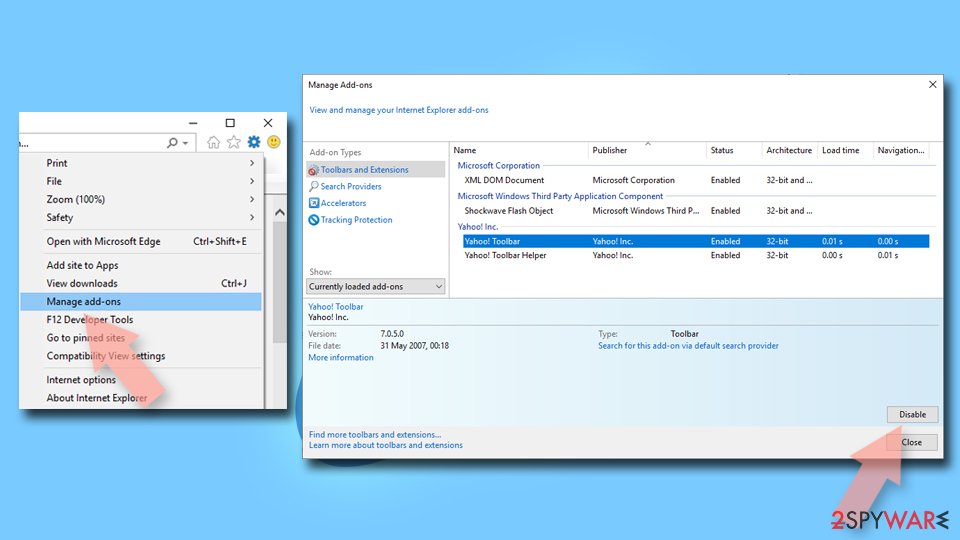
- Open Internet Explorer, click on the Gear icon (IE menu) on the top-right corner of the browser
- Pick Manage Add-ons.
- You will see a Manage Add-ons window. Here, look for suspicious plugins. Click on these entries and select Disable.

Change your homepage if it was altered:
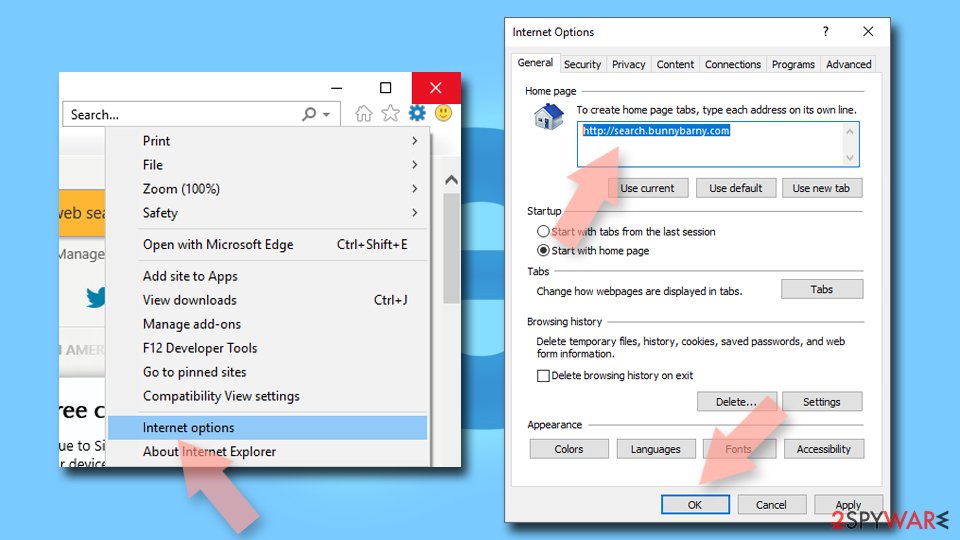
- Open IE and click on the Gear icon.
- Select Internet Options.
- In the General tab, delete the Home page address and replace it by your preferred one (for example, Google.com).
- Click Apply and then select OK.

Delete temporary files:
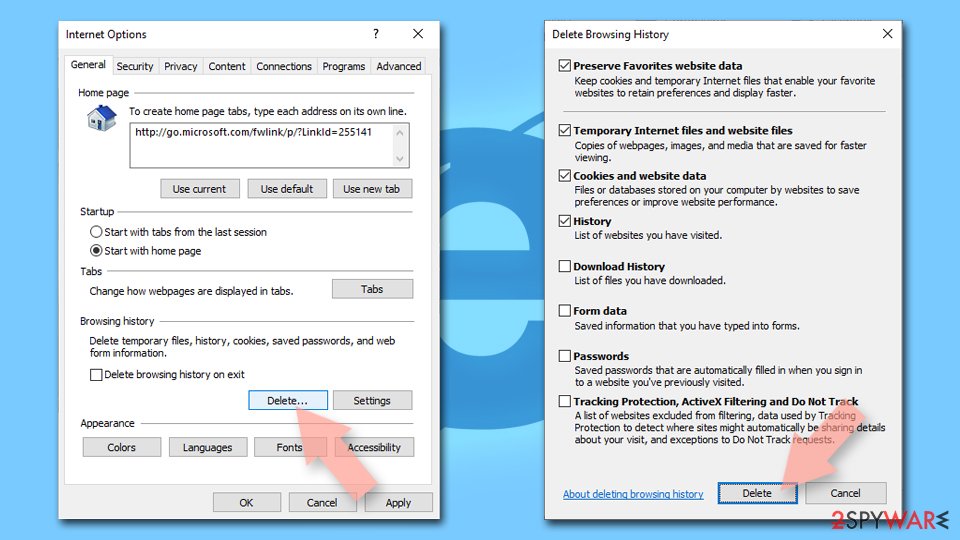
- Press on the Gear icon and select Internet Options.
- Under Browsing history, click Delete...
- Select relevant fields and press Delete.

Reset Internet Explorer:
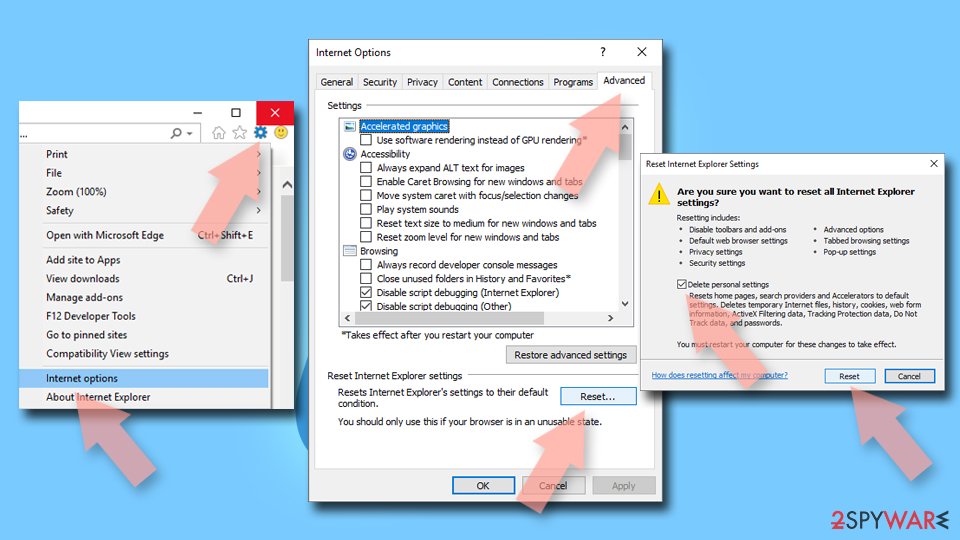
- Click on Gear icon > Internet options and select Advanced tab.
- Select Reset.
- In the new window, check Delete personal settings and select Reset.

Remove from Microsoft Edge
Delete unwanted extensions from MS Edge:
- Select Menu (three horizontal dots at the top-right of the browser window) and pick Extensions.
- From the list, pick the extension and click on the Gear icon.
- Click Remove.


Clear cookies and other browser data:
- Click on the Menu (three horizontal dots at the top-right of the browser window) and select Settings > Privacy, search, and services..
- Under Clear browsing data, pick Choose what to clear.
- Select Cookies and other site data and Cached images and files. (apart from passwords, although you might want to include Media licenses as well, if applicable) and click on Clear.


Restore new tab and homepage settings:
- Click the menu icon and choose Settings.
- Then find On startup section.
- Click Remove next to any suspicious startup page.
Reset MS Edge if the above steps did not work:
- Press on Ctrl + Shift + Esc to open Task Manager.
- Click on More details arrow at the bottom of the window.
- Select Details tab.
- Now scroll down and locate every entry with Microsoft Edge name in it. Right-click on each of them and select End Task to stop MS Edge from running.


Instructions for Chromium-based Edge
Delete extensions from MS Edge (Chromium):
- Open Edge and click select Settings > Extensions.
- Delete unwanted extensions by clicking Remove.


Clear cache and site data:
- Click on Menu and go to Settings.
- Select Privacy, search and services.
- Under Clear browsing data, pick Choose what to clear.
- Under Time range, pick All time.
- Select Clear now.


Reset Chromium-based MS Edge:
- Click on Menu and select Settings.
- On the left side, pick Reset settings.
- Select Restore settings to their default values.
- Confirm with Reset.
- This will disable extensions and reset startup pages but will not delete bookmarks, saved passwords, or browsing history.


Remove from Mozilla Firefox (FF)
Remove dangerous extensions:
- Open Mozilla Firefox browser and click on the Menu (three horizontal lines at the top-right of the window).
- Select Add-ons.
- In here, select the unwanted extension and click Remove.


Reset the homepage:
- Click three horizontal lines at the top right corner to open the menu.
- Choose Settings.
- Under Home, set your preferred homepage and new tab settings.
Clear cookies and site data:
- Click Menu and pick Settings.
- Go to Privacy & Security section.
- Scroll down to locate Cookies and Site Data.
- Click on Clear Data...
- Select Cookies and Site Data and Temporary cached files and pages, then click Clear.


Reset Mozilla Firefox
If clearing the browser as explained above did not help, reset Mozilla Firefox:
- Open Mozilla Firefox browser and click the Menu.
- Go to Help and then choose Troubleshooting Information.

- Under Give Firefox a tune up section, click on Refresh Firefox...
- Once the pop-up shows up, confirm the action by pressing on Refresh Firefox.



Remove from Google Chrome
Delete malicious extensions from Google Chrome:
- Open Google Chrome, click on the Menu (three vertical dots at the top-right corner) and select More tools > Extensions.
- In the newly opened window, you will see all the installed extensions. Uninstall all suspicious extensions related to the unwanted program by clicking Remove.


Clear cache and web data from Chrome:
- Click on Menu and pick Settings.
- Under Privacy and security, select Clear browsing data.
- Select Browsing history, Cookies and other site data, as well as Cached images and files.
- Click Clear data.


Change your homepage:
- Click menu and choose Settings.
- Look for a suspicious site in the On startup section.
- Click on Open a specific or set of pages and click on three dots to find the Remove option.
Reset Google Chrome:
If the previous methods did not help you, reset Google Chrome to eliminate all the unwanted components:
- Click on Menu and select Settings.
- In the Settings, scroll down and click Advanced.
- Scroll down and locate Reset and clean up section.
- Now click Restore settings to their original defaults.
- Confirm with Reset settings.


Delete from Safari
Remove dangerous extensions:
- Open Safari, click Safari in the menu at the top-left of the screen, and select Preferences.
- Go to the Extensions tab, look for any suspicious entries, and click Uninstall to remove them.


Clear history and website data:
- Click Safari in the menu and pick Clear History.
- Set Clear to all history and confirm with Clear History.


Reset Safari:
- Click Safari in the menu and select Preferences > Advanced.
- Enable Show Develop menu in menu bar.
- From the menu bar, click Develop and select Empty Caches.


Did this guide help?
3 comments
Jericho
What a silly web browser!!! Only ads and dubious links everywhere
Victim
Hi. My PC was hijacked by Chromodo browser, so I updated SpyHunter and removed it immediately. It showed lots of ads and redirected to untrustworthy pages.
Eric Safrit
This time its not funny! I did not install Chromodo browser, but it changed Chrome and ruined all the settings that I had on it. Damn!