

Totiteck is a browser hijacker that uses unimpressive UI but claims huge web browsing benefits
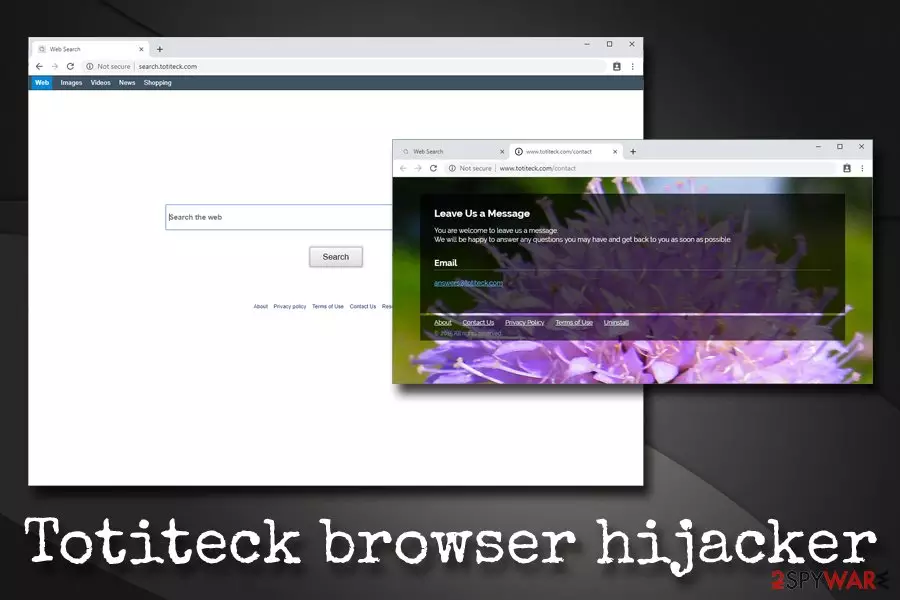
Totiteck is a potentially unwanted program that silently enters users' computers and changes the settings of Google Chrome, Mozilla Firefox, Safari, Opera, or MS Edge web browsers. Once inside, sets the new tab URL and homepage to Search.totiteck.com.
All the searchers are then redirected to Yahoo, with tons of sponsored links right at the top. In such a way, Totiteck manages to manipulate search results, consequently drastically changing the websites users would typically visit. While it might seem relatively innocent behavior, the ramifications might be quite serious, such as money loss or the infection of potentially unwanted programs/malware.
The presence of PUPs is also often associated with information tracking. Totiteck.com tracks cookies, technical information, browsing activities, and other data, and later shares it with third-parties. Thus, you should terminate the hijacker[1] that alters settings of your browser and use legitimate search engines instead.
| Name | Totiteck |
| Category | Potentially unwanted program |
| Type | Browser hijacker |
| Sub-type | Download manager |
| Infiltration | Software bundles, third-party websites, deceptive sites, other PUPs |
| Risks | Loss of money, information disclosure to unknown parties, malware infections |
| Symptoms | Hijacked homepage and new tab, altered search results, slow operation of the web browser, etc. |
| Set homepage | Search.totiteck.com |
| Termination | Delete the unwanted app by using our removal guide below or scan the machine with an anti-malware tool, so you can remove Totiteck.com properly |
| Recovery | To fix damage caused by the infection, use FortectIntego |
Allegedly, the advertised tool is a download manager that will help users to download files. However, downloaded manages are among the worst applications when it comes to their usefulness and safety. There is no need to use Totiteck as the functionality of downloading, and uninstalling is already implemented within the operating system. In most cases, users will get minimal benefit from the application but instead will have to deal with intrusive advertisements all over the Internet.
As its developers, Totiteck Software, claim on the official website, the tool is used to enhance the downloading experience:
Install applications the easy way and without the hassle, using the Totiteck downloader. The Totiteck platform stems from years of experience with installing applications, resulting in a highly optimized process, yielding faster downloads, a better user experience and more successful installations
Totiteck.com was created having one thought in mind: to promote affiliate marketing. Once users are redirected to sponsored websites or they visit one of the top search results, the developers get paid. Besides, there might be additional agreements, for example, pay-per-install[2] or pay-per-purchase.
Unfortunately, not all the content promoted by Totiteck.com virus is useful or even safe. In some cases, users might land on technical support scam sites that promote useless software like system optimizers (otherwise known as hoax software)[3] as a part of a deceptive scheme that claims malware infection after a fake scan.
Therefore, if you have been wondering if you should proceed with Search.totiteck.com removal, we highly advise you to do it with SpyHunterCombo Cleaner or MalwarebytesMalwarebytes. Security tools can find all the PUPs and clean the PC properly. Then scan the device with FortectIntego to revert all the changes made by the hijacker.

If Search.totiteck.com PUP has slithered into your system, it might also start tracking your activity on the Internet. It collects non-personal data, including:
- browsing history;
- lists of downloads and bookmarks;
- search query history;
- cookies;[4]
- other browsing-related data.
There is no doubt that Search.totiteck.com collects such information for a reason; however, no one knows what the reason is. Some security vendors claim that developers this data with third-party companies. If you are worried about your cyber-safety, you should remove Search.totiteck.com with a reputable anti-malware program or take care of its termination manually – simply follow the detailed guide below.
Deceptive methods of browser hijacker distribution
The usual potentially unwanted program distribution method is software bundling. This deceptive marketing practice has been prevalent for years and is used by many freeware/shareware developers as well as its hosting sites. While it is not always malignant, some practices show that potentially unwanted programs are intentionally hidden within installation wizards, so that users would have minimal chances of noticing pre-ticked boxes, misleading button placements, and other tricks.
Therefore, you need to be extremely careful when installing new applications, especially if they come from a third-party site. While it would be unreasonable to ask you to stay away from such websites, you should be aware of its potential dangers, and use caution while looking for new software to install.
Before you do, however, you should always make sure that the application you are about to install is not a potentially unwanted program. To do that, you should read reviews online, visit forums, or blog posts. These descriptions can often hint whether or not the application is safe to use and does not hide any underlying features or even fees.

During the installation, never rush the procedure, check if the most critical documents are provided (Terms of Service, Privacy Policy, etc.) and always opt for Advanced or Custom settings instead of Recommended or Quick ones. In such a way, you will avoid useless optional programs before they manage to enter your machine.
Terminate Totiteck PUP and get rid of Search.totiteck.com homepage
You can remove Totiteck.com virus manually – simply follow our detailed guide below. However, getting rid of browser hijackers or other potentially unwanted programs might not be that easy sometimes. The applications might hide under the extensions list within the browser, or do not provide an uninstallation executable. Some more severe infections can even conceal the presence from the installed program list.
Therefore, if you are unsuccessful with manual Totiteck removal, you should rely on anti-malware software that can find the underlying content and eliminate all the stubborn components that are hidden inside the system. Besides, security applications can also delete other infections that might have sneaked in while you were operating your browser during Totiteck hijack.
Uninstall from Windows
Uninstall from Windows 10/8:
- Type Control Panel into the Windows search box and open the result.
- Under Programs, select Uninstall a program.


Uninstall from Windows 7/XP:
- Click on Windows Start > Control Panel (Windows XP users should click on Add/Remove Programs).
- In Control Panel, select Programs > Uninstall a program.


Remove the unwanted program:
- In the Programs and Features window, look for any recently installed suspicious entries, select them, and click Uninstall.
- If User Account Control appears, click Yes to confirm, then complete the removal.


Delete from macOS
Remove the unwanted application:
- From the menu bar, select Go > Applications.
- In the Applications folder, look for any suspicious entries, then drag them to Trash (or right-click and pick Move to Trash).


Delete leftover files and folders:
- Select Go > Go to Folder.
- Enter /Library/Application Support and remove any suspicious folders related to the unwanted program.
- Repeat the same check in the /Library/LaunchAgents and /Library/LaunchDaemons folders, deleting any suspicious entries.

- Finally, empty the Trash to permanently remove the leftovers.

Reset Internet Explorer
Remove dangerous add-ons:
- Open Internet Explorer, click on the Gear icon (IE menu) on the top-right corner of the browser
- Pick Manage Add-ons.
- You will see a Manage Add-ons window. Here, look for suspicious plugins. Click on these entries and select Disable.


Change your homepage if it was altered:
- Open IE and click on the Gear icon.
- Select Internet Options.
- In the General tab, delete the Home page address and replace it by your preferred one (for example, Google.com).
- Click Apply and then select OK.


Delete temporary files:
- Press on the Gear icon and select Internet Options.
- Under Browsing history, click Delete...
- Select relevant fields and press Delete.


Reset Internet Explorer:
- Click on Gear icon > Internet options and select Advanced tab.
- Select Reset.
- In the new window, check Delete personal settings and select Reset.


Remove from Microsoft Edge
Delete unwanted extensions from MS Edge:
- Select Menu (three horizontal dots at the top-right of the browser window) and pick Extensions.
- From the list, pick the extension and click on the Gear icon.
- Click Remove.


Clear cookies and other browser data:
- Click on the Menu (three horizontal dots at the top-right of the browser window) and select Settings > Privacy, search, and services..
- Under Clear browsing data, pick Choose what to clear.
- Select Cookies and other site data and Cached images and files. (apart from passwords, although you might want to include Media licenses as well, if applicable) and click on Clear.


Restore new tab and homepage settings:
- Click the menu icon and choose Settings.
- Then find On startup section.
- Click Remove next to any suspicious startup page.
Reset MS Edge if the above steps did not work:
- Press on Ctrl + Shift + Esc to open Task Manager.
- Click on More details arrow at the bottom of the window.
- Select Details tab.
- Now scroll down and locate every entry with Microsoft Edge name in it. Right-click on each of them and select End Task to stop MS Edge from running.


Instructions for Chromium-based Edge
Delete extensions from MS Edge (Chromium):
- Open Edge and click select Settings > Extensions.
- Delete unwanted extensions by clicking Remove.


Clear cache and site data:
- Click on Menu and go to Settings.
- Select Privacy, search and services.
- Under Clear browsing data, pick Choose what to clear.
- Under Time range, pick All time.
- Select Clear now.


Reset Chromium-based MS Edge:
- Click on Menu and select Settings.
- On the left side, pick Reset settings.
- Select Restore settings to their default values.
- Confirm with Reset.
- This will disable extensions and reset startup pages but will not delete bookmarks, saved passwords, or browsing history.


Remove from Mozilla Firefox (FF)
Remove dangerous extensions:
- Open Mozilla Firefox browser and click on the Menu (three horizontal lines at the top-right of the window).
- Select Add-ons.
- In here, select the unwanted extension and click Remove.


Reset the homepage:
- Click three horizontal lines at the top right corner to open the menu.
- Choose Settings.
- Under Home, set your preferred homepage and new tab settings.
Clear cookies and site data:
- Click Menu and pick Settings.
- Go to Privacy & Security section.
- Scroll down to locate Cookies and Site Data.
- Click on Clear Data...
- Select Cookies and Site Data and Temporary cached files and pages, then click Clear.


Reset Mozilla Firefox
If clearing the browser as explained above did not help, reset Mozilla Firefox:
- Open Mozilla Firefox browser and click the Menu.
- Go to Help and then choose Troubleshooting Information.

- Under Give Firefox a tune up section, click on Refresh Firefox...
- Once the pop-up shows up, confirm the action by pressing on Refresh Firefox.



Remove from Google Chrome
Delete malicious extensions from Google Chrome:
- Open Google Chrome, click on the Menu (three vertical dots at the top-right corner) and select More tools > Extensions.
- In the newly opened window, you will see all the installed extensions. Uninstall all suspicious extensions related to the unwanted program by clicking Remove.


Clear cache and web data from Chrome:
- Click on Menu and pick Settings.
- Under Privacy and security, select Clear browsing data.
- Select Browsing history, Cookies and other site data, as well as Cached images and files.
- Click Clear data.


Change your homepage:
- Click menu and choose Settings.
- Look for a suspicious site in the On startup section.
- Click on Open a specific or set of pages and click on three dots to find the Remove option.
Reset Google Chrome:
If the previous methods did not help you, reset Google Chrome to eliminate all the unwanted components:
- Click on Menu and select Settings.
- In the Settings, scroll down and click Advanced.
- Scroll down and locate Reset and clean up section.
- Now click Restore settings to their original defaults.
- Confirm with Reset settings.


Delete from Safari
Remove dangerous extensions:
- Open Safari, click Safari in the menu at the top-left of the screen, and select Preferences.
- Go to the Extensions tab, look for any suspicious entries, and click Uninstall to remove them.


Clear history and website data:
- Click Safari in the menu and pick Clear History.
- Set Clear to all history and confirm with Clear History.


Reset Safari:
- Click Safari in the menu and select Preferences > Advanced.
- Enable Show Develop menu in menu bar.
- From the menu bar, click Develop and select Empty Caches.


Did this guide help?
3 comments
vita
supper annoying search engine! I could not understand what was the freaking problem of it for a long time.
leo
just removed it!!!!!!!!!
JosephHOZW
Bye to this browser hanger-on! I have never thought that such little computer parasite can cause such major system slowdowns. Totally ruins your mood if you want to quickly access some websites.