

Venis ransomware is on the loose
Venis virus does not only threaten to encode all your files, but it may be found as ransomware-as-a-service as well. File-encrypting malware with random titles or references to pop culture are no longer a novelty. Speaking of which, there was a time when cyber_baba@aol.com or batman_good@aol.com viruses rampaged, let alone invincible Cerber which recently launched its fourth edition – Cerber v.4.0. In any case, if your computer has been infected, should now concentrate on VenisRansomware removal. You can speed up the process by employing FortectIntego anti-malware. This tool manages the procedure within a couple of minutes. It is programmed to remove Venis entirely. By the way, this virus might also be related to another notorious file-encrypting virus – Fantom ransomware, so, to prevent Venis from potentially sneaking its malicious accomplice on your PC, you should hurry to remove it.
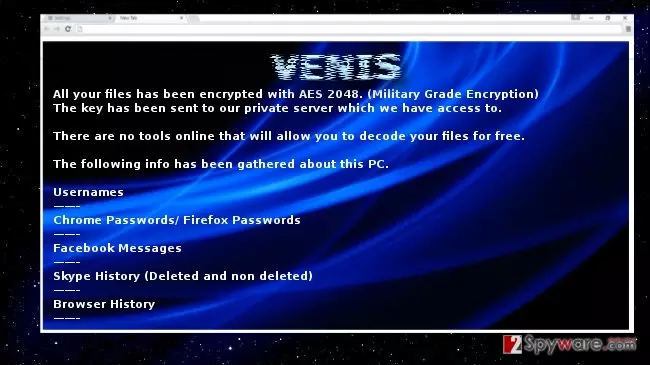
VenisRansomware is still undergoing various modifications, so its ransom note delivery strategies may vary depending on a particular virus version. The virus experts note that currently, the virus may either drop a ransom note in the text format directly on your desktop or reroute you to a suspicious website “venis.pw” and present the data recovery instructions there. In these notes, the hackers ensure their victims that all of their data has been encrypted with a cryptographically powerful algorithm, AES 2048, and that they will never this data back unless they pay for the private data recovery key. Indeed, this technique causes trouble even for the IT specialists, not to mention the regular users. Moreover, the hackers set a 72-hour limit for remitting the payment. To pressure users into paying up, they also threaten to delete the data and the recovery key if the ransom is not transmitted until the specified period of time. Besides, the scammers also threaten the victims to publish their confidential social network data which they have supposedly managed to collect. A full note can be seen below:
A11 your files has been encrypted with AES 2048. (Military Grade Encryption)
The key has been sent to our private server which we have access to.
There are no tools online that will allow you to decode your files for free.
The following info has been gathered about this PC.
Usernames
Chrome Passwords/Firefox Passwords
Facebook Messages
Skype History (Deleted and non deleted)
Browser History
Tor History
You have 72 Hours To Comply. (Each delay will cause a price increase)
Drives are completely wiped after this time period is finished while the info is released for the public. (Nothing is spared)
Send us a message at: (Email)
VenisRansom@protonmail.com
Moreover, some IT experts assume that the threat is related to Fantom ransomware as the hackers employ similar email address for communication with the users. In the case of this ransomware, as you can see, you can contact the cyber criminals via VenisRansom@protonmail.com, in comparison with restorefiles@protonmail.ch provided by an afore-mentioned virus. Venis developers demand to transmit the money via Tor network which is a technique preferred by another ransomware titan – Locky.
The virus has received much attention for its ability to meddle with Windows Firewall and enable Remote Desktop Connection. In other words, it injects the code of netsh advfirewall firewall add rule name=”Remote Desktop” dir=in protocol=tcp localport=3389 profile=any action=allow (PID: 3796) into Firewall registry files. Such feature allows the ransomware to retain your system under control and enables Firewall to bypass it. What is more, the virus is also capable of activating remote control function. Unlike other ransomware which simply encode the files, this virus permits the hackers to monitor your device.
What is more, the crooks decided to strengthen the attack by launching the site where anyone who sympathizes hackers can get access to virus distribution and, likewise, increase the profits earned from such activity. Likewise, venis malware has been detected in the black market. Fortunately, the website has been terminated already. Therefore, it would be unwise to follow the guidelines of the crooks and waste money for data recovery since the chances of retrieving it are too low.
The deceptive means of ransomware distribution
For now, the VenisRansomware spreads mainly via infected attachments of spam emails. Let us warn you to be extremely cautious while reviewing the contents of your spam folder especially if you receive an email from an official institution. It is a common strategy for hackers to pretend to be the officers of police or civil service and alarm you with false committed crimes or with tax deadlines. You can distinguish the real email from the fake one by taking an attentive look at logo and credentials. In addition, such emails may contain grammar mistakes and typos. It doesn’t cost anything to proof-check the sender before opening the attached file, but taking such precautions can surely save you from getting your PC infected with Venis virus.
Venis termination steps
This ransomware is surely a new challenge for IT experts. While they are working on the decryption tool, you should focus on Venis removal. Let security applications, such as FortectIntego or MalwarebytesMalwarebytes, to take care of the threat. Do not forget to update them so they could obtain the newest virus definitions. It is likely that the virus will be updated soon so outdated software might fail to terminate the malware. If you cannot remove Venis virus because your system is malfunctioning or it is out of control, use the below-delivered guide to regain full access.
Did this guide help?
4 comments
sunsetMoon
I wonder if Anonymous could hack these hackers?
Error707
And when I deliberately installed Shadow Explorer, it turns out that this virus deletes the copies? What a lucky day...
cyberPARTY
How many infected users? Does the virus attack corporations as well?
deya@com
Was it sold already?