

Things to know about .Exploit ransomware
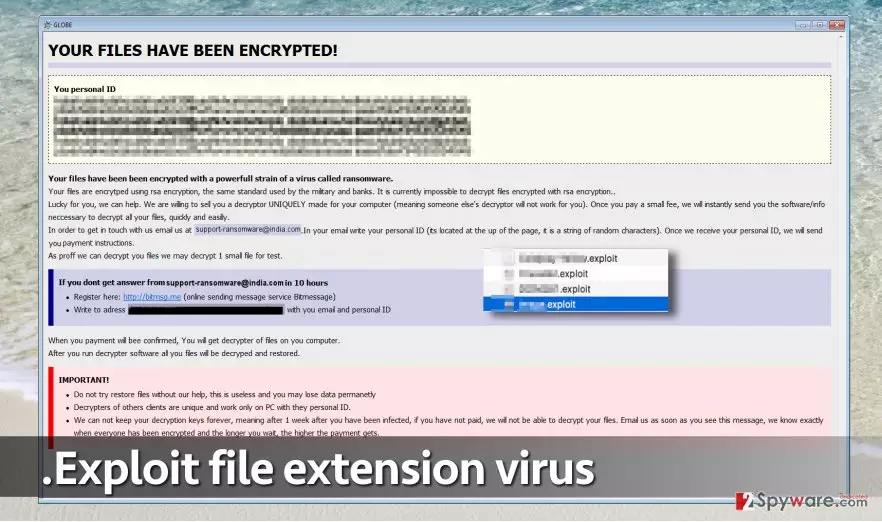
.Exploit file extension virus appears to be a new version of Globe ransomware virus. In fact, it has appeared around the same time when .duhust file extension virus did. The virus is very new, and so far only a few attacks have been fixated. The virus applies encryption to personal files and makes them useless for an unspecified period, and asks their owner to pay a ransom. It also adds .Exploit file extensions to encrypted files, and that is where the name of this virus comes from. The virus places the requirement to pay the ransom in a file titled How to restore files.hta. It also contains victim’s personal ID and criminals’ email address. Email is the only way to communicate with criminals who have created this ransomware. In this case, Exploit file extension virus provides support-ransomware@india.com address. Earlier versions are known under these names: .GSupport3 file extension virus, Globe2 ransomware virus, and .UCRYPT file extension virus.
The victim can get in touch with criminals by writing to the provided mail and adding the personal victim’s ID to the message so that malware authors could identify the victim and decide which decryption code to send to him/her. We must point out that every victim gets a unique decryption key, which is the only tool that can open encrypted files. However, understand that in this situation, criminals have an absolute power and they are not obliged to help you. You must realize that they can simply take the ransom and forget about you. They ask to make the ransom payment via Bitcoin payment system, which helps them remain invisible and untrackable. As a result, there is no way to identify or track down these scammers. So instead of paying the ransom, take care of .Exploit virus removal. At the moment, files cannot be decrypted for free, but we suggest you be patient and not pay the ransom, even if you wish to do it. Previous versions of Globe virus have been successfully cracked, and malware analysts shortly released free decryptors that helped victims to recover their files. Although there is no .exploit virus decryption tool available at the moment, one might appear online soon. Stay tuned, and in the meantime, remove .Exploit ransomware virus. For that, use an anti-malware tool like FortectIntego.
How did you infect your PC with this malware?
Apparently, authors of the .Exploit file extension ransomware are pushing this malware to victims via spam emails, malvertising, and other distribution methods. They take all necessary measures infect as many people as possible. We highly recommend you to avoid opening emails that come from questionable individuals or companies, also bogus ads promoting software updates, which annoyingly pop-up on your PC, tablet or computer screens. Avoid sites that promise to show you “shocking videos,” which can be watched only after installing some suspicious browser extension. Just by installing a single add-on you can drop malware on your computer. Therefore, we suggest you watch what you install and avoid visiting questionable third-party sites that aggressively urge you to install certain programs or updates.
How can you remove .Exploit file extension virus?
.Exploit virus should be carefully removed from the system using anti-malware tool. It is a complex application, and we do not recommend you to experiment with it or try to delete it manually. For .Exploit file extension virus removal, run FortectIntego and let it check the system for malicious components. Our recommended tools have proven to be very efficient and delete the vast majority of computer viruses.
Did this guide help?
4 comments
Florian
Screw ransomware. Nobody should pay these goddamn ransoms!!
Edg4r
all files marked with .exploit extensions does anybody know how to decrypt them???
alexandra
I opened a suspicious email letter yesterday and I believe it contained ransomware.. I have opened it although I didnt know the sender in person. How naive i was...
leo
removed it, but cannot restore files... didnt have a backup