

What is known about the mysterious Search.searchmabb.com search engine?
Once infected with Search.searchmabb.com virus, you will shortly notice that web browsers act somehow suspiciously. Despite its promising description, Search.searchmabb.com is nothing but a useless and ad-supported search engine that can hijack[1] your web browsers (IE, Edge, Firefox and Chrome) without your permission. Once it hops into the system, it changes homepage and new tab page settings in target web browsers to convince the victim use MapBeast search engine. This search engine is going to appear every time the victim opens a compromised web browser, opens a new tab in it, or attempts to enter a search query[2] into the address bar. We have discovered that this shady search engine delivers SaferBrowser search results, and this fact itself shows that this search engine is untrustworthy because SaferBrowser is a well-known company that develops hundreds of useless browser hijackers that change user’s homepage address in a quite unfair way. In order to remove Search.searchmabb.com redirect virus, it is not enough to disable Map Beast extension – you need to perform a full Search.searchmabb.com removal with anti-spyware[3] like FortectIntego or delete it with the help of tutorial provided below.
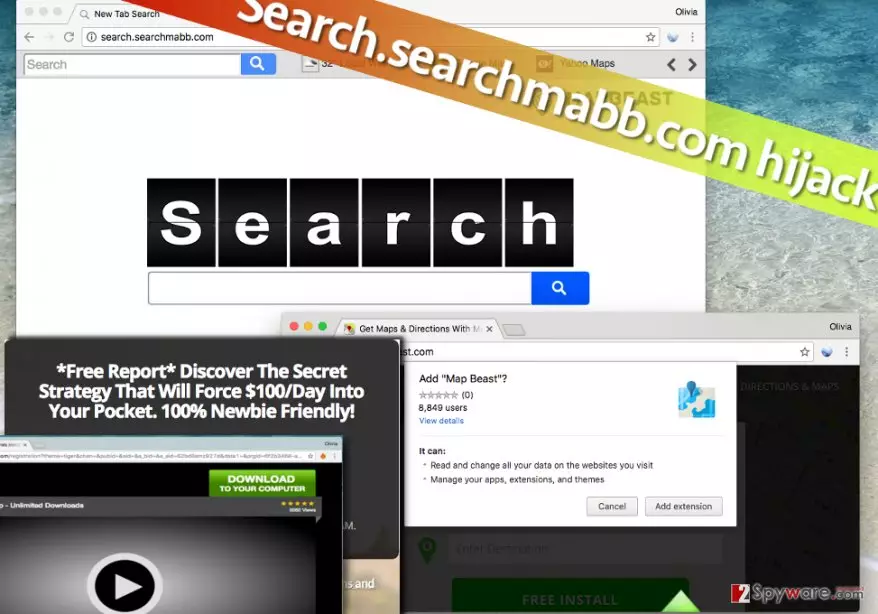
You probably want to know why this potentially unwanted program wants you to use this particular search engine? It seeks to deliver you a mixture of paid and organic search results and force you to visit certain websites in order to get paid. Its main vision is to drive traffic to affiliate website and generate as much revenue as possible. Sadly, it does not monitor these sites, so chances of visiting hazardous websites are high. Be careful because these redirects[4] can take you to shady third-party websites that advertise vague applications, provide hazardous ads, or ask to enter sensitive information. Please, stay clear of such sites. For example, we have received an offer to install an additional potentially unwanted program known as DiscreteSearch virus as soon as we agreed to install Search.searchmabb.com. Who knows what other programs this questionable browser hijacker might advertise!
When did I install this browser hijacker?
Browser hijackers are not malicious programs, but they are highly annoying and they still pose a risk to the computer system, so malware experts tend to call them potentially unwanted programs. Search.searchmabb.com hijack is an unpleasant occurrence and if you do not want to experience it again, follow these simple steps every time you decide to install a new program on your computer:
- Choose a reliable download source. Do not download programs from shady-looking Internet sites.
- Get rid of programs bundled with your download. To do this, open the installer and proceed to the installation settings. Here, choose Custom or Advanced option, and deselect all optional items added to your download.
- Finish the installation in the usual manner.
How can I remove Search.searchmabb.com from the system?
Browser hijackers should not stay on the computer system longer than it takes to notice them. These programs are created entirely for its developer’s benefit, so computer users should not tolerate them and get rid of them as soon as it is possible. If you have never attempted to remove a browser hijacker, Search.searchmabb.com removal might seem a challenging task to do, but if you follow instructions that we have provided, it shouldn’t be a problem to you. Alternatively, you can finish Search.searchmabb.com removal using the anti-malware[5] or anti-spyware tool.
Uninstall from Windows
Uninstall from Windows 10/8:
- Type Control Panel into the Windows search box and open the result.
- Under Programs, select Uninstall a program.


Uninstall from Windows 7/XP:
- Click on Windows Start > Control Panel (Windows XP users should click on Add/Remove Programs).
- In Control Panel, select Programs > Uninstall a program.


Remove the unwanted program:
- In the Programs and Features window, look for any recently installed suspicious entries, select them, and click Uninstall.
- If User Account Control appears, click Yes to confirm, then complete the removal.


Delete from macOS
Remove the unwanted application:
- From the menu bar, select Go > Applications.
- In the Applications folder, look for any suspicious entries, then drag them to Trash (or right-click and pick Move to Trash).


Delete leftover files and folders:
- Select Go > Go to Folder.
- Enter /Library/Application Support and remove any suspicious folders related to the unwanted program.
- Repeat the same check in the /Library/LaunchAgents and /Library/LaunchDaemons folders, deleting any suspicious entries.

- Finally, empty the Trash to permanently remove the leftovers.

Reset Internet Explorer
Remove dangerous add-ons:
- Open Internet Explorer, click on the Gear icon (IE menu) on the top-right corner of the browser
- Pick Manage Add-ons.
- You will see a Manage Add-ons window. Here, look for suspicious plugins. Click on these entries and select Disable.


Change your homepage if it was altered:
- Open IE and click on the Gear icon.
- Select Internet Options.
- In the General tab, delete the Home page address and replace it by your preferred one (for example, Google.com).
- Click Apply and then select OK.


Delete temporary files:
- Press on the Gear icon and select Internet Options.
- Under Browsing history, click Delete...
- Select relevant fields and press Delete.


Reset Internet Explorer:
- Click on Gear icon > Internet options and select Advanced tab.
- Select Reset.
- In the new window, check Delete personal settings and select Reset.


Remove from Microsoft Edge
Delete unwanted extensions from MS Edge:
- Select Menu (three horizontal dots at the top-right of the browser window) and pick Extensions.
- From the list, pick the extension and click on the Gear icon.
- Click Remove.


Clear cookies and other browser data:
- Click on the Menu (three horizontal dots at the top-right of the browser window) and select Settings > Privacy, search, and services..
- Under Clear browsing data, pick Choose what to clear.
- Select Cookies and other site data and Cached images and files. (apart from passwords, although you might want to include Media licenses as well, if applicable) and click on Clear.


Restore new tab and homepage settings:
- Click the menu icon and choose Settings.
- Then find On startup section.
- Click Remove next to any suspicious startup page.
Reset MS Edge if the above steps did not work:
- Press on Ctrl + Shift + Esc to open Task Manager.
- Click on More details arrow at the bottom of the window.
- Select Details tab.
- Now scroll down and locate every entry with Microsoft Edge name in it. Right-click on each of them and select End Task to stop MS Edge from running.


Instructions for Chromium-based Edge
Delete extensions from MS Edge (Chromium):
- Open Edge and click select Settings > Extensions.
- Delete unwanted extensions by clicking Remove.


Clear cache and site data:
- Click on Menu and go to Settings.
- Select Privacy, search and services.
- Under Clear browsing data, pick Choose what to clear.
- Under Time range, pick All time.
- Select Clear now.


Reset Chromium-based MS Edge:
- Click on Menu and select Settings.
- On the left side, pick Reset settings.
- Select Restore settings to their default values.
- Confirm with Reset.
- This will disable extensions and reset startup pages but will not delete bookmarks, saved passwords, or browsing history.


Remove from Mozilla Firefox (FF)
Remove dangerous extensions:
- Open Mozilla Firefox browser and click on the Menu (three horizontal lines at the top-right of the window).
- Select Add-ons.
- In here, select the unwanted extension and click Remove.


Reset the homepage:
- Click three horizontal lines at the top right corner to open the menu.
- Choose Settings.
- Under Home, set your preferred homepage and new tab settings.
Clear cookies and site data:
- Click Menu and pick Settings.
- Go to Privacy & Security section.
- Scroll down to locate Cookies and Site Data.
- Click on Clear Data...
- Select Cookies and Site Data and Temporary cached files and pages, then click Clear.


Reset Mozilla Firefox
If clearing the browser as explained above did not help, reset Mozilla Firefox:
- Open Mozilla Firefox browser and click the Menu.
- Go to Help and then choose Troubleshooting Information.

- Under Give Firefox a tune up section, click on Refresh Firefox...
- Once the pop-up shows up, confirm the action by pressing on Refresh Firefox.



Remove from Google Chrome
Delete malicious extensions from Google Chrome:
- Open Google Chrome, click on the Menu (three vertical dots at the top-right corner) and select More tools > Extensions.
- In the newly opened window, you will see all the installed extensions. Uninstall all suspicious extensions related to the unwanted program by clicking Remove.


Clear cache and web data from Chrome:
- Click on Menu and pick Settings.
- Under Privacy and security, select Clear browsing data.
- Select Browsing history, Cookies and other site data, as well as Cached images and files.
- Click Clear data.


Change your homepage:
- Click menu and choose Settings.
- Look for a suspicious site in the On startup section.
- Click on Open a specific or set of pages and click on three dots to find the Remove option.
Reset Google Chrome:
If the previous methods did not help you, reset Google Chrome to eliminate all the unwanted components:
- Click on Menu and select Settings.
- In the Settings, scroll down and click Advanced.
- Scroll down and locate Reset and clean up section.
- Now click Restore settings to their original defaults.
- Confirm with Reset settings.


Delete from Safari
Remove dangerous extensions:
- Open Safari, click Safari in the menu at the top-left of the screen, and select Preferences.
- Go to the Extensions tab, look for any suspicious entries, and click Uninstall to remove them.


Clear history and website data:
- Click Safari in the menu and pick Clear History.
- Set Clear to all history and confirm with Clear History.


Reset Safari:
- Click Safari in the menu and select Preferences > Advanced.
- Enable Show Develop menu in menu bar.
- From the menu bar, click Develop and select Empty Caches.


Did this guide help?
4 comments
Angela
Hey! Your guide helped me to remove Search.searchmabb.com. Thanks a loooooot!
serverd
Thanks. I havent even thought about protecting my system... Gotta take care of it now!
Bubble
Such an annoying virus! Why the hell someone wants to create such useless search tools! Everybody wants to delete them at the end!
Brygo24
exactly...