

Polski ransomware variants emerge one after another
Polski virus is a computer virus that targets one particular Central-European country – Poland[1]. It infects the system to render all files useless and append .aes file extensions to them. Additionally, the malware leaves a ransom note that provides the sum of money that cyber extortionists demand – a ransom. The ransom note is called !!! – – ODZYSKAJ-PLIKI – – !!!.htm.
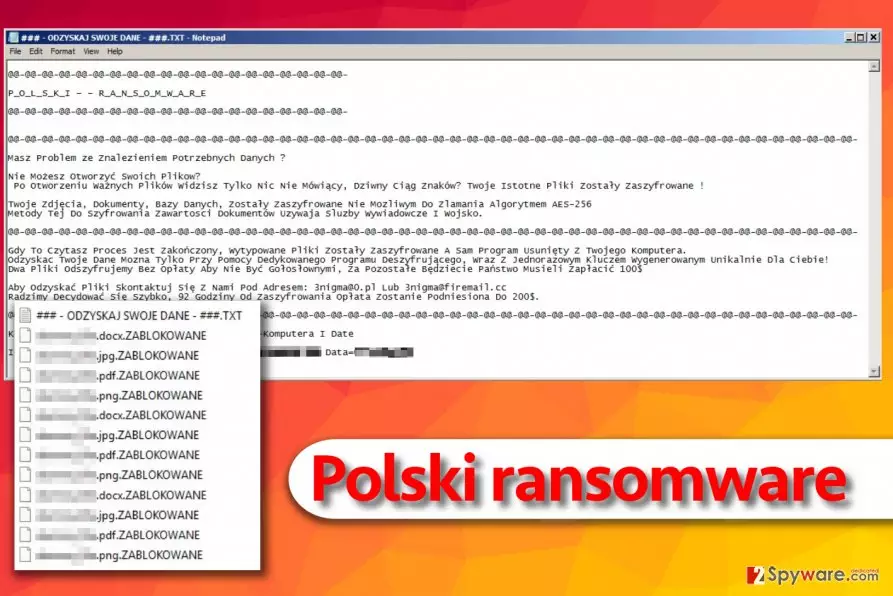
Later versions of the Polski ransomware use .ZABLOKOWANE extensions and ### – ODZYSKAJ SWOJE DANE – ###.TXT file as a ransom note. Cyber security experts agree that this new version belongs to Vortex ransomware group.
While English-oriented crypto-malware dominates in the market, a higher number of more “multicultural” viruses emerge. A while ago, a Malaysian virus has been detected. Usually, the main targets remain the same: it's the Unites States, Germany, France, UK, and other economically developed countries.
However, initiatives from hackers of other nationality have been emerging. For example, Czech ransomware rampaged on the web. Now Polish-speaking netizens became a new target. According to the ransom note, the developers sympathize with the notorious CryptoLocker[2] as they refer to this threat in the end.
The design of this threat does not remind of the mentioned-virus. However, its functionalities are certainly alike. However, it does not mean that even if you are infected with this malware, you can give into distress. Firstly, remove Polski and then consider recovering your affected files. As for the elimination, we recommend using FortectIntego.
It is likely that the malware targets Polish computer users, but not limited. This time the racketeers provided an extensive ransom note. Though all file-encrypting viruses operate in the same way, each of them possesses slight modifications[3]. Speaking of Polski malware, it exploits AES-256 algorithm to encode users’ data.

In the !!! – – ODZYSKAJ-PLIKI – – !!!.htm and !!! – – ODZYSKAJ-PLIKI – – !!!.txt ransom notes, the developers make quite an introduction to ransomware specifications. It even delivers several links to media articles about commonly known crypto-malware. Below, you can see the first lines of the ransom note.
@@@@@@@@@@@@@@@@@@@@@@@@@@@@@@@@@@@
P O L S K I R A N S O M W A R E
@@@@@@@@@@@@@@@@@@@@@@@@@@@@@@@@@@@
###########################################Nie możesz znaleźć potrzebnych plików na dysku twardym ?
Zawartość Twoich plików jest nie do otwarcia?
It is suspected that all the decryption keys are located in a distant command and control servers as two temporal email addresses are given: rsapl@openmailbox.org and estion@sigaint.org. The virus also leaves its mark by appending .aes and .aes256 file extension to the encrypted files. Instead of an ID number, the cyber villains suggest typing 61621122 in the “Subject” box.
Another common feature – encourage victims to pay by offering to decrypt a couple of files for free. As common for CryptoLocker, the hackers urge the users to hurry up with the transaction.
According to the note, after 72 hours the ransom will double. The initial sum remains to be 249 USD[4]. Despite the alerts, there are no guarantees that the crooks will play fair and return the data. Instead, focus on Polski removal.
New version of Polish ransomware emerges in summer of 2017
On August 7, 2017, cyber security researchers spotted a new version of Polski virus that uses different file extensions to mark encrypted files and also a freshly composed ransom note. The very first look at the virus reveals that it uses AESxWin tool (available on GitHub) to encrypt victim's files. The virus presents a slightly different ransom note (called ### – ODZYSKAJ SWOJE DANE – ###.TXT):
@@-@@-@@-@@-@@-@@-@@-@@-@@
P_O_L_S_K_I – – R_AN_S_O_M_W_A_R_E
@@-@@-@@-@@-@@-@@-@@-@@-@@
Masz Problem ze Znalezieniem Potrzebnych Danych?
Nie Możesz Otworzyć Swoich Plików?
Po Otworzeniu Ważnych Plików Widzisz Tylko Nic Nie Mówiący, Dziwny Ciąg Znaków? Twoje Istotne Pliki Zostały Zaszyfrowane !
Twoje Zdjęcia, Dokumenty, Bazy Danych, Zostały Zaszyfrowane Nie Możliwym Do Złamania Algorytmem AES-256
Metody Tej Do Szyfrowania Zawartości Dokumentów Używają Służby Wywiadowcze I wojsko.
The ransomware suggests writing to 3nigma@0.pl or 3nigma@firemail.cc for data recovery instructions. Clearly, the virus authors want a ransom from the computer user, although we do not recommend listening to their demands. They ask to pay $100 or $200 if the victim fails to pay within 92 hours. Instead of paying the ransom, we suggest you to remove the virus and check data recovery solutions we provided under this article.
Common ransomware infiltration methods
Usually, the majority of crypto-malware spread via spam emails. Crooks manifest their mastery by counterfeiting emails of official institutions. After noticing an email which is supposedly sent from the FBI or transportation agency, users rarely consider them suspicious.
The very malware resides in a .zip folder, .js or executable file. What is more, ransomware may await for new victims disguised in an exploit kit.
Speaking of Polski ransomware attack, it may occur as a result of using text messaging program called Gadu-Gadu. Malvertising is also an option. In short, boost up your computer security by regularly updating crucial system applications and then improve the general security of the computer by installing anti-virus and anti-malware programs. This combination will also help you decrease the number of spam emails and, likewise, decrease the risk of encountering a cyber menace[5].
Eliminate Polski ransomware with ease
When it comes to crypto-malware, it would be better not to waste time and start Polski removal immediately. You can do it with FortectIntego or MalwarebytesMalwarebytes. Time is crucial as every spent minute might give the virus more chances to inflict greater damage[6].
After you successfully remove Polski virus, you can take a look at data recovery instructions. It is unknown whether the virus deletes volume shadow copies so you might stand a chance recovering the files. If you encounter any obstacles, feel free to use the below-displayed guide. Lastly, you may attempt terminate the malware by ending its task commands in Task Manager.
Did this guide help?
3 comments
MetaM
Interesting, the Poles are joining the business...
bill00baggins
Still no sign of the decrypter...?
concernglobal
The FBI needs to do something about these viruses!