

Search.searchwfaa.com promises to bring people Weather Forecast Alerts
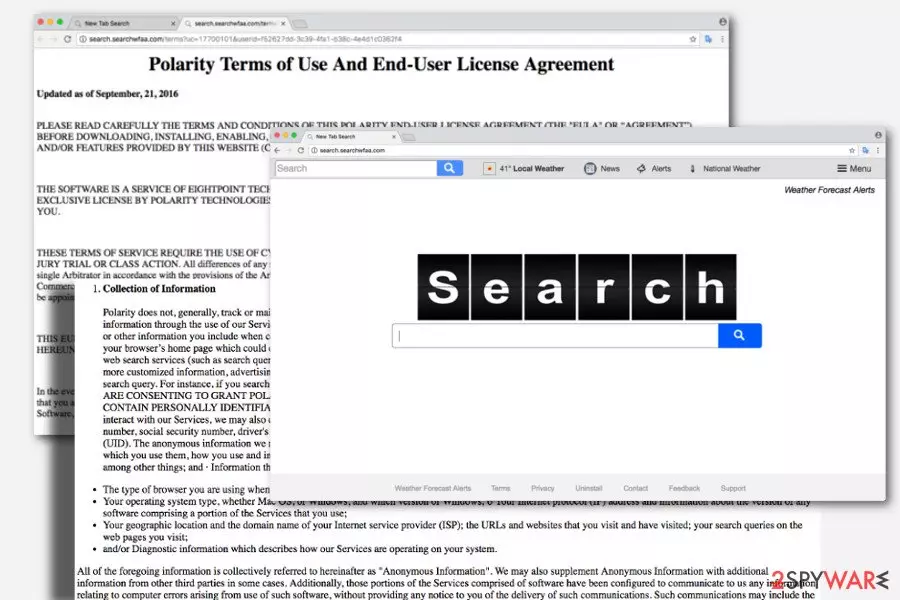
Search.searchwfaa.com (also known as Weather Forecast Alerts or wfaa) is another potentially unwanted program from the never-ending list of the browser hijackers[1]. This PUP spreads in the software bundle and after installation replaces targeted browser's homepage and search engine's URL address.
What is more, it modifies some registry entries and shortcuts to prevent users from eliminating these changes. Weather Forecast Alerts wants to force people to use this search engine as long as possible. Even though this engine delivers results from Yahoo search, they might be altered.
Ability to mess up with search results is one of the most annoying features of this cyber parasite. If you decide to use this tool, you should keep in mind that some organic links might be replaced with sponsored ones. Search.searchwfaa.com links might lead to the potentially dangerous websites, infected domains or you may be involved in an online scam[2]. These redirects may end up with malware attack, data or money loss, and even identity theft[3].
This simply designed website has a weather-themed toolbar at the top of the page. It provides local weather temperature, provides weather forecast and other information.
What is more, Weather Forecast Alerts virus seems to be related with Safer Browser and My News Wire which are also known as PUPs. Therefore, clicking these links are not recommended as well. Probably, you can realize that this program does not carry out its primary function properly, has relationships with shady developers, and takes over the browser without asking permission. These arguments should encourage you to think about Search.searchwfaa.com removal solutions.
However, if you need one more push to start doing, here it is. The hijacker is spying on you. Indeed, this application collects information about your browsing habits and history, technical information about your device, operating system, and browsers, etc. Aggregated information is often used to “improve” services; however, most of the time they are used to deliver personalized ads which help to generate pay-per-click[4] revenue for the developers.
Hopefully, now you are ready to remove Weather Forecast Alerts from the computer. If you want to speed up the process, use FortectIntego.

When was my browser hijacked?
For the majority of computer users, Search.searchwfaa.com hijack is sudden and unexpected. It seems that this search engine appears out of nowhere; however, programs rarely appear on the computers without owner’s participation. Unfortunately, it’s true; you’re responsible for letting this tiny cyber infection to get inside.
The hijack may have occurred during the freeware installation[5]. Probably, you have installed software using Quick or Recommend settings which install all additional components by default. Bear in mind that you can only rely on Advanced/Custom settings which reveal the list of additional applications. However, choosing these settings is not enough.
You have to follow each setup carefully and do not miss the list of suggested apps or pre-selected statement agreeing to make search.searchwfaa.com as your default homepage. It goes without saying that all these entries should be deselected.
Weather Forecast Alerts elimination
Browser hijackers are not hard to eliminate manually; however, it’s easier to rely on reputable anti-malware software. Automatic Search.searchwfaa.com removal requires scanning the system with updated security program. Within several minutes the program finishes the task, and you will be able to set preferred homepage and default search engine.
However, if this method doesn’t satisfy your need and you prefer fighting cyber infections bare hands, please have a look at our prepared instructions below. They will help to remove Weather Forecast Alerts from the computer.
Uninstall from Windows
Uninstall from Windows 10/8:
- Type Control Panel into the Windows search box and open the result.
- Under Programs, select Uninstall a program.


Uninstall from Windows 7/XP:
- Click on Windows Start > Control Panel (Windows XP users should click on Add/Remove Programs).
- In Control Panel, select Programs > Uninstall a program.


Remove the unwanted program:
- In the Programs and Features window, look for any recently installed suspicious entries, select them, and click Uninstall.
- If User Account Control appears, click Yes to confirm, then complete the removal.


Delete from macOS
Remove the unwanted application:
- From the menu bar, select Go > Applications.
- In the Applications folder, look for any suspicious entries, then drag them to Trash (or right-click and pick Move to Trash).


Delete leftover files and folders:
- Select Go > Go to Folder.
- Enter /Library/Application Support and remove any suspicious folders related to the unwanted program.
- Repeat the same check in the /Library/LaunchAgents and /Library/LaunchDaemons folders, deleting any suspicious entries.

- Finally, empty the Trash to permanently remove the leftovers.

Reset Internet Explorer
Remove dangerous add-ons:
- Open Internet Explorer, click on the Gear icon (IE menu) on the top-right corner of the browser
- Pick Manage Add-ons.
- You will see a Manage Add-ons window. Here, look for suspicious plugins. Click on these entries and select Disable.


Change your homepage if it was altered:
- Open IE and click on the Gear icon.
- Select Internet Options.
- In the General tab, delete the Home page address and replace it by your preferred one (for example, Google.com).
- Click Apply and then select OK.


Delete temporary files:
- Press on the Gear icon and select Internet Options.
- Under Browsing history, click Delete...
- Select relevant fields and press Delete.


Reset Internet Explorer:
- Click on Gear icon > Internet options and select Advanced tab.
- Select Reset.
- In the new window, check Delete personal settings and select Reset.


Remove from Microsoft Edge
Delete unwanted extensions from MS Edge:
- Select Menu (three horizontal dots at the top-right of the browser window) and pick Extensions.
- From the list, pick the extension and click on the Gear icon.
- Click Remove.


Clear cookies and other browser data:
- Click on the Menu (three horizontal dots at the top-right of the browser window) and select Settings > Privacy, search, and services..
- Under Clear browsing data, pick Choose what to clear.
- Select Cookies and other site data and Cached images and files. (apart from passwords, although you might want to include Media licenses as well, if applicable) and click on Clear.


Restore new tab and homepage settings:
- Click the menu icon and choose Settings.
- Then find On startup section.
- Click Remove next to any suspicious startup page.
Reset MS Edge if the above steps did not work:
- Press on Ctrl + Shift + Esc to open Task Manager.
- Click on More details arrow at the bottom of the window.
- Select Details tab.
- Now scroll down and locate every entry with Microsoft Edge name in it. Right-click on each of them and select End Task to stop MS Edge from running.


Instructions for Chromium-based Edge
Delete extensions from MS Edge (Chromium):
- Open Edge and click select Settings > Extensions.
- Delete unwanted extensions by clicking Remove.


Clear cache and site data:
- Click on Menu and go to Settings.
- Select Privacy, search and services.
- Under Clear browsing data, pick Choose what to clear.
- Under Time range, pick All time.
- Select Clear now.


Reset Chromium-based MS Edge:
- Click on Menu and select Settings.
- On the left side, pick Reset settings.
- Select Restore settings to their default values.
- Confirm with Reset.
- This will disable extensions and reset startup pages but will not delete bookmarks, saved passwords, or browsing history.


Remove from Mozilla Firefox (FF)
Remove dangerous extensions:
- Open Mozilla Firefox browser and click on the Menu (three horizontal lines at the top-right of the window).
- Select Add-ons.
- In here, select the unwanted extension and click Remove.


Reset the homepage:
- Click three horizontal lines at the top right corner to open the menu.
- Choose Settings.
- Under Home, set your preferred homepage and new tab settings.
Clear cookies and site data:
- Click Menu and pick Settings.
- Go to Privacy & Security section.
- Scroll down to locate Cookies and Site Data.
- Click on Clear Data...
- Select Cookies and Site Data and Temporary cached files and pages, then click Clear.


Reset Mozilla Firefox
If clearing the browser as explained above did not help, reset Mozilla Firefox:
- Open Mozilla Firefox browser and click the Menu.
- Go to Help and then choose Troubleshooting Information.

- Under Give Firefox a tune up section, click on Refresh Firefox...
- Once the pop-up shows up, confirm the action by pressing on Refresh Firefox.



Remove from Google Chrome
Delete malicious extensions from Google Chrome:
- Open Google Chrome, click on the Menu (three vertical dots at the top-right corner) and select More tools > Extensions.
- In the newly opened window, you will see all the installed extensions. Uninstall all suspicious extensions related to the unwanted program by clicking Remove.


Clear cache and web data from Chrome:
- Click on Menu and pick Settings.
- Under Privacy and security, select Clear browsing data.
- Select Browsing history, Cookies and other site data, as well as Cached images and files.
- Click Clear data.


Change your homepage:
- Click menu and choose Settings.
- Look for a suspicious site in the On startup section.
- Click on Open a specific or set of pages and click on three dots to find the Remove option.
Reset Google Chrome:
If the previous methods did not help you, reset Google Chrome to eliminate all the unwanted components:
- Click on Menu and select Settings.
- In the Settings, scroll down and click Advanced.
- Scroll down and locate Reset and clean up section.
- Now click Restore settings to their original defaults.
- Confirm with Reset settings.


Delete from Safari
Remove dangerous extensions:
- Open Safari, click Safari in the menu at the top-left of the screen, and select Preferences.
- Go to the Extensions tab, look for any suspicious entries, and click Uninstall to remove them.


Clear history and website data:
- Click Safari in the menu and pick Clear History.
- Set Clear to all history and confirm with Clear History.


Reset Safari:
- Click Safari in the menu and select Preferences > Advanced.
- Enable Show Develop menu in menu bar.
- From the menu bar, click Develop and select Empty Caches.


Did this guide help?
3 comments
Laura
This site became my homepage after installing video player... meh.
Cindy
Ive just removed it from my browser!
Meth
useless serach engine. USELESS!!