

Search Dimension – misleading search engine that is not worth your attention
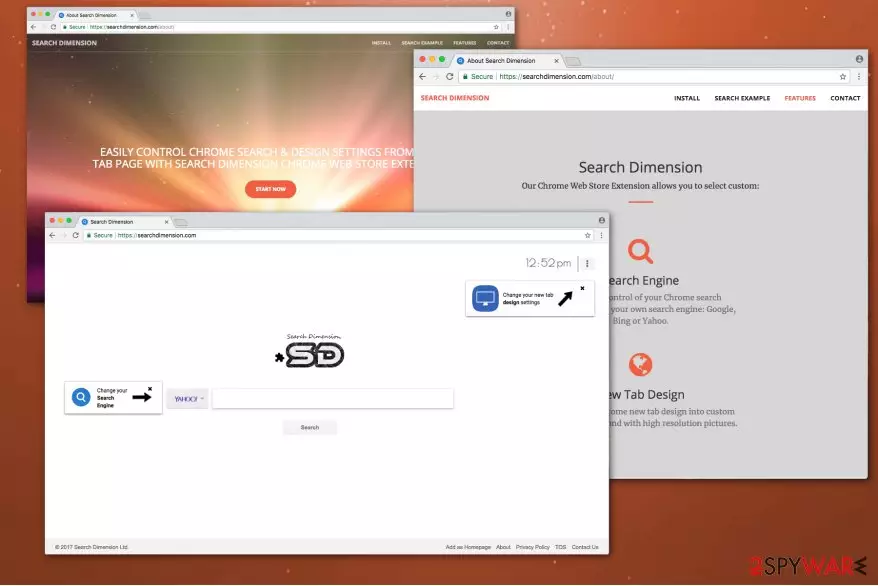
Search Dimension is a browser hijacker which is promoted as a convenient tool helping users change their search provider and improve their browsing experience in this way. According to its developers, users are allowed to select between Yahoo, Google, Bing, and an infamous blpsearch virus. However, you can become really disappointed right after making Searchdimension.com as your main search engine.
If you let this potentially unwanted program enter your PC system (it can do that without your knowledge as well!), you should expect constant redirects on your web browser. Searches are typically redirected to hxxps://searchdimension.com/ and related websites that are working on making the money through various schemes. Besides, the virus can install Search Control extension without your approval.
The most famous money-making scheme, which has been especially popular among browser hijackers, is called “pay-per-click” scheme. It generates income right after the user clicks the ad. Naturally, Search Dimension can cause tons of different ads in users' search results.[1]
When dealing with redirects on your browser, you should remember that such activity can expose your computer to dangerous content. Typically, the developer takes no responsibility for the trustworthiness of advertised web pages.[2] To protect yourself, make sure you initiate Search Dimension removal on your computer as soon as it shows up on your browser. Likewise, we do not recommend installing this vague piece of software on your system.
In general, our team recommends avoiding all programs that are promoted as a great way to “enhance” users' experience on the web. As different analysis and practices show, this term generally means is that the software is going to add extensions or even other, less noticeable components, to your system that will initiate redirects to highly suspicious pages.

If that is not enough, we must warn you that Searchdimension.com virus adds Search Control browser extension, currently compatible with Chrome browser only. The worst part is that this browser extension actually collects information that might identify you.
If you carefully read the Privacy Policy, Search Dimension developers admit the following:
We may collect information from you that may identify you, such as your name, address, email address, and telephone number.
Moreover, the gathered details may include the personally non-identifiable data which can be analyzed and used to provide tailored advertising. You should also keep in mind that Searchdimension.com shares the collected details with their business partners, advertisers, ad networks, and other situations. As a result, its users might encounter identity theft or other privacy-related issues.
If you do not want this potentially unwanted program to manage data about you as a user, remove Searchdimension.com from your system without any hesitation. For that, you might want to use an anti-spyware program like FortectIntego. Otherwise, use manual elimination guide given below the article.
Learn how the browser hijacker has sneaked on your PC
The extension which supports the unreliable activity of the browser hijacker might either be installed from the Chrome Web Store manually or stealthily infiltrated via software-bundles. If you have never attempted to get this browser extension, it might have probably infected your PC once you downloaded freeware.
Therefore, next time you should be extra careful and avoid installing it (or to learn how to avoid installing unwanted programs in general) and check the statements provided in software installation settings. We advise users to switch the installation mode to Custom/Advanced one and deselect all suggested entries one after another.
SearchDimension virus removal procedure which takes only a few minutes
There are to Searchdimension.com removal methods — manual and automatic termination. The fastest and safest one is to install the reliable security software to get rid of the browser hijacker for you. It will ensure that all related entries are deleted, and your Chrome browser is reset to the primary stage.
However, you can also try to remove Search Dimension virus manually. The elimination guide presented below will help you with the procedure. Make sure to follow it attentively since experts from BedyNet.ru[3] warn that if you skip steps, you might face an irreversible computer harm.
Uninstall from Windows
Uninstall from Windows 10/8:
- Type Control Panel into the Windows search box and open the result.
- Under Programs, select Uninstall a program.


Uninstall from Windows 7/XP:
- Click on Windows Start > Control Panel (Windows XP users should click on Add/Remove Programs).
- In Control Panel, select Programs > Uninstall a program.


Remove the unwanted program:
- In the Programs and Features window, look for any recently installed suspicious entries, select them, and click Uninstall.
- If User Account Control appears, click Yes to confirm, then complete the removal.


Delete from macOS
Remove the unwanted application:
- From the menu bar, select Go > Applications.
- In the Applications folder, look for any suspicious entries, then drag them to Trash (or right-click and pick Move to Trash).


Delete leftover files and folders:
- Select Go > Go to Folder.
- Enter /Library/Application Support and remove any suspicious folders related to the unwanted program.
- Repeat the same check in the /Library/LaunchAgents and /Library/LaunchDaemons folders, deleting any suspicious entries.

- Finally, empty the Trash to permanently remove the leftovers.

Reset Internet Explorer
Remove dangerous add-ons:
- Open Internet Explorer, click on the Gear icon (IE menu) on the top-right corner of the browser
- Pick Manage Add-ons.
- You will see a Manage Add-ons window. Here, look for suspicious plugins. Click on these entries and select Disable.


Change your homepage if it was altered:
- Open IE and click on the Gear icon.
- Select Internet Options.
- In the General tab, delete the Home page address and replace it by your preferred one (for example, Google.com).
- Click Apply and then select OK.


Delete temporary files:
- Press on the Gear icon and select Internet Options.
- Under Browsing history, click Delete...
- Select relevant fields and press Delete.


Reset Internet Explorer:
- Click on Gear icon > Internet options and select Advanced tab.
- Select Reset.
- In the new window, check Delete personal settings and select Reset.


Remove from Microsoft Edge
Delete unwanted extensions from MS Edge:
- Select Menu (three horizontal dots at the top-right of the browser window) and pick Extensions.
- From the list, pick the extension and click on the Gear icon.
- Click Remove.


Clear cookies and other browser data:
- Click on the Menu (three horizontal dots at the top-right of the browser window) and select Settings > Privacy, search, and services..
- Under Clear browsing data, pick Choose what to clear.
- Select Cookies and other site data and Cached images and files. (apart from passwords, although you might want to include Media licenses as well, if applicable) and click on Clear.


Restore new tab and homepage settings:
- Click the menu icon and choose Settings.
- Then find On startup section.
- Click Remove next to any suspicious startup page.
Reset MS Edge if the above steps did not work:
- Press on Ctrl + Shift + Esc to open Task Manager.
- Click on More details arrow at the bottom of the window.
- Select Details tab.
- Now scroll down and locate every entry with Microsoft Edge name in it. Right-click on each of them and select End Task to stop MS Edge from running.


Instructions for Chromium-based Edge
Delete extensions from MS Edge (Chromium):
- Open Edge and click select Settings > Extensions.
- Delete unwanted extensions by clicking Remove.


Clear cache and site data:
- Click on Menu and go to Settings.
- Select Privacy, search and services.
- Under Clear browsing data, pick Choose what to clear.
- Under Time range, pick All time.
- Select Clear now.


Reset Chromium-based MS Edge:
- Click on Menu and select Settings.
- On the left side, pick Reset settings.
- Select Restore settings to their default values.
- Confirm with Reset.
- This will disable extensions and reset startup pages but will not delete bookmarks, saved passwords, or browsing history.


Remove from Mozilla Firefox (FF)
Remove dangerous extensions:
- Open Mozilla Firefox browser and click on the Menu (three horizontal lines at the top-right of the window).
- Select Add-ons.
- In here, select the unwanted extension and click Remove.


Reset the homepage:
- Click three horizontal lines at the top right corner to open the menu.
- Choose Settings.
- Under Home, set your preferred homepage and new tab settings.
Clear cookies and site data:
- Click Menu and pick Settings.
- Go to Privacy & Security section.
- Scroll down to locate Cookies and Site Data.
- Click on Clear Data...
- Select Cookies and Site Data and Temporary cached files and pages, then click Clear.


Reset Mozilla Firefox
If clearing the browser as explained above did not help, reset Mozilla Firefox:
- Open Mozilla Firefox browser and click the Menu.
- Go to Help and then choose Troubleshooting Information.

- Under Give Firefox a tune up section, click on Refresh Firefox...
- Once the pop-up shows up, confirm the action by pressing on Refresh Firefox.



Remove from Google Chrome
Delete malicious extensions from Google Chrome:
- Open Google Chrome, click on the Menu (three vertical dots at the top-right corner) and select More tools > Extensions.
- In the newly opened window, you will see all the installed extensions. Uninstall all suspicious extensions related to the unwanted program by clicking Remove.


Clear cache and web data from Chrome:
- Click on Menu and pick Settings.
- Under Privacy and security, select Clear browsing data.
- Select Browsing history, Cookies and other site data, as well as Cached images and files.
- Click Clear data.


Change your homepage:
- Click menu and choose Settings.
- Look for a suspicious site in the On startup section.
- Click on Open a specific or set of pages and click on three dots to find the Remove option.
Reset Google Chrome:
If the previous methods did not help you, reset Google Chrome to eliminate all the unwanted components:
- Click on Menu and select Settings.
- In the Settings, scroll down and click Advanced.
- Scroll down and locate Reset and clean up section.
- Now click Restore settings to their original defaults.
- Confirm with Reset settings.


Delete from Safari
Remove dangerous extensions:
- Open Safari, click Safari in the menu at the top-left of the screen, and select Preferences.
- Go to the Extensions tab, look for any suspicious entries, and click Uninstall to remove them.


Clear history and website data:
- Click Safari in the menu and pick Clear History.
- Set Clear to all history and confirm with Clear History.


Reset Safari:
- Click Safari in the menu and select Preferences > Advanced.
- Enable Show Develop menu in menu bar.
- From the menu bar, click Develop and select Empty Caches.


Did this guide help?
4 comments
trumbz
Thanks for providing the answer to my question! I finally managed to get rid of searchdimension. It was hiding in chrome as search control extension!
Drake
Oh my god. Finally someone provided a good tutorial. The ones i found on other websites seem to be auto-written!
harrod
Scanning the system with Reimage atm.
Mango
I hate browser hijackers. I always end up installing them, even if I try to be careful when installing new programs on my PC.