

Kripto64 ransomware: Turkish hackers manifest their abilities
Kripto64 virus joins the enormous family of ransomware viruses. Taking into account several factors such as ransomware-as-a-service[1], open-source or so-called “educational” ransomware threats, the reasons why such business is booming become clear[2]. The latter, educational, viruses tempt less skilled crooks into the dark market. Interested racketeers may find specific software which does the job for them – they just need to enter the ransom message, make slight configuration and set the wanted price. As a result, Kripto64 malware is suspected to be designed according to this model as well. It is created on the basis of Hidden Tear open-source ransomware. According to the ransom message, the threat – is the wrongdoing of Turkish hackers as the text is presented in the respective language. The netizens of this region are suspected to be the primary target, however, it is futile to think that it will not cross cyber borders and seize the data of a French or Swiss user. Find out about its prevention measures. In case you encountered this malware, remove Kripto64 right away. FortectIntego or MalwarebytesMalwarebytes assists in eliminating the infection completely.
Though the malware encrypts files, it may append different file type extension to the affected files. !!! Dikkat !!! ransom note alerts victims to transfer 500 Turkish Lira, or $135 within five days from the hijack. Otherwise, the computer will be severely damaged. Such warnings their emotional effect at it highly popular for ransomware crooks to scare victims and exert psychological pressure on them. According to the notification, after transmitting the money, the fraudsters would supposedly connect to the computer and unblock the files[3]. Likewise, this sparks suspicions that Kripto64 ransomware is not highly elaborate and virus researchers may come up with the decryption key soon. Let us warn you not to make the transaction and let the hackers inflict more serious damage. Even if they decode the files, they could plant spyware in the operating system and “detonate” a virtual infection remotely in the future[4]. Instead of considering the payment, proceed to Kripto64 removal.
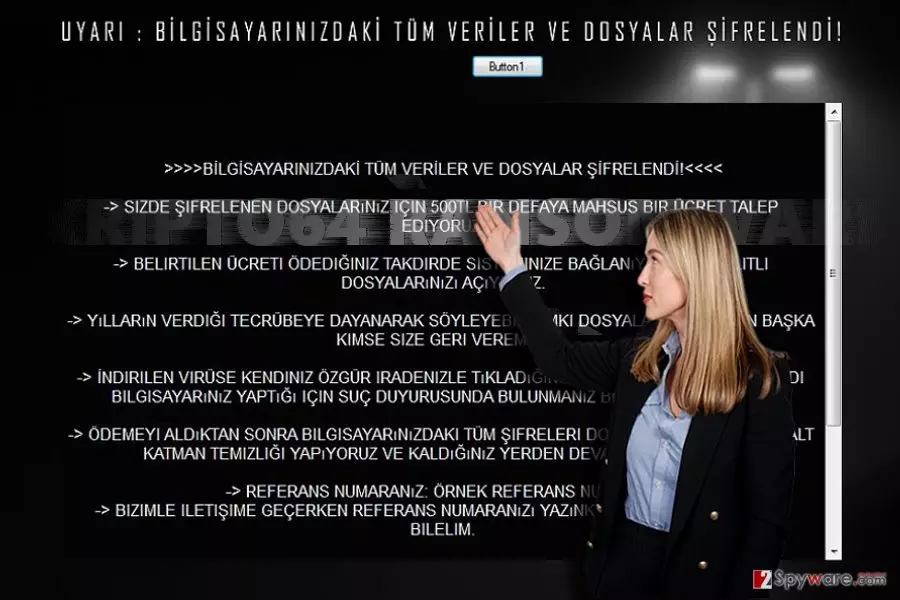
Transmitting the malware
According to the technical report, Kypto64 crypto-malware is detected as a trojan. Fortunately, some of the anti-virus programs detect it as Win32.Trojan.WisdomEyes.16070401.9500.9715, Ransom:MSIL/Ryzerlo.A, and Ransom_Ryzerlo.R011H0DD417. It may as well spread in the form a spam attachment. Kripto.exe or alternatively named executable file might be wrapped in the .zip folder and attached to the email. Such messages with menacing content are often presented as highly important. What is more, the hackers may even forge the credential of a real employee of an official institution and urge you to extract the content of the emails. Do not fall for emails which encourage to claim your prizes won in a shady lottery. Exploit kits[5] also facilitate the ransomware hacking techniques. In order to lower the risk of Kripto64 hijack, make sure you update your security applications and beware of spam emails.
Is there a way to eliminate the ransomware completely?
Ransomware developers try to persuade users of the hopelessness of the situation. Nonetheless, getting infected with ransomware is not the final verdict. Launch your security application, e.g. FortectIntego or MalwarebytesMalwarebytes, and initiate Kripto64 removal process. It is likely that the malware may prevent you from deleting it and, as a result, disable certain system functions or lock computer screen. Do not worry and take a look at the below-shown guide to regain full access. Security application will not help you decrypt the files, but some of the below-suggested might.
Did this guide help?
3 comments
Leon-Fuma
Everyone wants to earn a billion...
LiefElf
Doesnt seem too difficult to crack...
devorinus
Lets hope it will not appear again.