

Review of My-Bing.com
While looking for a new search engine, you might have accidentally encountered My-Bing.com virus. Otherwise, it might have replaced your home page after installing a new application. If the former case applies to you, you might wonder why this search engine has changed your main search engine without your notice. Such behavior is not surprising since this search engine has been classified as a browser hijacker. In other words, such browsing tools employ additional browser “filters” which present slightly modified search results. What is more, they tend to spy on your habits by collecting quite a handful of your browsing habits. My-Bing.com redirect phenomenon becomes an irritating issue within a while as well. In short, keeping this search engine will not satisfy your expectations for a speedy and high-class browsing services, but in fact, might have an opposite effect on its processes[1]. These reasons should encourage you to remove My-Bing.com. Speed up the process with FortectIntego or MalwarebytesMalwarebytes.
If you have followed our posts before, you might have noticed that there are dominant browser hijacker “families” on the market. Previously Imali Ltd has been very active in generating multiple search engines with almost identical search engines. While the activities of this company subsided, other emerged. The owner of this browser hijacker happens to be ClientConnect Ltd which is located in the same country as the previously mentioned company. Certainly, they might be different legal entities. Neither of them earns gratitude from virus researchers. All of their products are highly questionable. This search engine is no exception as well. When you type in “M-Bing.com,” you get redirected to http://www.trovi.com/?gd=SY1000314&searchsource=55&UM=8. Trovi hijackers have already caught IT professionals’ attention. There are several versions roaming on the internet: Trovi.com, Lab.trovi.com, and Trovigo.com.
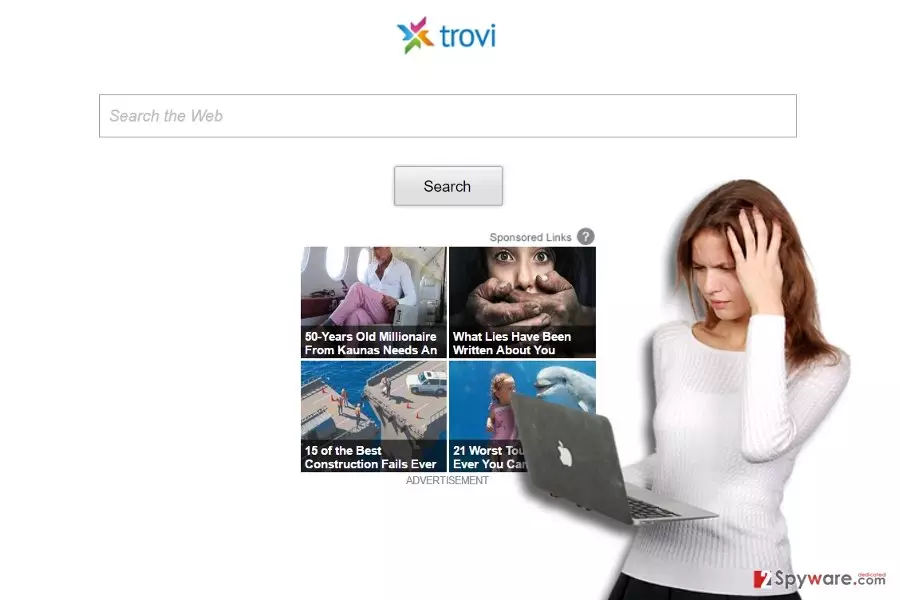
The fact that you type one address and you get redirected to another – certainly, not an indicator of a reliable search engine. Even if it employs Bing as the database for delivering search results, it does not change the fact that My Bing search engine is still a hijacker. What is more, this search engine uses the collected information about your surfing preferences and may share it with its partner companies. Now the owners are more inclined to do so after the recent legislation approved by the Congress[2]. After processing your personal information, your email Inbox might get crammed with personalized offers[3]. Excessive advertising is not the only negative aspect of My-Bing.com hijack. You might fail to tell a difference where is the commercial offer generated by this hijacker and where it is a harbinger of real menace[4].
How did this hijacker get into my PC if I didn’t install it?
Less advanced users are mistaken thinking that this search engine hijacked their browsers like ordinary viruses do. In fact, the majority of virtual infections are accelerated by users themselves, only that they are not aware of it. My-Bing.com or Trovi hijacker settled on the operating system when you rushed through the installation settings. In order to pinpoint any browser hijacker or PUP, opt for “Custom” settings after launching the installation wizard. Regardless of where you download new applications, it is crucial to deselect unwanted add-ons before starting the installation of an intended program. Now let us proceed to My-Bing.com removal procedure.
Is it troublesome to delete the PUP?
Even if the hijacker might be persistent, it is not difficult to remove My-Bing.com virus if you entrust this procedure an anti-spyware application. Users who are used to dealing with malware infections themselves will make use of manual My-Bing.com removal guide. Despite what option you will choose, it would be useful to reset the browser fully. Next time you install a new application, make sure you install it without add-ons[5]. Other user reviews might come in handy if you intend to shift to a new browser.
Uninstall from Windows
Uninstall from Windows 10/8:
- Type Control Panel into the Windows search box and open the result.
- Under Programs, select Uninstall a program.


Uninstall from Windows 7/XP:
- Click on Windows Start > Control Panel (Windows XP users should click on Add/Remove Programs).
- In Control Panel, select Programs > Uninstall a program.


Remove the unwanted program:
- In the Programs and Features window, look for any recently installed suspicious entries, select them, and click Uninstall.
- If User Account Control appears, click Yes to confirm, then complete the removal.


Delete from macOS
Remove the unwanted application:
- From the menu bar, select Go > Applications.
- In the Applications folder, look for any suspicious entries, then drag them to Trash (or right-click and pick Move to Trash).


Delete leftover files and folders:
- Select Go > Go to Folder.
- Enter /Library/Application Support and remove any suspicious folders related to the unwanted program.
- Repeat the same check in the /Library/LaunchAgents and /Library/LaunchDaemons folders, deleting any suspicious entries.

- Finally, empty the Trash to permanently remove the leftovers.

Reset Internet Explorer
Remove dangerous add-ons:
- Open Internet Explorer, click on the Gear icon (IE menu) on the top-right corner of the browser
- Pick Manage Add-ons.
- You will see a Manage Add-ons window. Here, look for suspicious plugins. Click on these entries and select Disable.


Change your homepage if it was altered:
- Open IE and click on the Gear icon.
- Select Internet Options.
- In the General tab, delete the Home page address and replace it by your preferred one (for example, Google.com).
- Click Apply and then select OK.


Delete temporary files:
- Press on the Gear icon and select Internet Options.
- Under Browsing history, click Delete...
- Select relevant fields and press Delete.


Reset Internet Explorer:
- Click on Gear icon > Internet options and select Advanced tab.
- Select Reset.
- In the new window, check Delete personal settings and select Reset.


Remove from Microsoft Edge
Delete unwanted extensions from MS Edge:
- Select Menu (three horizontal dots at the top-right of the browser window) and pick Extensions.
- From the list, pick the extension and click on the Gear icon.
- Click Remove.


Clear cookies and other browser data:
- Click on the Menu (three horizontal dots at the top-right of the browser window) and select Settings > Privacy, search, and services..
- Under Clear browsing data, pick Choose what to clear.
- Select Cookies and other site data and Cached images and files. (apart from passwords, although you might want to include Media licenses as well, if applicable) and click on Clear.


Restore new tab and homepage settings:
- Click the menu icon and choose Settings.
- Then find On startup section.
- Click Remove next to any suspicious startup page.
Reset MS Edge if the above steps did not work:
- Press on Ctrl + Shift + Esc to open Task Manager.
- Click on More details arrow at the bottom of the window.
- Select Details tab.
- Now scroll down and locate every entry with Microsoft Edge name in it. Right-click on each of them and select End Task to stop MS Edge from running.


Instructions for Chromium-based Edge
Delete extensions from MS Edge (Chromium):
- Open Edge and click select Settings > Extensions.
- Delete unwanted extensions by clicking Remove.


Clear cache and site data:
- Click on Menu and go to Settings.
- Select Privacy, search and services.
- Under Clear browsing data, pick Choose what to clear.
- Under Time range, pick All time.
- Select Clear now.


Reset Chromium-based MS Edge:
- Click on Menu and select Settings.
- On the left side, pick Reset settings.
- Select Restore settings to their default values.
- Confirm with Reset.
- This will disable extensions and reset startup pages but will not delete bookmarks, saved passwords, or browsing history.


Remove from Mozilla Firefox (FF)
Remove dangerous extensions:
- Open Mozilla Firefox browser and click on the Menu (three horizontal lines at the top-right of the window).
- Select Add-ons.
- In here, select the unwanted extension and click Remove.


Reset the homepage:
- Click three horizontal lines at the top right corner to open the menu.
- Choose Settings.
- Under Home, set your preferred homepage and new tab settings.
Clear cookies and site data:
- Click Menu and pick Settings.
- Go to Privacy & Security section.
- Scroll down to locate Cookies and Site Data.
- Click on Clear Data...
- Select Cookies and Site Data and Temporary cached files and pages, then click Clear.


Reset Mozilla Firefox
If clearing the browser as explained above did not help, reset Mozilla Firefox:
- Open Mozilla Firefox browser and click the Menu.
- Go to Help and then choose Troubleshooting Information.

- Under Give Firefox a tune up section, click on Refresh Firefox...
- Once the pop-up shows up, confirm the action by pressing on Refresh Firefox.



Remove from Google Chrome
Delete malicious extensions from Google Chrome:
- Open Google Chrome, click on the Menu (three vertical dots at the top-right corner) and select More tools > Extensions.
- In the newly opened window, you will see all the installed extensions. Uninstall all suspicious extensions related to the unwanted program by clicking Remove.


Clear cache and web data from Chrome:
- Click on Menu and pick Settings.
- Under Privacy and security, select Clear browsing data.
- Select Browsing history, Cookies and other site data, as well as Cached images and files.
- Click Clear data.


Change your homepage:
- Click menu and choose Settings.
- Look for a suspicious site in the On startup section.
- Click on Open a specific or set of pages and click on three dots to find the Remove option.
Reset Google Chrome:
If the previous methods did not help you, reset Google Chrome to eliminate all the unwanted components:
- Click on Menu and select Settings.
- In the Settings, scroll down and click Advanced.
- Scroll down and locate Reset and clean up section.
- Now click Restore settings to their original defaults.
- Confirm with Reset settings.


Delete from Safari
Remove dangerous extensions:
- Open Safari, click Safari in the menu at the top-left of the screen, and select Preferences.
- Go to the Extensions tab, look for any suspicious entries, and click Uninstall to remove them.


Clear history and website data:
- Click Safari in the menu and pick Clear History.
- Set Clear to all history and confirm with Clear History.


Reset Safari:
- Click Safari in the menu and select Preferences > Advanced.
- Enable Show Develop menu in menu bar.
- From the menu bar, click Develop and select Empty Caches.


Did this guide help?
2 comments
waffles1
Smart diversion.
LakesLock
Annoying pest...